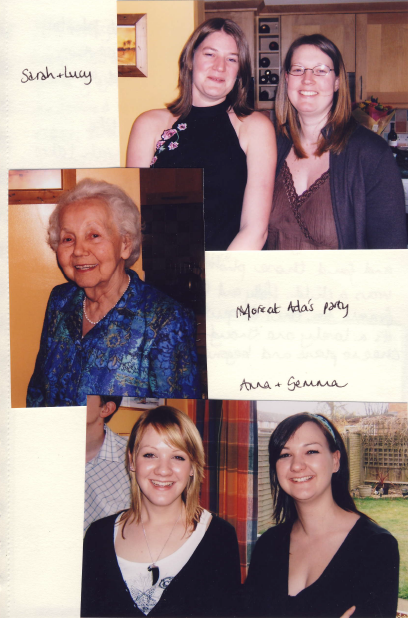
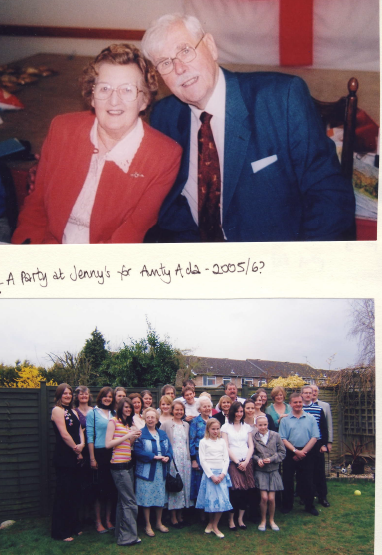
A biography of the DAVIS dynasty. Especially the fascinating life, and not just his police career of Victor Tom DAVIS and his family.
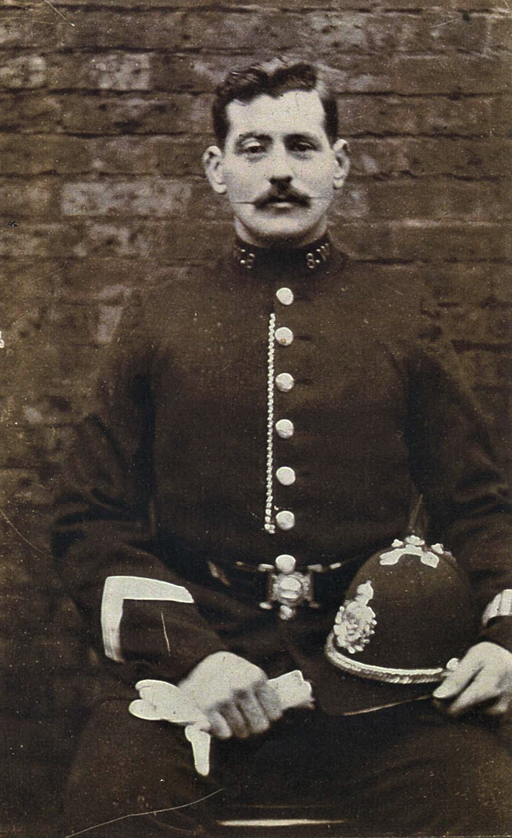
When Tom DAVIS was born on the 16th March 1886, he was not expected to live long, but after being well looked after, he proved the doctors wrong !
Tom was a Weymouth boy, who grew up to be more than average in size and strength and at the age of 20 he joined the local Borough Force at Weymouth, and was allocated his Force number 8. The photo above is when he was a Borough Constable.
Later he was a Dorset Constabulary Constable on amalgamation in 1921 and was a credit to his County.
Tom’s son Victor, was in the same mould and was no doubt described by others, way before me as, “larger than life” due to him being tall and having a booming voice !
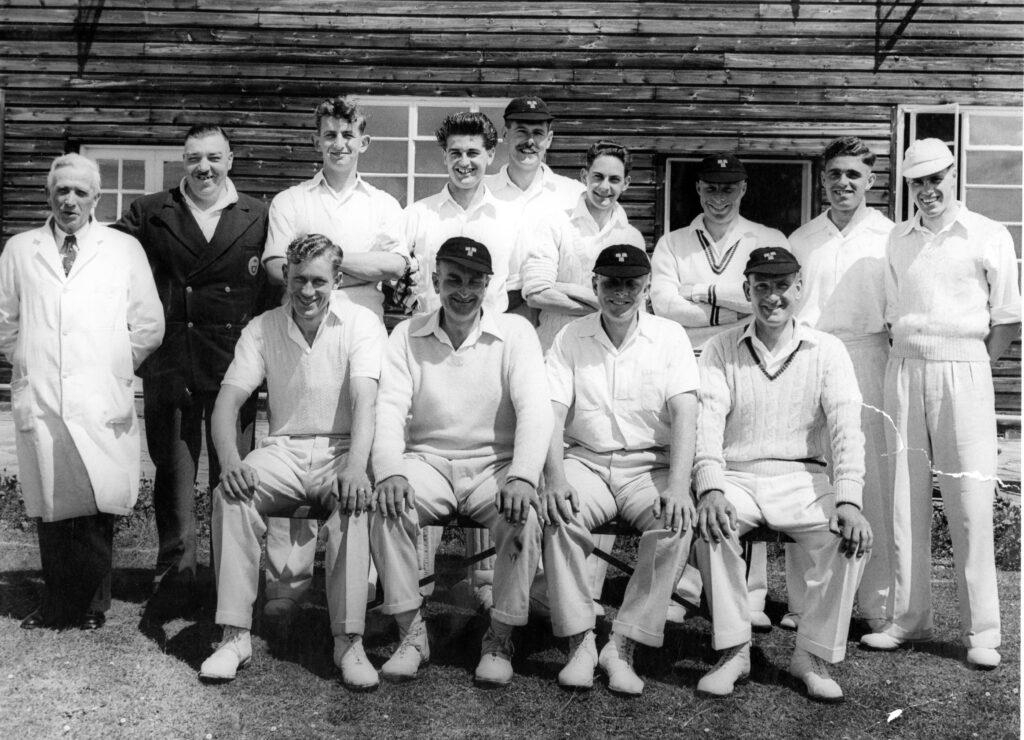
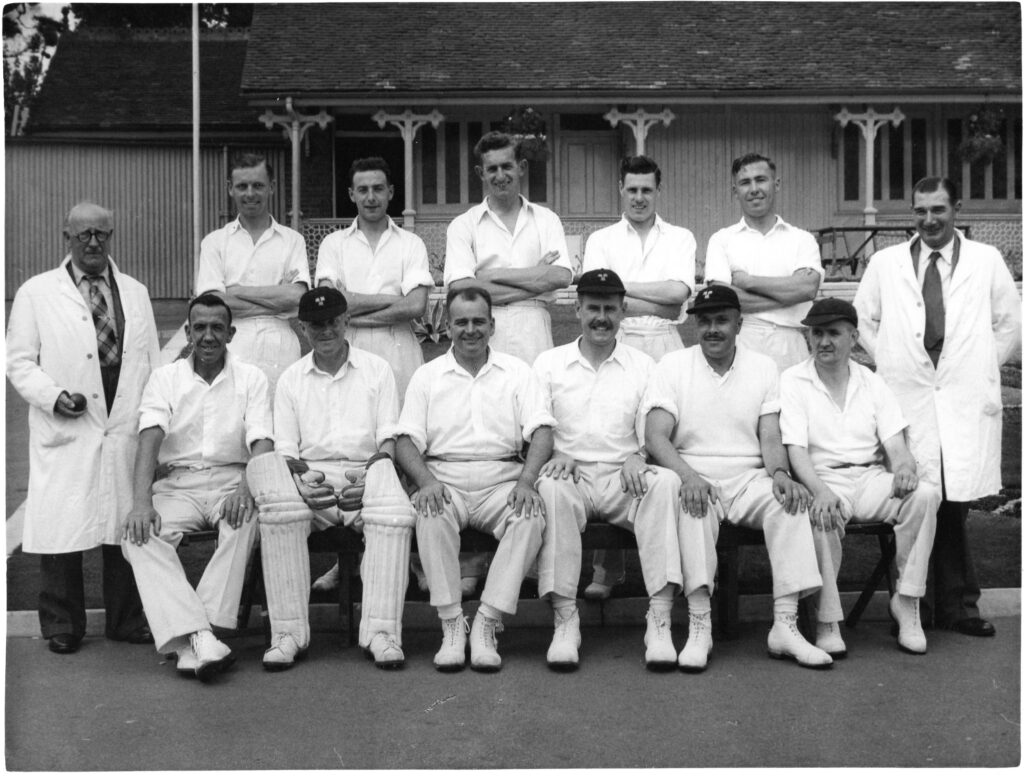
I knew about Vic before I started my blog, because my father and he both played cricket for the Constabulary and I had two photographs of them, but really I did not know much else and certainly very little about his father, Tom.
Here are the cricket photographs from the mid 1950’s/60’s, Tom is the tallest. at the middle in the rear row and sitting in the middle in the second photo.
With my connections to other police pensioners I found out in 2013 that Tom was long gone, but Vic was living near Dorchester, but I had no contact with him and living 350 miles away did not help !
Dorset NARPO and Andy BROWN reported in Feb 2015. that he visited retired C/Supt Vic DAVIS, (the much loved “Victor Tom”) on Tuesday last; they had coffee and a good laugh – Vic was in good spirits and is very happy in his new surroundings. Andy says, that Vic is doing very well for his 93 years. As Andy says “Always a real gent and respected by all who served with him”.
In November that year, Chris BOND informed the police pensioners that Vic DAVIS has had a fall at his care home, Zetland Court resulting in a broken hip, and that Vic was in Bed 20, Ward B3 of Poole General Hospital.
In Chris’s words, “I saw him this afternoon – he was still a bit groggy, but I didn’t have to ask directions to his Bay, I could hear him half way up the corridor!”
“Vic will probably be in the hospital for a week – if you’re passing he would love to see you.”
About a month later this update was posted.
Vic was visited in hospital by his daughter Anita on two occasions last week. She has confirmed that Vic has suffered a fractured femur which has been pinned. She also advises us that he was returned to his home at Zetland Court yesterday, the 4th December.
Anita (his daughter) and the family have asked that their thanks be passed on to everyone who sent Vic cards, or visited him whilst he was in hospital.
I’m sure that any visits to Zetland Court would be appreciated. Possibly the most admired, popular and respected officer of his era.
I sent Vic a letter after that update, but I did not get a response.
In early 2016 Narpo chairman and family friend, Mick WALLIS, visited Vic DAVIS and said, ” Vic was wheelchair bound at that time. His fractured femur has been pinned and, although in some pain he seemed to be cheerful and he asked Mick to give his best wishes to all who know him”
I contacted Mick and asked him when he next saw Vic, if he could gain some information for me by asking Vic about the Constabulary. Mick and I knew he would have lots to say, so I was very hopeful !
In June, Mick visited Vic and reported back :
“I went to see Victor Tom today all ready with the book and paper to get his replies to your questions…………..BUT……………..his hearing aids were either broken or they had flat batteries and I had a hell of a job to get through to him. He is very deaf !”
But Mick was not giving up and said he would try again on his next visit.
Unfortunately after that, when Mick visited Vic , Vic just gave him basic stock answers to all of his questions so it did not help me much and I was never in a position to visit as living miles away.
So after a few years I realised that I had missed my chance. If only I had still lived in Dorset !
Victor Tom DAVIS passed away at Zetland Court home in Bournemouth on the 18th April 2017.
It took a while but in 2021 I made contact with Vic’s son Peter and then his daughter Anita and they gave me Vic’s autobiography in 2022. It has taken me three years to find time but I will print it now.
I am very grateful to Vic’s family, not only for letting me use it, but also it was them, especially his grand children that inspired him to write his memoirs. In 2011, on his 90th birthday the family presented him with a book of photographs and letters they had written to help him start his story.
Vic Davis
My Parents
I must start this story with some remarks about my parents who had such a great influence on me, which has lasted throughout my life.
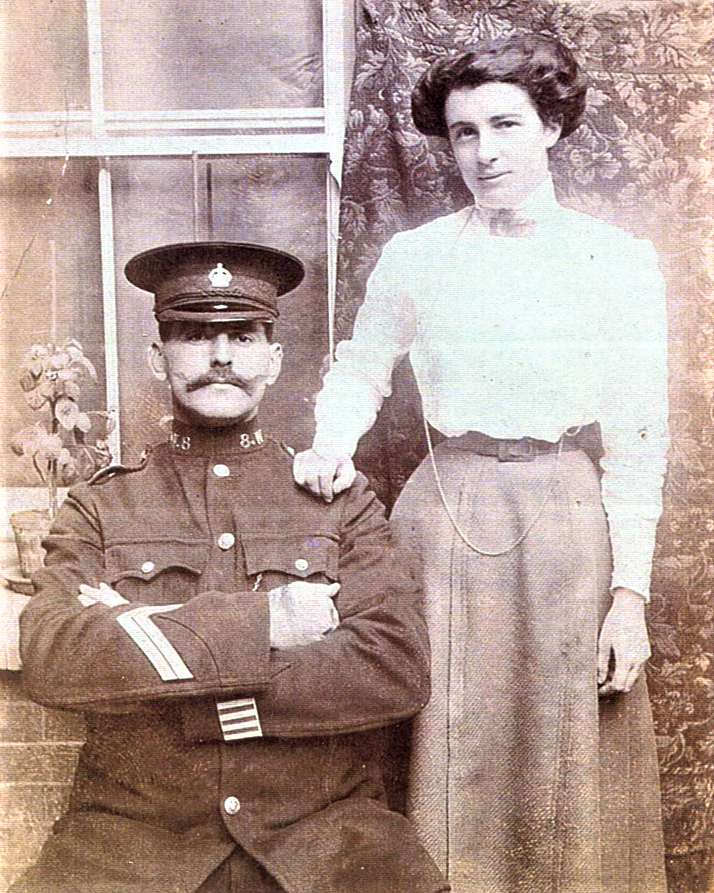
My father, Tom Davis, was born in Corscombe in west Dorset, where his father was parish clerk, sexton at the church and, with his wife, kept the village post office.
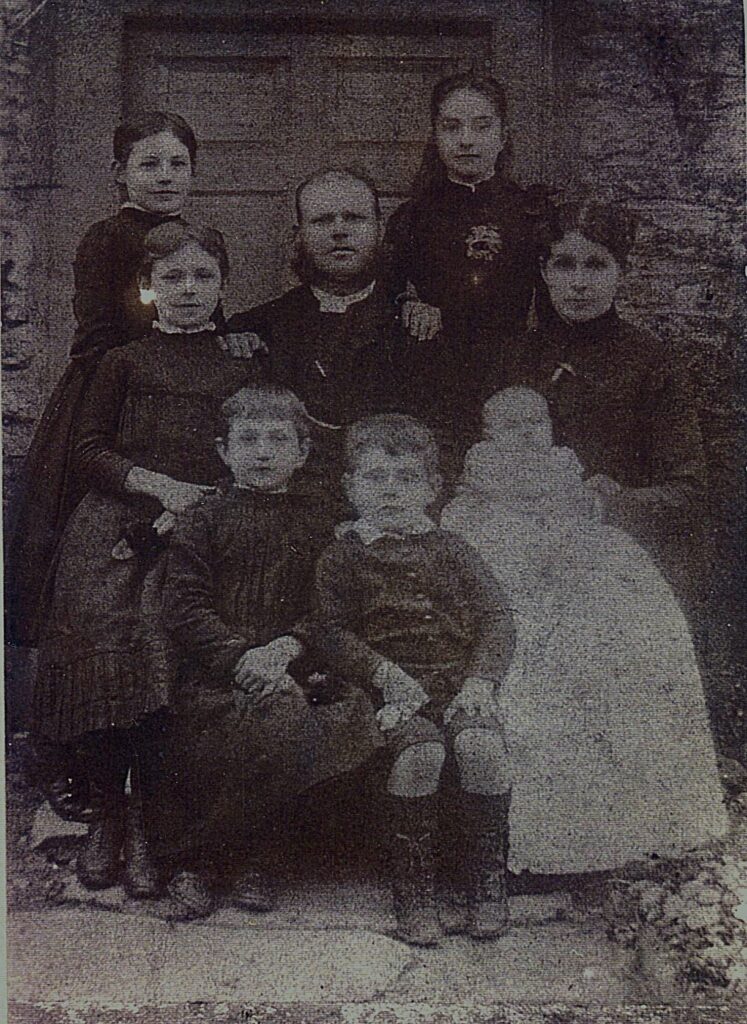
My Grand Parents with 6 of their 9 children.
Father was a sickly child at birth and it was thought that he would not live very long. He was therefore christened at his home in front of the fire when three days old and given just one name, Tom, so that there was something to place on his gravestone. Of course he survived to become one of the strongest men I ever knew and, at 6ft 2½in and weighing over 16 stones, was a handful for anyone to meddle with. He attended the parish school but at eleven years old he misbehaved and was punished by being made to stand in the corner of the room holding a slate on his head with three or four books on it. He told me that he stayed there for about five minutes and then threw the slate and books across the room and walked out of school. He never went back again.
His father was a building mason and Dad went with him to a number of places to work, repairing churches and building houses at Crewkerne and Evershot. He later joined the Dorset Yeomanry as a trooper. This was a volunteer unit similar to the modern TA but where each volunteer had to supply his own horse. He attended a number of annual camps with the Yeomanry, mainly at Preston in Weymouth. For a time he courted a young lady at Halstock who presented him with a pair of gold cuff links which I have and frequently use to today.
In 1906 he joined the Weymouth Borough Police in which he was known as ‘Trooper’ through his yeomanry experience.
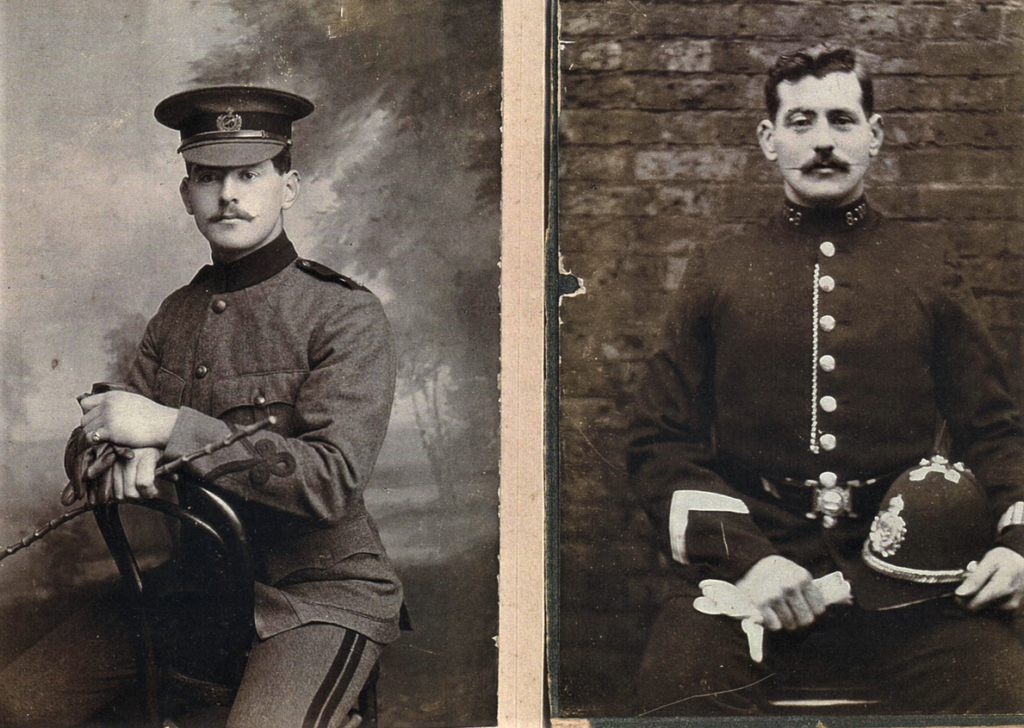
(Left) My Father in uniform of the Dorset Yeomanry, 1905 & (Right) in winter uniform of Weymouth Borough Police.
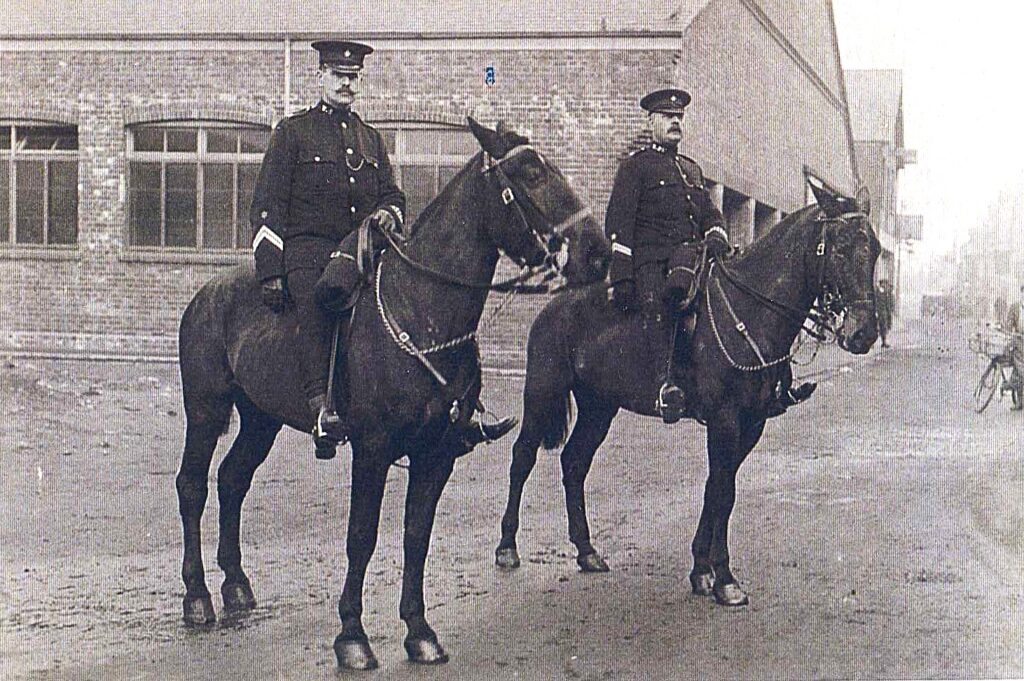
My Father and a colleague as mounted section of Weymouth Borough Police.
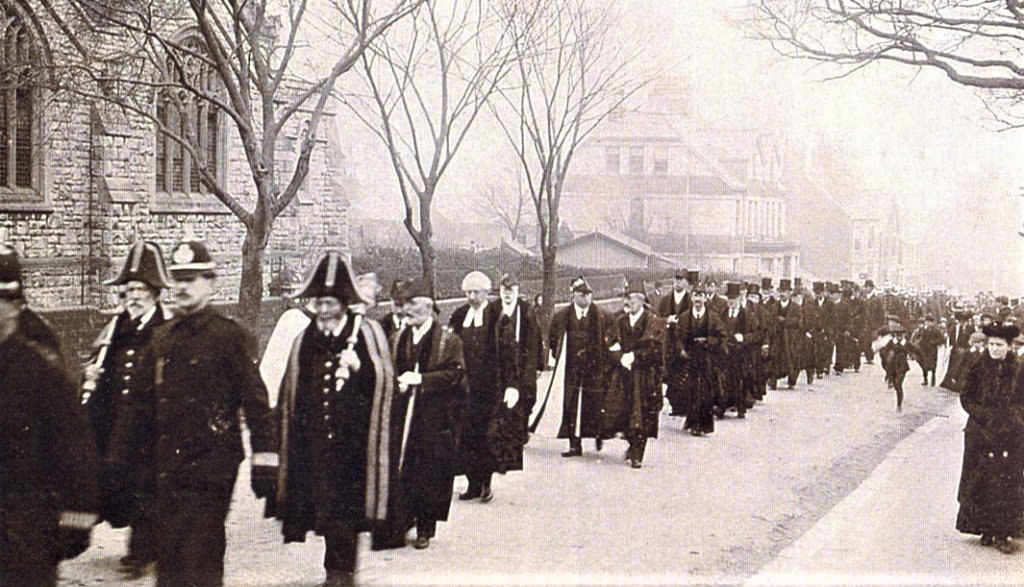
My Father, second P.C. on the left escorting Weymouth Borough Mayor & corporation to church.
My mother, Lillian Victoria Holton, was born near Salisbury, but after a few years moved with her parents to Weymouth, where her father George Holton opened a butcher’s shop in Crescent Street. He later moved the business to 10 Ranelagh Road. My mother was the first of nine children, one of whom, May, lived to over 100 years.
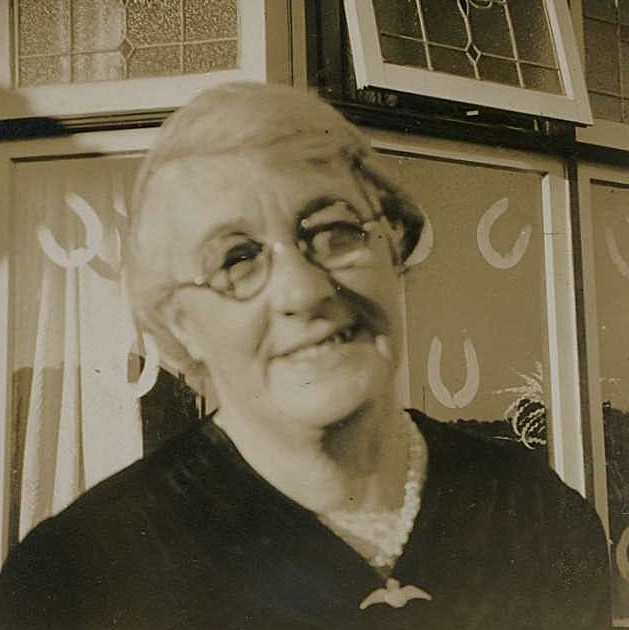
My Mother at home, 1944.
George Holton, who was also a town councillor, apparently had no objection to his daughter courting a policeman and Mum and Dad were married at St. John’s Church, Weymouth. They made their first home in Orion Road and later moved to 13 Ranelagh Road, where I was born on 24th October 1921. Both my sister, who was five years my senior, and I were christened at St. John’s Church. My sister Lillian Rose was later married at that church in 1940 to George Speer of Sandford, Wareham and our cousin Mary Westcott was bridesmaid.
During the 1914-1918 Great War large numbers of sailors were put ashore at Weymouth and there were camps of the Australian Army at Westham and Littlemoor. The sailors had a habit of surrounding a policeman who was arresting an offender and would not let him make his arrest until he showed he was a better man than his prisoner. Police had another problem when returning an absentee sailor to his ship from a fishing boat that the Police had hired. The policeman was entitled to a reward of a shilling by returning the absentee to his ship. The problem was greatest when they approached the ship to prevent the sailor from jumping overboard and swimming to his ship, when he would not be classified as an absentee or a deserter, and the policeman would not receive his reward.

My Father guarding an airplane at Lodmoor, Weymouth, c.1911.
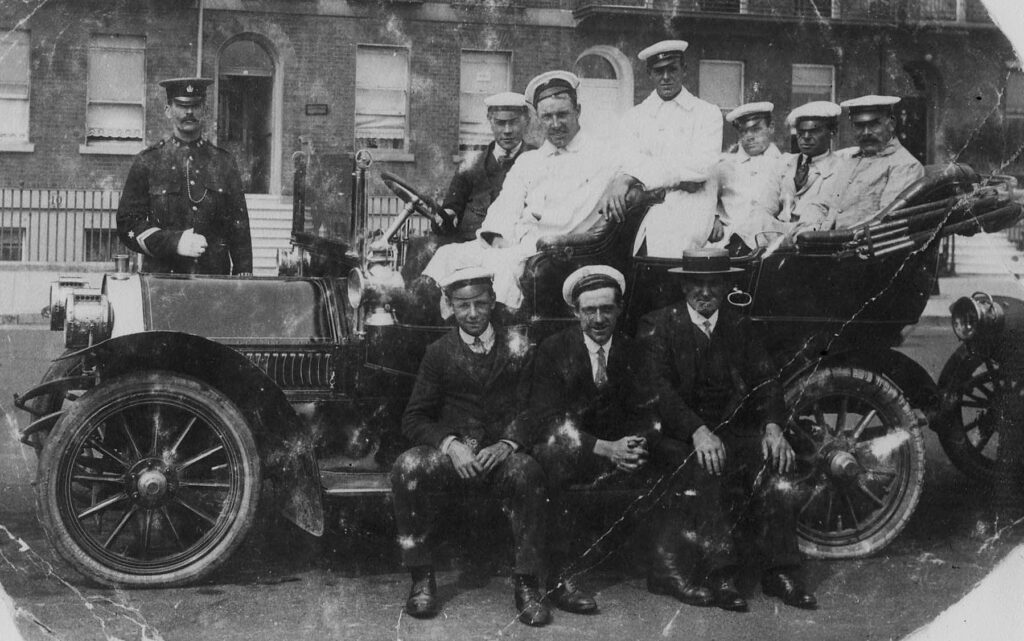
My Father with taxi & drivers on Weymouth esplanade, c.1912.
The Weymouth Borough Police Force was amalgamated with the Dorset Constabulary in 1921, and in 1923 my father was moved from Weymouth to Police HQ at Dorchester where he was made the Assistant Chief Constable’s ‘Man’ and cleaned the car and did other small jobs for the ACC. Father had to perform four hours patrol duty a day, most of which was taken up by supervising the markets and issuing movement licences, etc. for the animals. My mother had the task of supplying food for the new entrant recruits that joined the force and the single constables stationed at Dorchester. I had the run of the large yard and spent much time with my father.
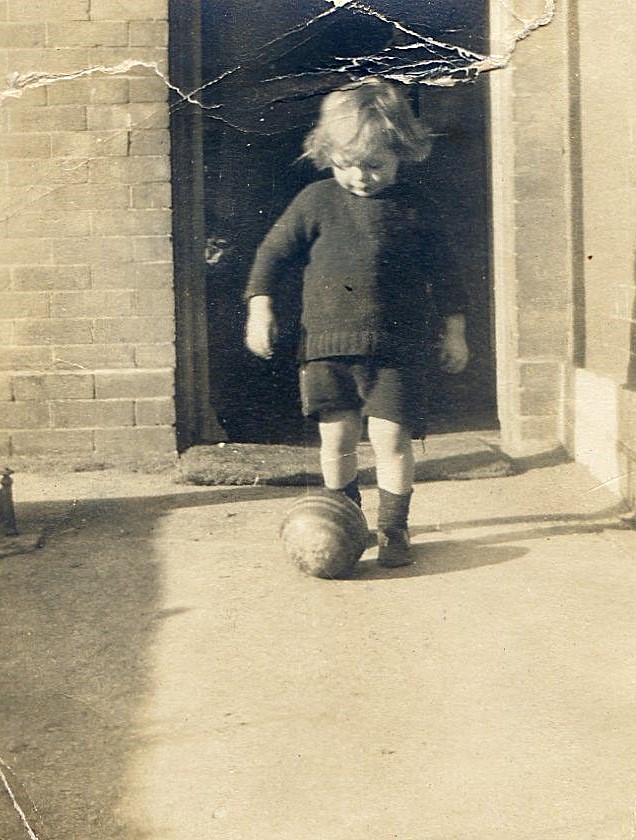
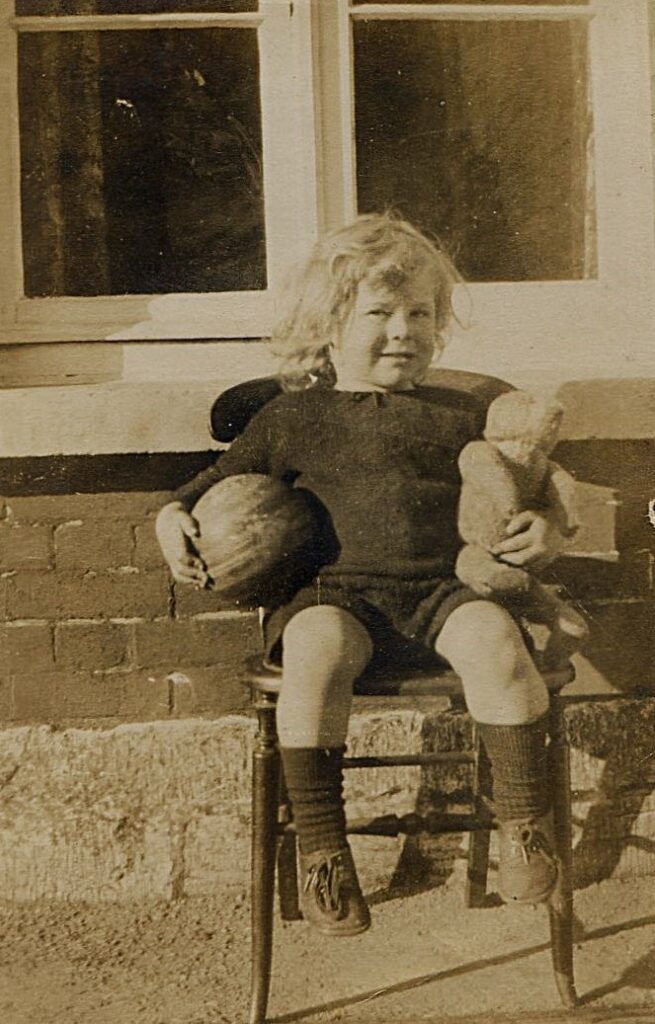
Me, already playing football aged two & (right) with ball and teddy at Dorchester Police HQ.
SIDE NOTE: From my grandfather.
Because there was a huge amount of recruits taken on after WW1 in 1919/20 and 1921, because a 1/3 of the Force retired, there were no vacancies until late 1923 for recruits. My grandfather Victor SWATRIDGE, was one of the first four recruits taken on in October 1923 after having to wait for 18 months. He was the first batch to be looked after by Vic’s parents.
My grand father Vic recalled that , ” Adjoining the single mens quarters, was the living accommodation of the reserve man ( Tom DAVIS). His sitting room was on the ground floor and overlooked the yard. The constable had a very young son and he was peering out of the window, he was very much doted upon by his father, a big powerful chap ! The boy was admiring out prowess, poor as it was as footballers when the ball went off target and crashed in their sitting room window, splintering the room with glass to the screams of the boy,
As recruits we all made a hurried departure to escape the wrath of his father and we did not return till his temper had subsided. We paid for the window to be repaired.”
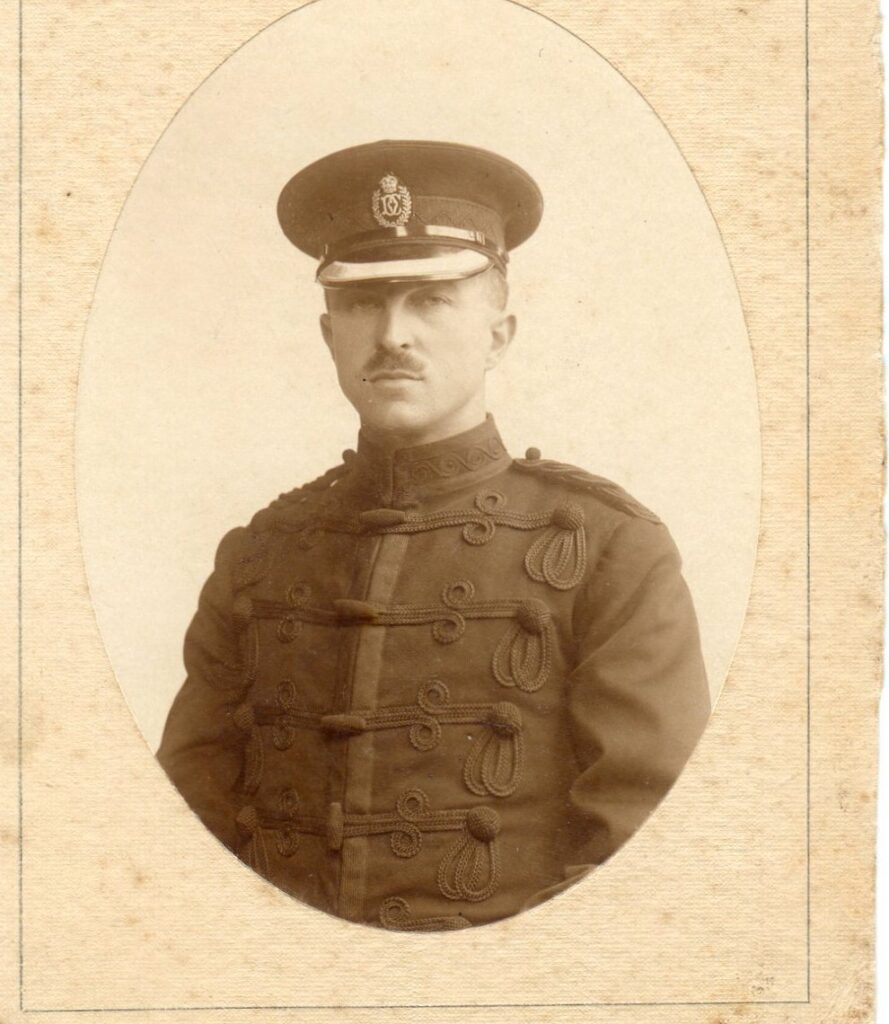
Alfred Barrett, Snr. Assistant CC. Dorset Constabulary, 1922.
In 1925 my father was moved to Swanage for patrol duties and my mother was responsible for feeding the three or four single constables stationed there. Father was a keen bell ringer, having been taught by his father as a child at Corscombe. When he was on ‘early turn’ at Swanage he used to go up into the church tower at about 7.30 am and ring hymn tunes on chimes of the bells installed there. The hammers were controlled by ropes down to a cabinet in the ringers’ room and there being eight bells, he was able to have eight notes for his hymn playing. Not all the nearby residents appreciated the early morning church bells but he continued to ring them until he retired from the police in 1932. On retirement he became the licensee of the ‘King’s Arms’ at Langton Matravers until we moved to Weymouth again in 1939 and he joined the 1st Police Reserves for duty at Weymouth, which he continued to perform until 1947.
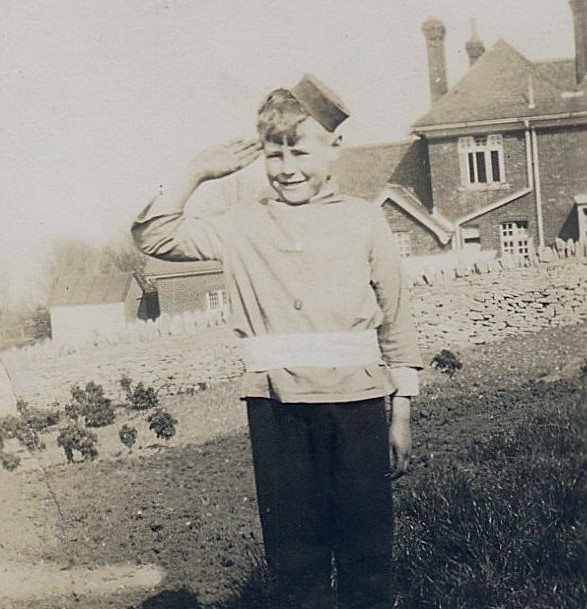
As a Pantomime Soldier, 1927.
Whilst we lived at Swanage I was a member of St. Mary’s Church choir and very much enjoyed singing, especially at the festival occasions of Christmas, Easter, etc. when we sang anthems in addition to the hymns. I still enjoy church music but can no longer read the music, and the old voice is very cracked. I was also a Boy Scout in the church troop and I have found what I was taught there of great use throughout my life.
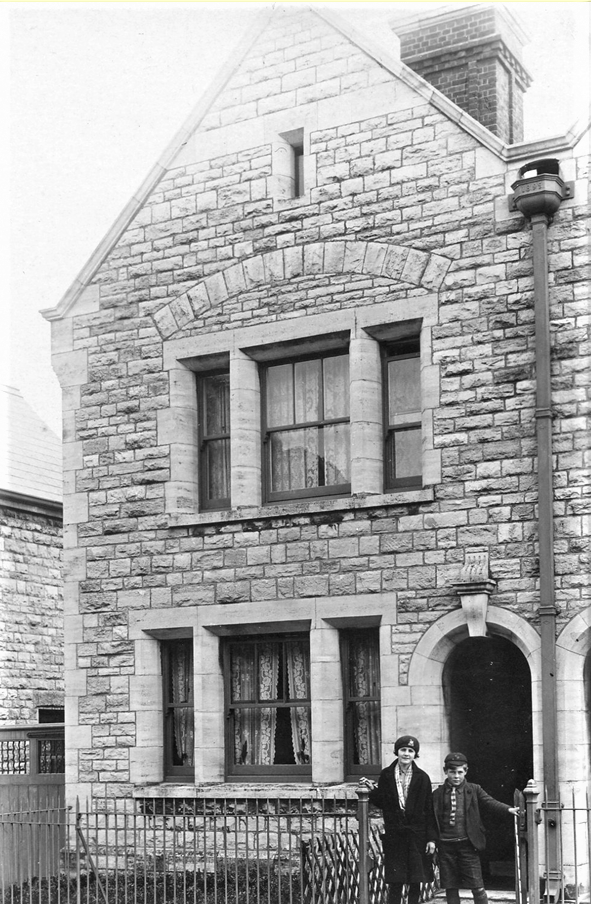
My sister and I ready for school at Swanage
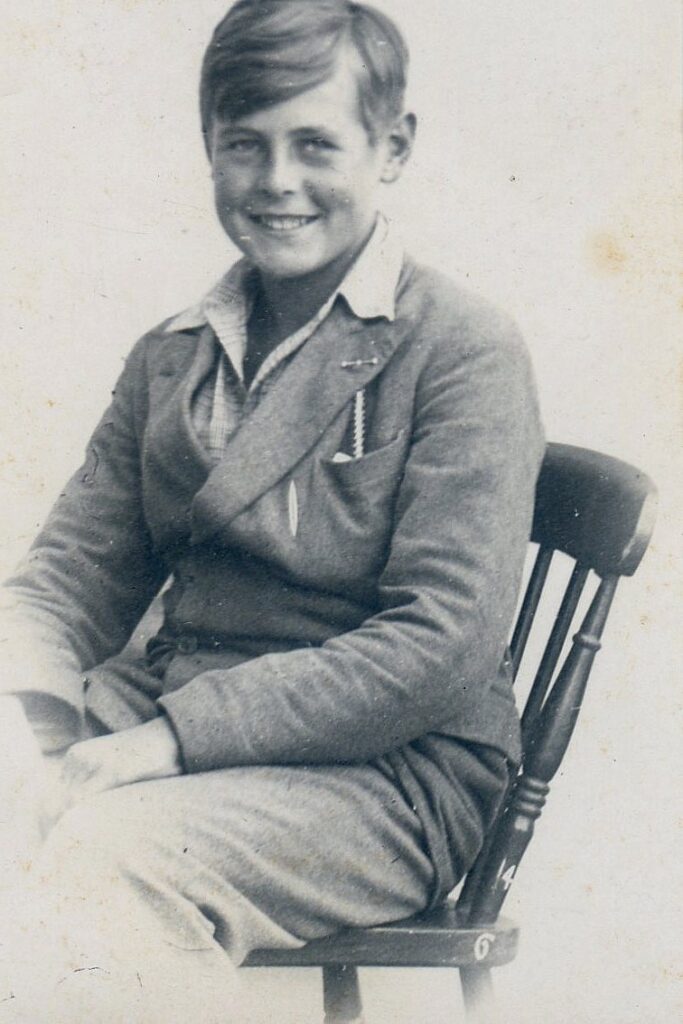
School photo, 1934.
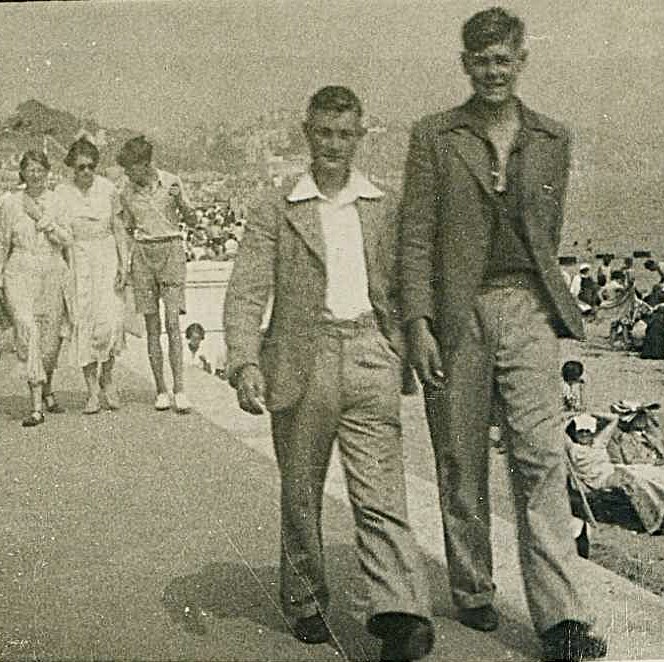
Harry Solomon & I on Swanage Esplanade, 1936.
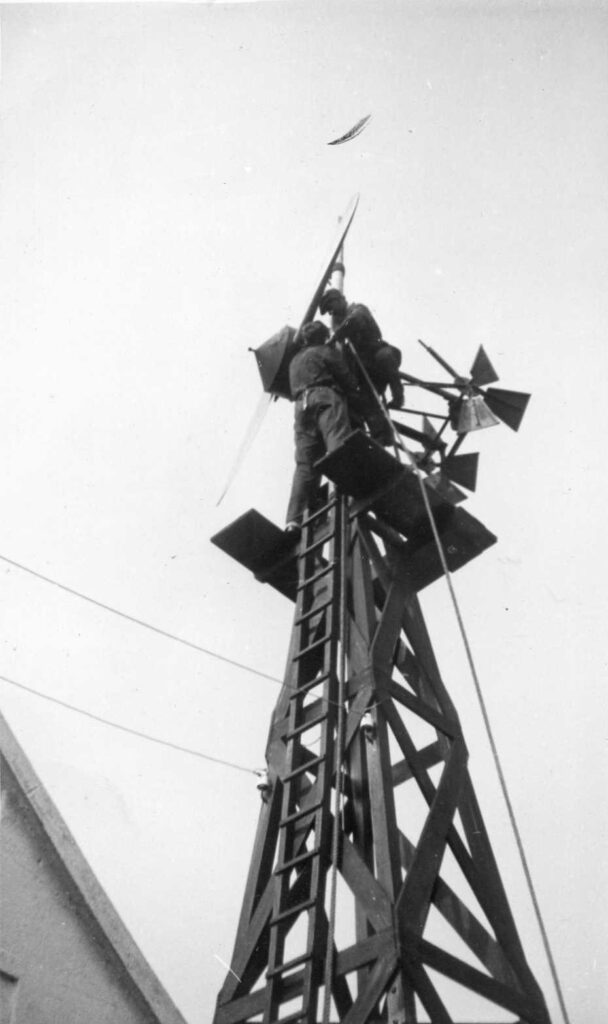
Benny Cresdie & I servicing a wind generator at Anvil Pt. Lighthouse, Swanage, 1938.
Leaving School and Joining the Police
After I left school at 14 I worked for a radio business where I had to collect and charge accumulators for radios, and deliver them with a van driver over the majority of Purbeck. After six months I started as an apprentice electrician with the Swanage Gas & Electric Co. where I stayed until we left the area to return to Weymouth in 1939. My wages for each year were 7/6 (now 37½p) a week rising to 10/- (50p) at year two and then 12/6 (62½p) for year three. In 1939 I joined the Dorset Constabulary and my pay was £3.2s.0d per week. I thought I had changed my name to Rothschild!
During my apprentice period I learned a great deal about doing what I was told to do, to anticipate my workman’s needs, to ensure the job, no matter what it was, was done properly and finished in a style which was pleasing to the eye, much of it at that time being surface work in lead covered cables and frequently in occupied houses and business premises. There were many manual tasks involved, which also taught me the need to be fit to carry them out. All these aspects of working with construction workers on sites in summer and winter, rain and snow, made me appreciate, later as a policeman, the problems working men had to contend with and to understand the pressures on them.
At Police HQ our training was, ‘in house’ by the senior officers based at Dorchester but was intermixed with much manual work polishing floors, digging someone’s garden, cleaning windows, etc. but as similar ‘training’ had been done over the years all had been through the same hoop.
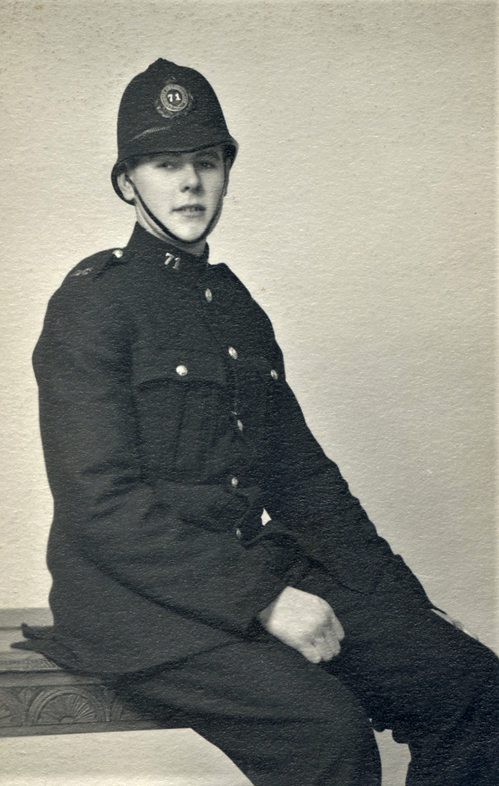
As P.C.71 Davis in winter uniform of Dorset Constabulary.
After my period at HQ I was issued with uniform, two of each, trousers summer and winter, tunics summer and winter, capes, helmets, caps, waterproof leggings, leather leggings, great coat, truncheon, handcuffs, pocket book, first-aid kit and a stack of advice on how to deal with everything that could come your way from swine fever, foot and mouth disease, sheep scab, etc., the offences from beating carpets in the street after 8 am up to manslaughter and murder, and especially where never to put your large feet at a serious crime scene.
All this kit, plus my own civilian clothes, had to be taken to Ashley Road, Upper Parkstone by train and thence up to the top of Constitution Hill by outside porter and his hand trucks. I was too green then to ask why one of the many motorcars in the force could not be used. The Branksome Section was in the hands of a Sergeant and consisted of 8 Regular Constables, 4 First police reserves and 3 War reserves. Four single constables were accommodated on the station with bedrooms above and their lounge was the enquiry office, the station officer’s office and beside it a room with a wash hand basin and a single gas ring on which all their food had to be cooked, with the exception of three cooked lunches each week supplied by the Sergeant’s wife who lived next door.
I was taken out on the beats for one afternoon by a reserve constable and told where the boundaries of our section were. I found that my other single officers were extremely helpful to me and friendships built there lasted throughout our service no matter what difference in rank may eventually occur. One of my first duties alone was patrolling Ashley Road from 6 am to 9 am. There was a crowd waiting at a bus stop and I walked on the pavement inside them. I failed to notice the height of the shop blind hung there and it knocked my helmet off, much to the amusement of the waiting people. A week or so later I was told by the Sergeant to go to the Alderney area and move on a family of gypsies. They told me that their horse was lame, one wheel of their caravan was broken, the chickens were all over the place, the wife was expecting a baby and the child was ill. Some of this may have been true but not all. I tried unsuccessfully to get them to move and returned to the station where the Sergeant told a PC to go with me, and as we approached the camp the gypsies moved on. Experience was being gained.
I had another important experience in my early stay at Branksome Police Section; I was told to inform a widow that her only daughter, aged about 25 years, had been killed in a traffic accident in Bournemouth. I called at the house, the door being up two steps. The lady came to the door and in the kindest way I knew I told her the sad news. She fell down the steps into my arms. I went next-door where I persuaded a lady to look after the widow. The lesson learned was always find a third person before you broke the news. This type of duty often occurs and is never easy.
A new Sergeant arrived who would not let his wife provide the three meals per week to the single PCs and this caused us to move to the Central Police Station where all our meals were supplied by the wife of a PC stationed there. This was a great improvement and we never objected to washing up the dishes after very good meals supplied to the 13 PCs there.

The Police constables under 26yrs of the Poole Division, released into the Armed Forces in 1942.
During this time some younger PCs were able to leave the force and join the armed forces. One PC, Jack Bennett, who had been stationed with me at Branksome joined the RAF, qualified as a pilot in South Africa but was killed flying a Lockheed Hudson bomber into a mountain in North Wales. Also another young PC, Jack Carter, the son of the Superintendent i/c the Poole Division, was killed flying a Hurricane fighter in formation over Scotland. These deaths were severely felt by us. In 1942 all policemen under the age of 26 years were released from the Police to the armed forces. I volunteered to train as a pilot in the RAF but was placed on deferred service for a few months, during which time I had to attend Air Cadet training evenings locally.
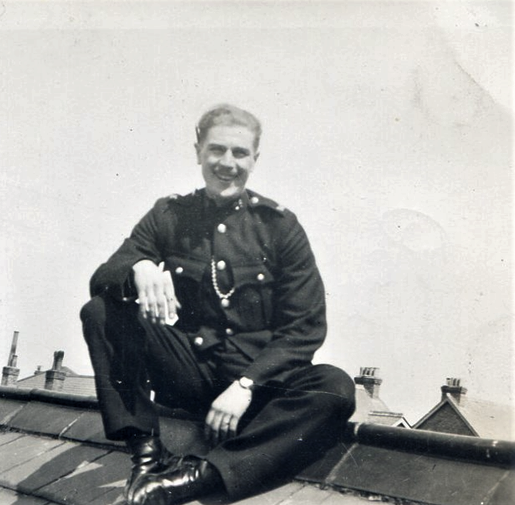
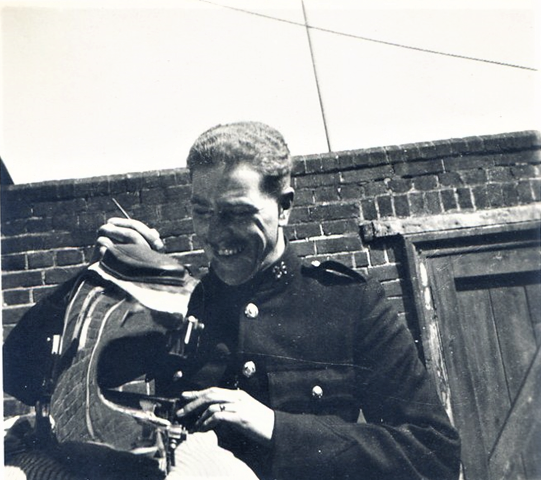
Here is P.C.26 Jack Bennett on the roof of Branksome Police Station before he entered the RAF. He died flying a Lockheed Hudson into a mountain in N. Wales. (Right) Jack Bennett painting the tank of Lloyd Staple’s Motorcycle at Branksome Police Station.
Meeting Peggy
Whilst I was at Branksome I had seen an attractive young lady alight from the bus each evening outside the Police Station. I arranged to meet her and we courted as often as my duties permitted. She was of course Florence Peggy Read who was born in Somerset but because her father had been gassed whilst serving in the Coldstream Guards in the 1914-18 War, moved to Dorset on doctor’s advice for cleaner air
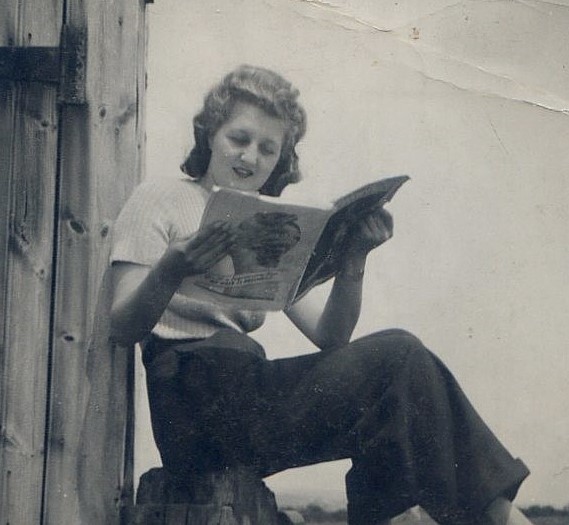
Peggy seated on a farm gate in Weymouth Bay Avenue, 1943.
I recall the first occasion I arranged to take Peggy to the cinema; on entrance I found that in transferring my cash from uniform to civilian clothes I had left my wallet in my uniform. Very embarrassing but we went for a long walk down to Branksome Chine that evening which I believe we enjoyed much more than we should have done watching the film. Some short while later I asked Peggy’s father if he would assent to Peggy and me becoming engaged to be married. He did agree and I went forth with Peggy to buy an engagement ring from a jeweller in Poole. We found a suitable ring, which I purchased and slipped on her finger. I recall that it cost me more than a month’s pay but felt that it was worth every penny.
During this time Peggy attended an engineers’ training school in Southampton where she qualified as a capstan lathe operator and returned to Parkstone to be employed by Hamworthy Engineering Co. at their small works on Hamworthy Quay. One day, when she and another lady were returning to the works from lunch, a German Dornier bomber flew over at low level and the rear gunner sprayed the road with bullets. The young ladies took refuge behind some dustbins nearby and were very fortunate to survive the shooting. Thinking of Peggy’s wartime experiences I recall that whilst seated in a stationary train at Southampton Railway Station, bombs fell on another part of the station and luckily Peggy escaped injury.
Joining the RAF
I was called up by the RAF and reported to the Lords Cricket Ground in London. Lords was not used for cricket during the wartime but became the reception centre for men joining the RAF who had volunteered for aircrew flying duties. I found that as young policemen had been released from their forces into the armed forces that there were hundreds of them at Lords. Our training there consisted of drill, marching, swimming and having kit issued. This latter aspect caused a problem for me as they had no size 15 boots to fit me. They sent me to Wembley Football Ground which had a very large storage area but here I found the only boots at size 15 they had were made for the African Army Units and were very wide indeed. The result was that I continued to wear my civilian footwear for some following months.
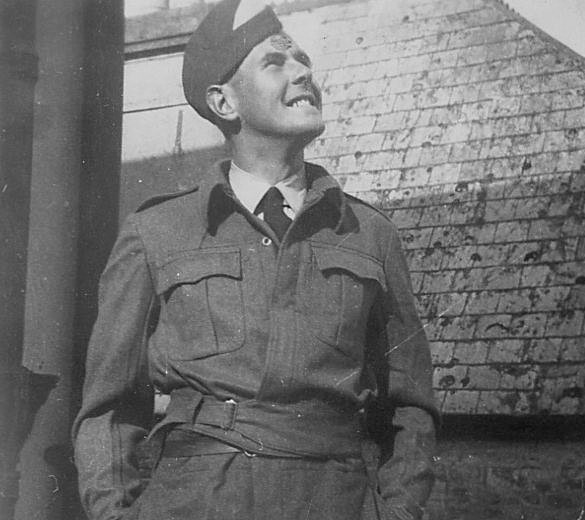
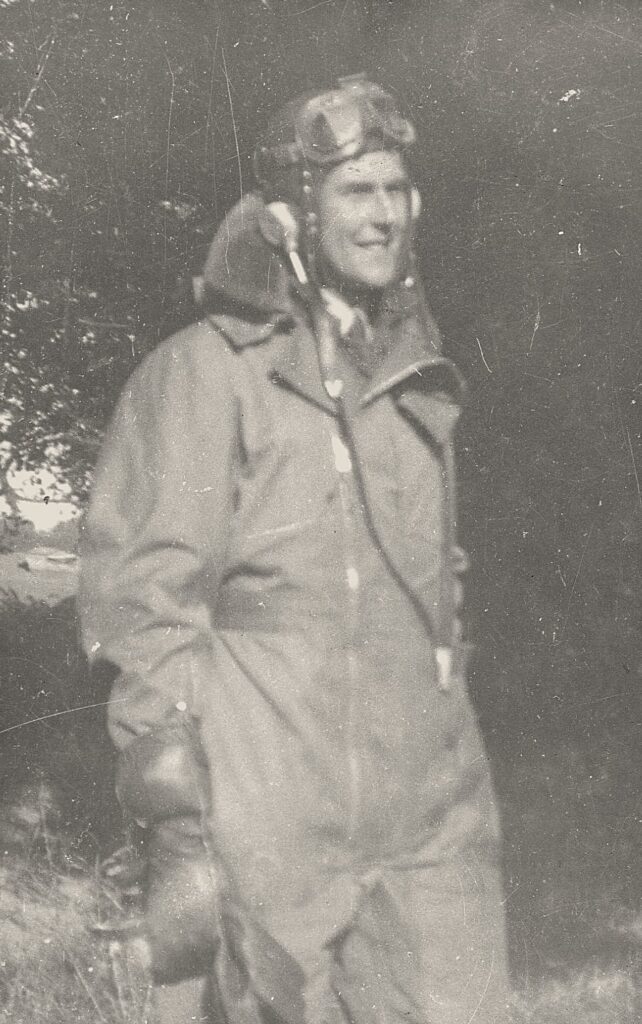
In RAF battle dress. The white flash on cap indicating aircrew in training. on the first photo and in flying kit at grading school, 1943.
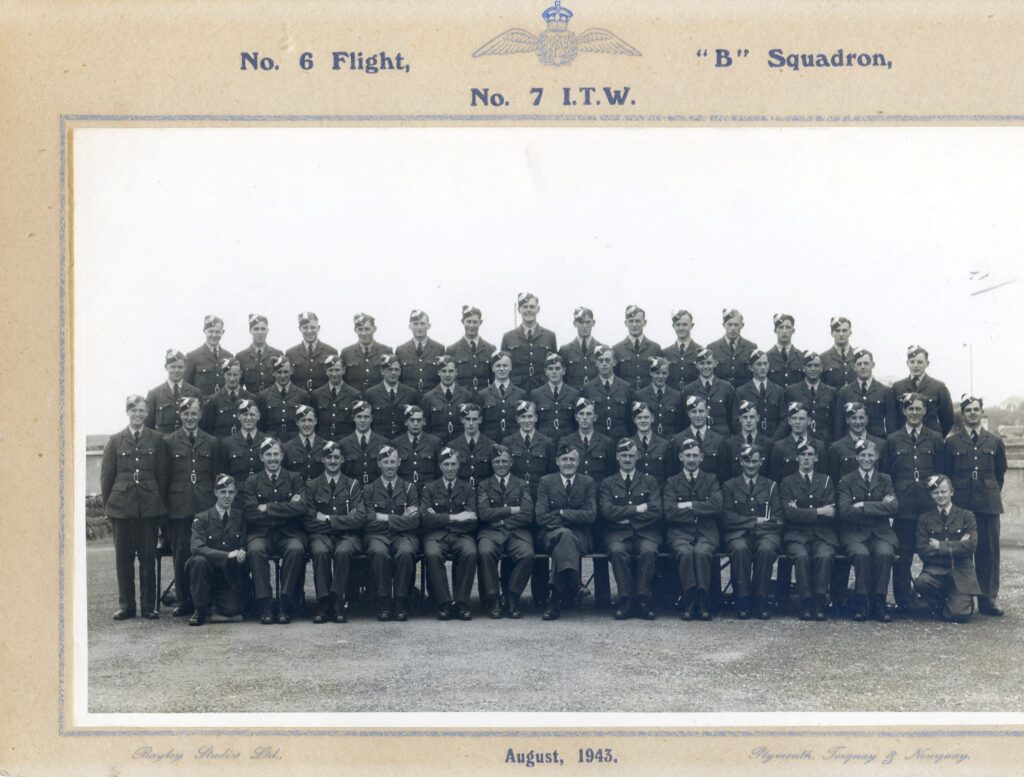
In the top centre of photograph, at Initial Training Wings (I.T.W), Newquay.
We were divided into squadrons and sent to ITWs (Initial Training Wings) located at seaside resorts around the south, west and north coasts and accommodated in hotels run by RAF personnel. Our squadron went to Newquay in Cornwall for 3 months of strict education in ground subjects such as signals, aircraft recognition, armaments, navigation, theory of flight, engines, parachute release, and foot drill every day, the theory being that the latter taught co-ordination between mind and muscle.
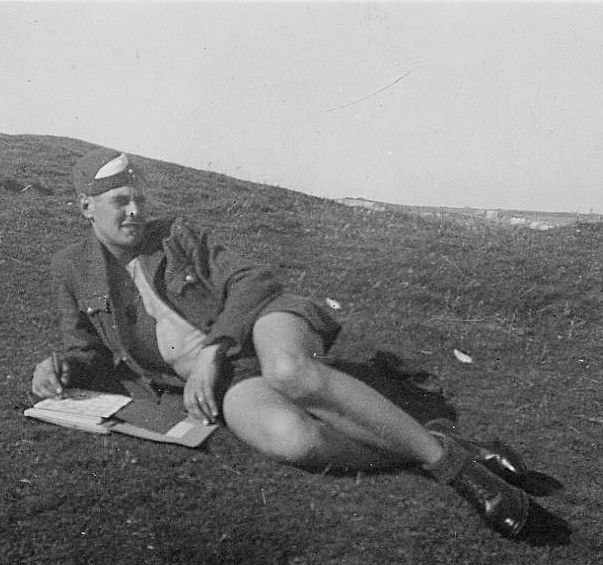
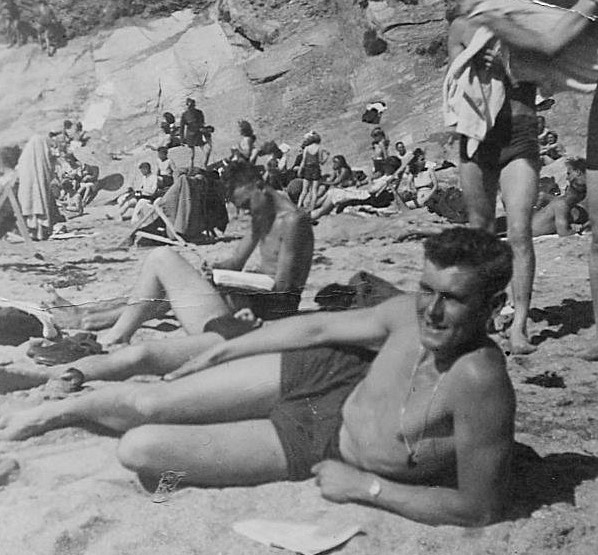
Left,) At cliff top, Newquay, studying notes & (right) on the beach at Newquay in the sunshine.
Much of our spare time was spent on the beaches where we invariably had our files of subject notes with us to refresh ready for the frequent examinations we had, failure of which meant a posting away from air-crew training to ground crew duties. Peggy was able to have a week’s holiday from her work at Poole and joined me at Newquay where I found her lodgings.
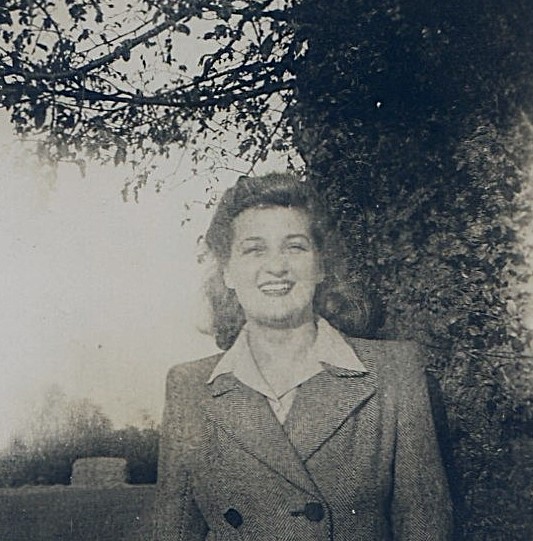
Peggy on her visit to me at Newquay, 1943.
Those of us who had passed through the ITW successfully were sent to grading schools in a variety of small aerodromes around the country, where we were taught to fly De Haviland Tiger moths but we would only be successfully passed to the next stage if we flew solo in under eleven hours. Fortunately I did so.
From the many grading schools some 10,000 aircrew cadets, complete with the white flashes on their forage caps, which indicated they were air-crew under training, were all accommodated in Nissan huts at Heaton Park in Manchester where it seemed to rain almost every day. From Heaton Park squads were posted to flying training schools in South Africa, Canada and a few to six schools in the USA. The stay at Heaton Park was monotonous to say the least and we were moved around this very large walled-in area in squadrons of some 2,000 strong. We thought we were being treated like sheep and in moving from one area to another would frequently start to ‘Baa’, much to the annoyance of the drill personnel who were supposedly in charge of us.
The wall around the park was about 7 ft high so it was not easy to leave. I can recall that some of the paths passed near the walls and one in particular had a bus stop outside it in the road. As squads passed this spot the more adventurous would climb over the wall and catch the bus before the drill corporals could stop them. Here I was fortunate in that I had been issued with an undated pass to leave the park to visit Wm. Timpson’s boot factory to be measured for and fitted with footwear. Timpsons continued to make boots, shoes, football boots and cricket boots for me for about 25 years after the war and, being made to measure, fitted perfectly.
Our Marriage
A number of chaps in my squadron were granted embarkation leave of 10 days, which meant that we should soon be on our way overseas to South Africa, Canada or the USA. Peggy and I, not knowing what the future had in store for us, decided to marry. This was one of the very best decisions we ever made. It was necessary for me to obtain a Special Licence from the Salisbury Diocese for us to marry in St. John’s Church in Ashley Road, Parkstone. I did so and it cost me 7/6 (36p) but like the engagement ring I had purchased before, it was worth every penny.
The wedding took place on 27th December 1943 and Peggy’s father gave her away. Lloyd Staples, a policeman with whom I was to serve for many years later, acted as best man and Peggy’s two sisters, June and Dorothy, were bridesmaids. The following appeared in the Bournemouth Daily Echo on 28th December 1943 (with my comments added):
FORMER CONSTABLE MARRIED
A pretty wedding took place at St John’s Church, Parkstone on Boxing Day (it was the 27th December that year) of Miss Florence Peggy READ, second daughter of Mr & Mrs R J Read, 50 Belmont Road, Parkstone and Mr Victor Tom DAVIS, RAF, only son of Mr & Mrs T Davis of 69 Weymouth Bay Avenue, Weymouth.
Rev W H Rowden (Vicar) officiated and the organist was Mr Gosling.
The bride, given away by her father, was attired in a white lace gown (borrowed from a friend owing to lack of clothing coupons), wreath and veil, and carried a bouquet of white chrysanthemums. She was attended by her sisters, Misses J & D Read. Miss J Read wore a pink taffeta dress (also borrowed from another friend for similar reasons) and the other bridesmaid was dressed in turquoise brocade (again borrowed but this time from the bride). Both carried bouquets of chrysanthemums. Gifts received from the bridegroom were identity bracelets (so they could be told apart). Best man was PC Stables (wrongly spelt in the paper, but he always ate well).
A reception was held in the bride’s home (where food aplenty was laid out on the Anderson shelter, the wedding cake being a converted Xmas cake and the majority of guests contributing to the eats). The honeymoon (one night) was spent at Weymouth, (after which the bridegroom’s parents returned). The bride travelled in a blue silk dress (this was her own and in spite of no thermal underwear was not cold) with elephant shade ‘jigger’ coat and black accessories. The bridegroom was formerly in the Dorset Constabulary (and informally in the RAF).
MARRIAGES
Davis – Read On December 27, 1943 at St. John’s Church, Parkstone by Special Licence (obtained at great speed and expense after her father’s permission and a dash to the Diocesan Offices at Salisbury) Victor Tom, only son of Mr & Mrs T Davis, 69 Weymouth Bay Avenue, Weymouth to Florence Peggy, second daughter of Mr & Mrs R J Read, 50 Belmont Road, Parkstone.
Readers of this story of my life will know that during the 1939-45 war food rationing was severe in the UK and consequently it was not going to be easy to arrange a wedding, especially as this was held on 27th December, during Christmas leave. Our friends and families came together with their small rations and prepared a delightful buffet meal at Peggy’s parents’ home in Belmont Road, Parkstone for all those attending the wedding. We were unable to find a photographer for the special occasion and in fact Peggy and I went to a photographer in Weymouth some days later, who took the picture in which the bride looked as beautiful as always. Our honeymoon of 4 days was spent at my parents’ home in Weymouth.
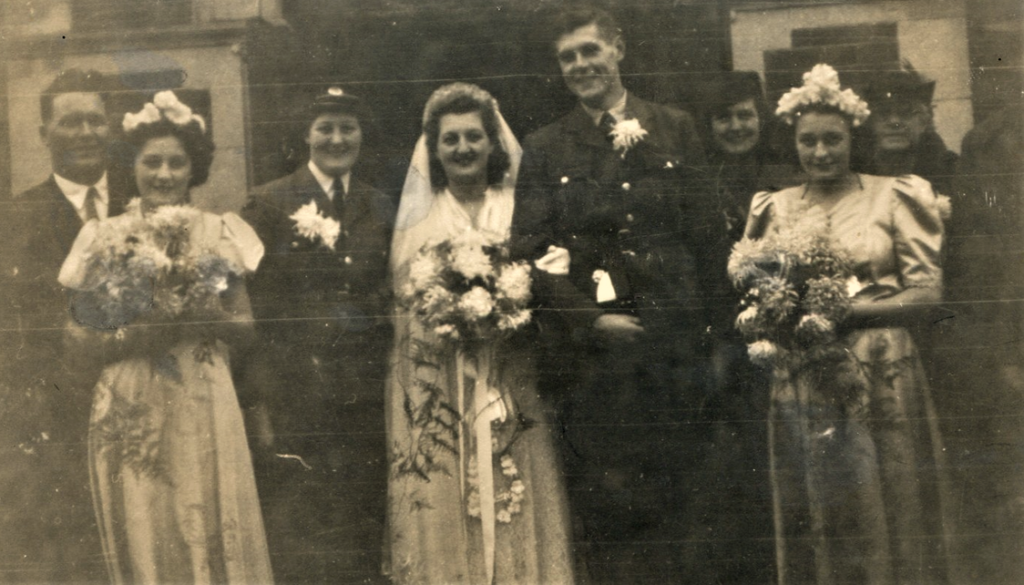
The wedding group outside St. John’s Church, Parkstone, from left to right, Lloyd Staples, June Read, Joan Read(in WAAF uniform), my bride Peggy, Me (in RAF uniform) CIs, my sister, Dorothy Read, my mother and father, 27th December, 1943.
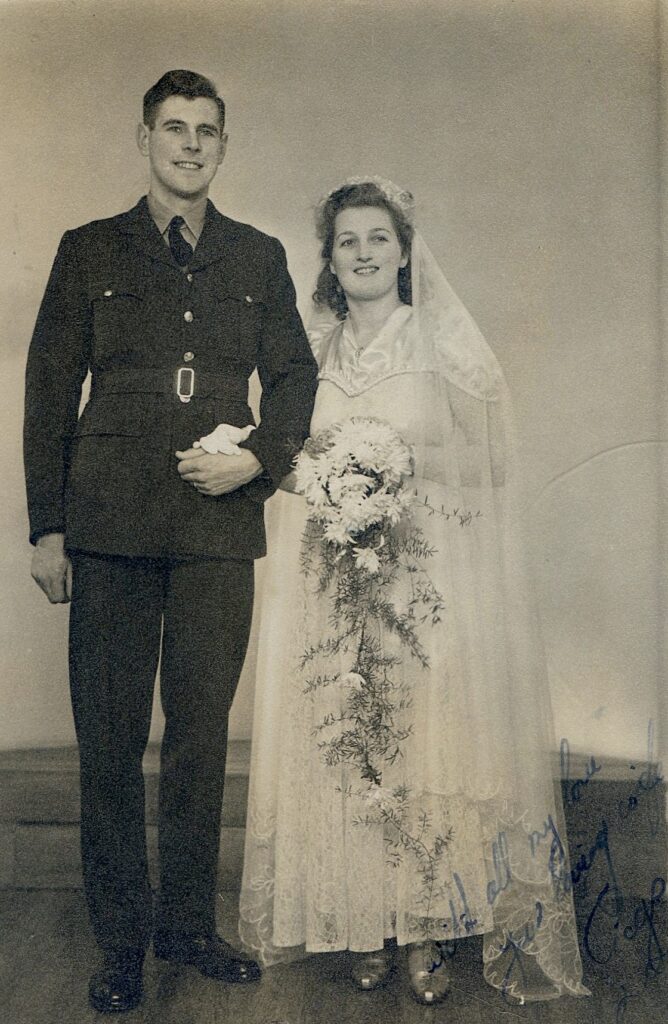
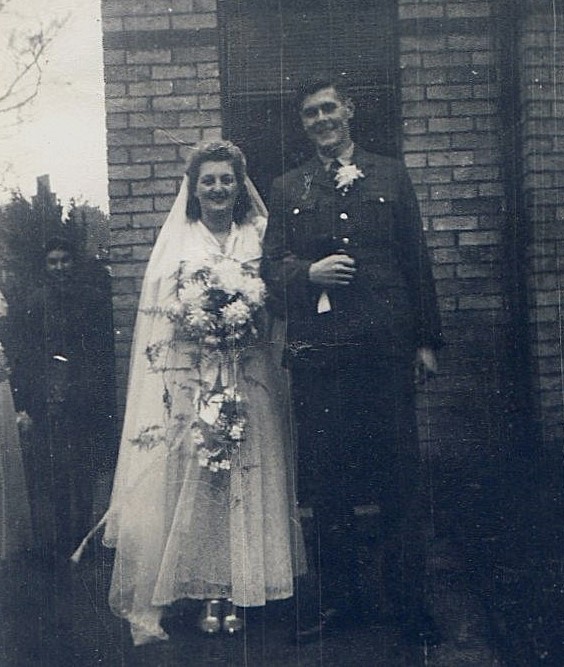
(Top) ,Outside 50 Belmont Rd. 27th December 1943, (right) Peggy and I together at Weymouth on 30th December 1943 as there was no photographer available for the wedding itself.
Training in the USA
At the end of my leave I returned to Heaton Park, where after a short while I was part of a draft of 150 cadets sent to the docks at Liverpool and embarked on the pre-war luxury liner Mauretania. We found there was but few crew aboard and within two days we sailed from Liverpool, out into the North Atlantic and a very severe gale. The ship, although of many thousand tons, was tossed about in an alarming manner and for two days I was quite ill and remained in bed.
When I regained some normality I reported to my ‘draft’ crew station which was an ‘oerlikon’ gun turret on the starboard side of the bridge, hanging half over and some 60 ft above the sea below. At this period we learned that when our ship was leaving New York on its previous voyage across the Atlantic, it was in collision with a merchant ship and suffered a hole in its bow. It was considered that to have the repair carried out in Liverpool would make the ship a target for German bombers. That was the reason we had aboard a skeleton crew and our skeleton draft would supplement the reduced crew. Our advantage was that with so few of us we had a choice of cabins to sleep in.
My duty on the gun turret was from 4 am to 8 am and from 4 pm to 8 pm. One morning I leaned across and saw that our compass heading was 090 degrees (E) whereas it should have been 270 degrees (W). I questioned the nearby Officer of the Watch who told me that they had received a warning of a number of German ‘U’ boats on our normal route and it had been decided to turn back and loop south to avoid them.
We docked in New York, left the ship and were taken to New York Central railway station to board a train for Moncton, New Brunswick in Canada. This was an interesting journey through the Maritime Provinces of Connecticut, Massachusetts, New Hampshire and Maine in the USA and over the border to New Brunswick in Canada. At Moncton we found there was a large RAF holding station from which air cadets were posted out to flying training stations in Canada and the USA. Snow was quite deep and the temperature at times went down to -28F making it necessary to wear as much clothing as possible to keep warm. The accommodation consisted of two-story wooden buildings, which were kept at a high temperature, which was very welcome. I recall that when walking to Moncton in a blizzard I bumped into another airman, who stumbled back and said, “You always were bumping into others, why don’t you look where you are going?” I peered through the clothing covering his face to see it was Victor Wilcox from Swanage who was in my class at school and with whom I used to spend many hours playing football. After the war he joined the Dorset Constabulary, retiring as a Superintendant to live in Martinstown just two miles from our home in Bradford Peverell.
I was amused by the Chinese laundryman to whom we used to take our laundry in Moncton, as no matter what day you left it, it was always ready on ‘Chewsday’ as he called it. When ironing shirts, etc. he would have a mouth full of water, which he would spray out over the garment through his broken teeth. Not very healthy but it was ‘Hobson’s choice’ there.
I was very pleased to have been selected as one of a hundred air cadets to train in Arizona, USA, believing that it would certainly be warmer there. Our draft of 100 consisted mainly of those who had crossed the Atlantic in the Mauretania so that we were all familiar with each other. The train journey to Arizona took us seven days through the provinces of Quebec and Ontario, over the US border to Detroit and Chicago, where we were let off the train for a few hours to see the city and its skyscrapers.
Our journey continued through Illinois, Missouri, Kansas, a few miles into Texas, into New Mexico and then into Arizona at Douglas on the Mexican border, to Tucson and Phoenix, the state capital of Arizona. Throughout the journey our carriages were fitted with reclining seats on which we spent all the days and nights. This was a problem to a degree but improved by the ladies who boarded the train at each stop and brought trays of fruit, chocolate, sweets and biscuits, most of which we had not seen since the war started. You can imagine how pleased we were to see them and to eat their very kind gifts to us.
There were a number of flying training airfields in the vicinity of Phoenix and we went to ‘Falcon Field’ near Mesa, some 30 miles east. This was No. 4 British Flying Training School and was one of the six which had been established across the USA even before the Americans entered the war. It was the result of General Arnold, head of the US Army Aircorp, wanting more airfields to train his pilots but being refused the costs by Congress. He communicated with his civilian friends who then financed all six airfields and let the US Army supply the aircraft only.
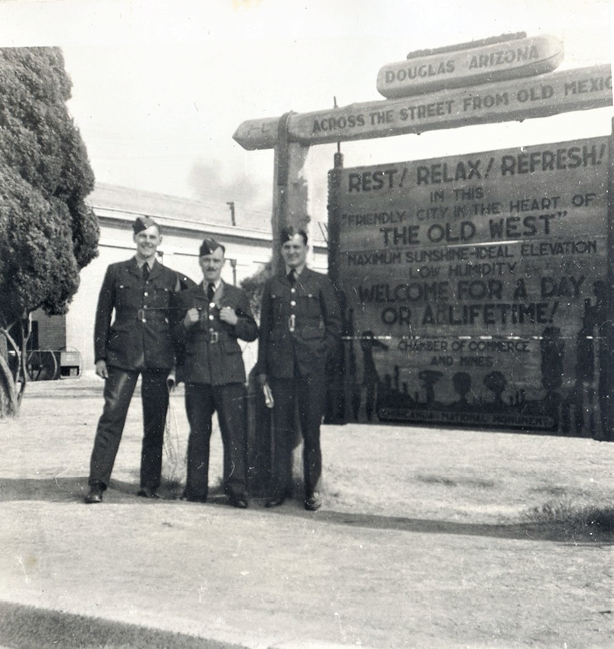
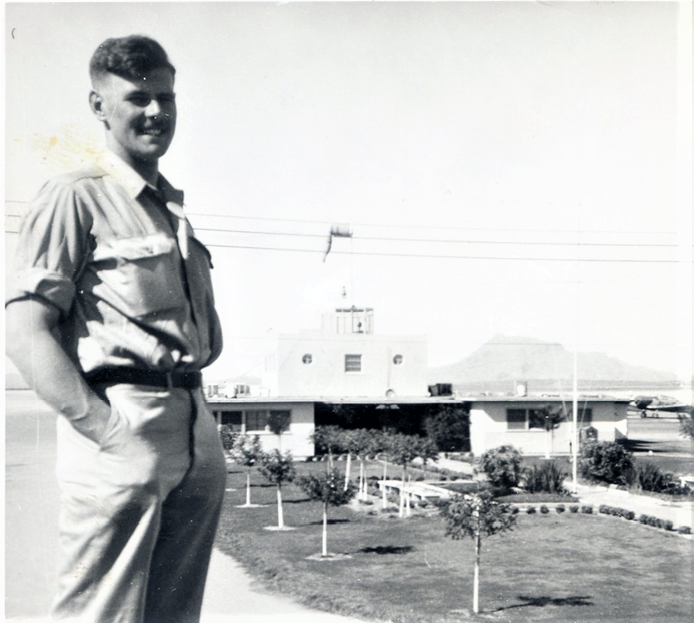
(Left)Mac, Jack and I at Douglas, Arizona, USA, en route to Phoenix & (right) On the roof of the accommodation block in Falcon Field, Mesa, USA. Swimming pool in the foreground & control tower and admin behind.
We found that Falcon Field was commanded by a Wing commander of the RAF and the following RAF personnel: Sqn. Leader as a Ch. Check flying Instructor, three F/Lts as check pilots, an RCAF F/Lt as navigation check instructor, an F/O as adjutant, a F/Sgt, firearms instructor, a Sgt as PT instructor. All the remaining instruction staff including flying, admin., engineering, ground instructors, catering and maintenance, were civilians supplied by the South West Airways who financed the aerodrome.
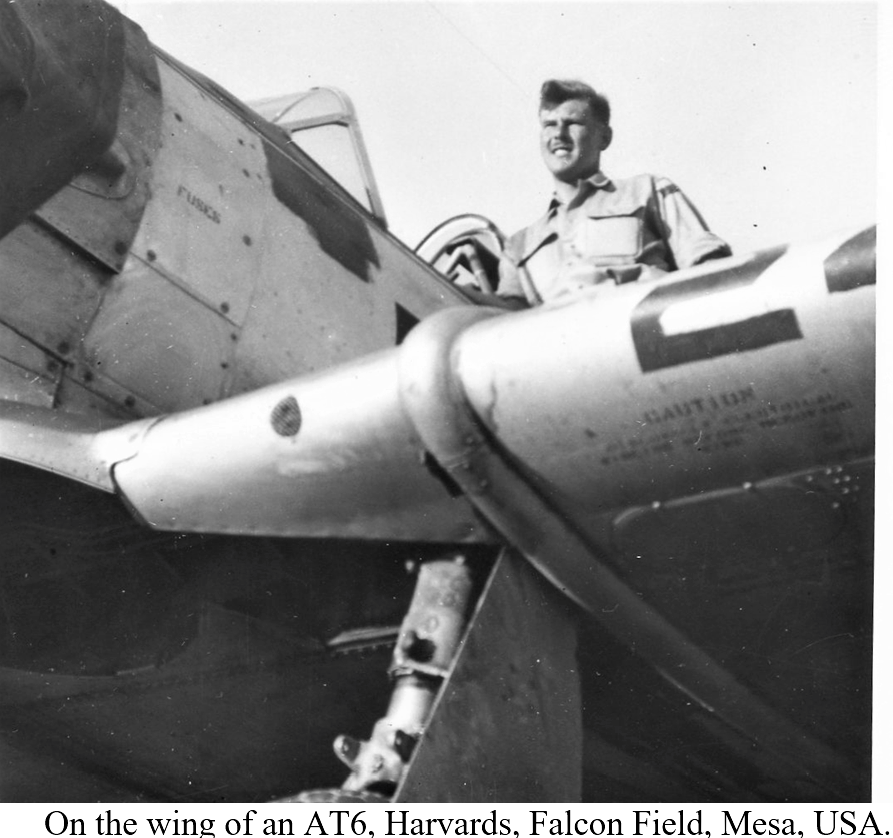
The flying training course consisted of three parts, primary, intermediate and advanced flying. The aircraft used in primary were Stearmans PT17s (biplanes but fully aerobatic) and AT6s (Harvard) monoplanes were used in intermediate and advanced courses. Our flying instructors were of very great experience in the air and many of them had built their own aircraft and some of them flew themselves to Falcon Field each day to work. We air cadets were divided into two halves, one flying and the other on ground subjects, each morning and afternoon. Four cadets were allocated to each flying instructor and when not flying, the cadets studied the ground subjects, etc. in the flight room to prepare for the exams each weekend and at the end of each part of the course. Failure of any exam meant that you were confined to camp for the weekend and too many failures resulted in failing the course and returning to ground duties.
The weather in the ‘Valley of the Sun’, where Falcon Field was located, became quite exceptional. In fact in one year ending in August whilst we were there, there were 363 days when it was suitable for cadet flying training. Temperatures reached 104F on occasions and the metal in the Harvard cockpit was very hot when you got into it on the parking area.
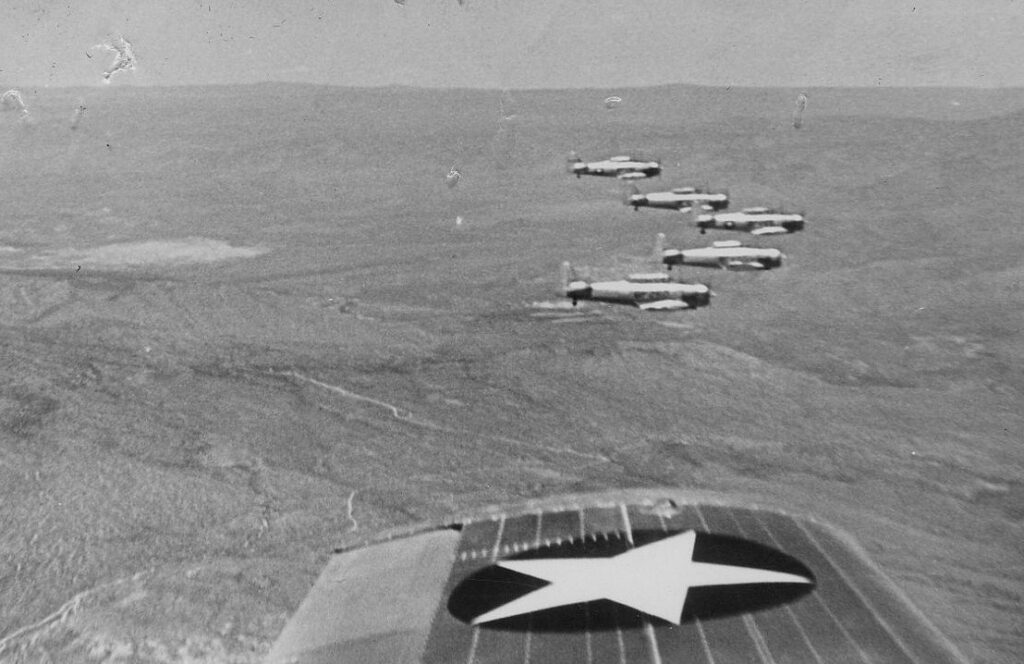
Formation Flying in Harvards, Arizona.
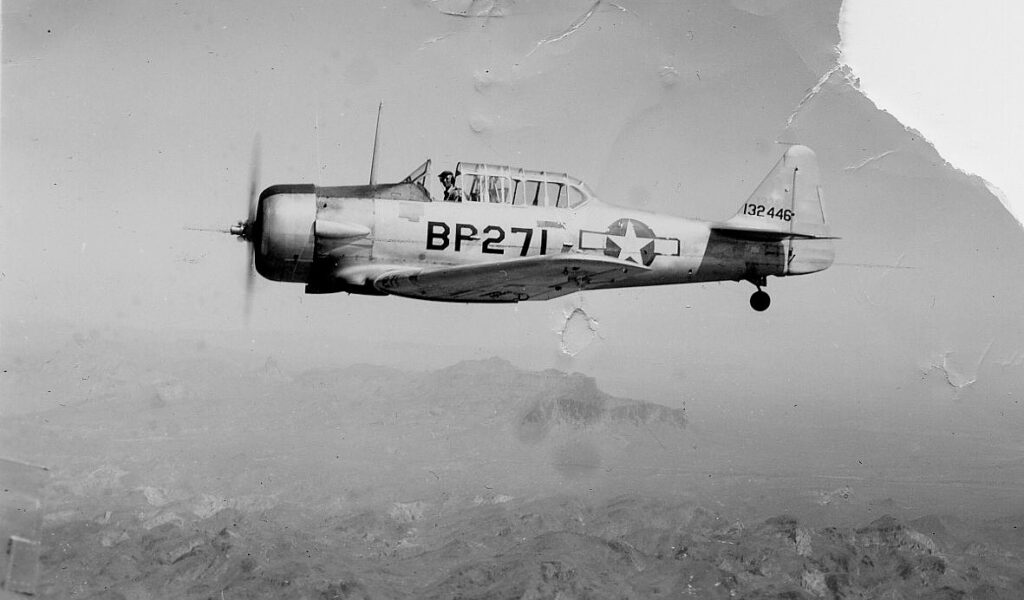
Flying over the Arizona Desert.
Arizona is mountainous with dry riverbeds across the desert. Small towns and hamlets each had a water tower with the name of the town painted in large letters around the top. We found this extremely useful when flying cross-country as it gave a ‘fix’ when we were uncertain as to our location or route. We were sent on cross-country flights with a cadet in the rear seat to navigate. I recall one such event when I was in the back seat with another cadet flying the plane. All went well until back at Falcon Field he landed it very badly, hitting the ground hard which caused the nose to go up and the air speed to drop off. I had removed the ‘joy stick’ from its flying position prior to take off so I could not take over. I grabbed the intercom and said ‘FULL THROTTLE – STICK FORWARD” and which he did. We flew around again and he made a near perfect landing. I was very relieved.
Later on when on the advanced part of the course, I was flying back from a long cross country to Texas and ahead was a line of mountains with heavy thunder clouds over them. I decided that I had just enough time to duck under the clouds and over the top of the mountains before the storm arrived. We made it and we were both relieved. We flew on over New Mexico to Falcon Field.
We were granted two separate weeks’ leave. On the first my two colleagues (both policemen before entering the RAF) and I hitch hiked to the Grand Canyon and stayed overnight. The Canyon was the most impressive sight I had ever seen, being 218 miles in length, up to 18 miles wide at the top and a mile deep down to the fast flowing Colorado River, which it is stated removes a million tons of soil from its bed each day. In the Canyon there are many mountains, 4,000 ft high, and the layers of the soil removed show up very prominently.
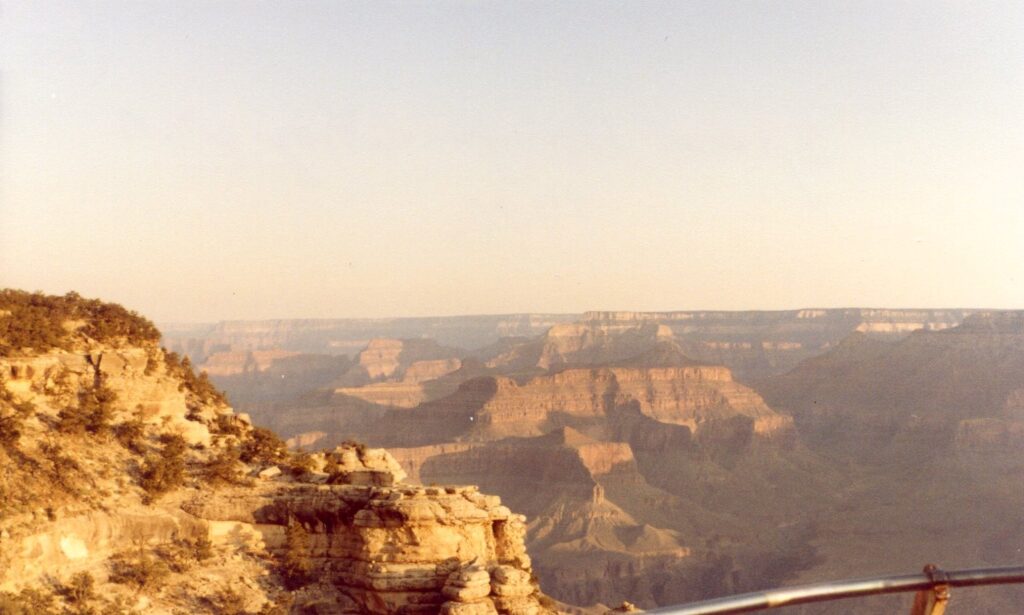
View of the Grand Canyon, The far rim is over 10 miles away. Its 218 miles long, between 10-18 miles wide and a mile deep.
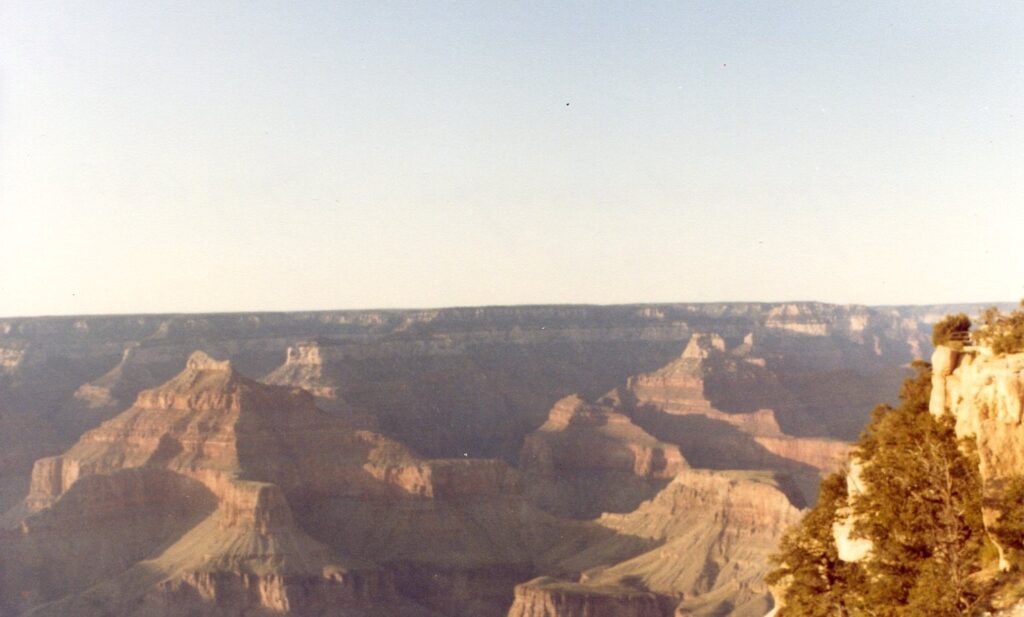
The Grand Canyon, Arizona. The mountains in the canyon are up to 5,00ft. high.
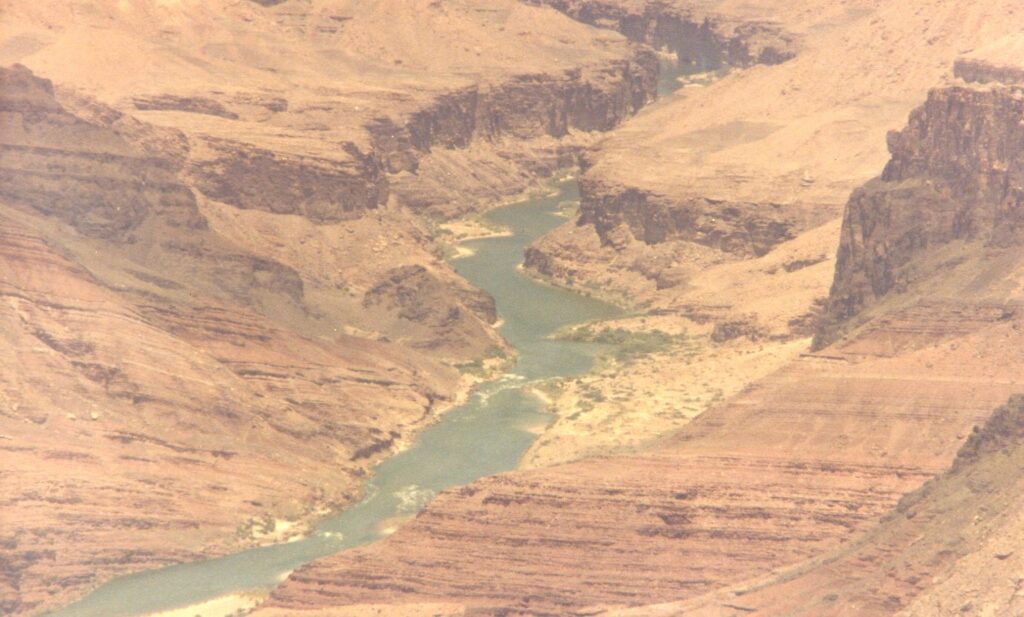
The Grand Canyon, the Colorado River is one mile below in this photograph.
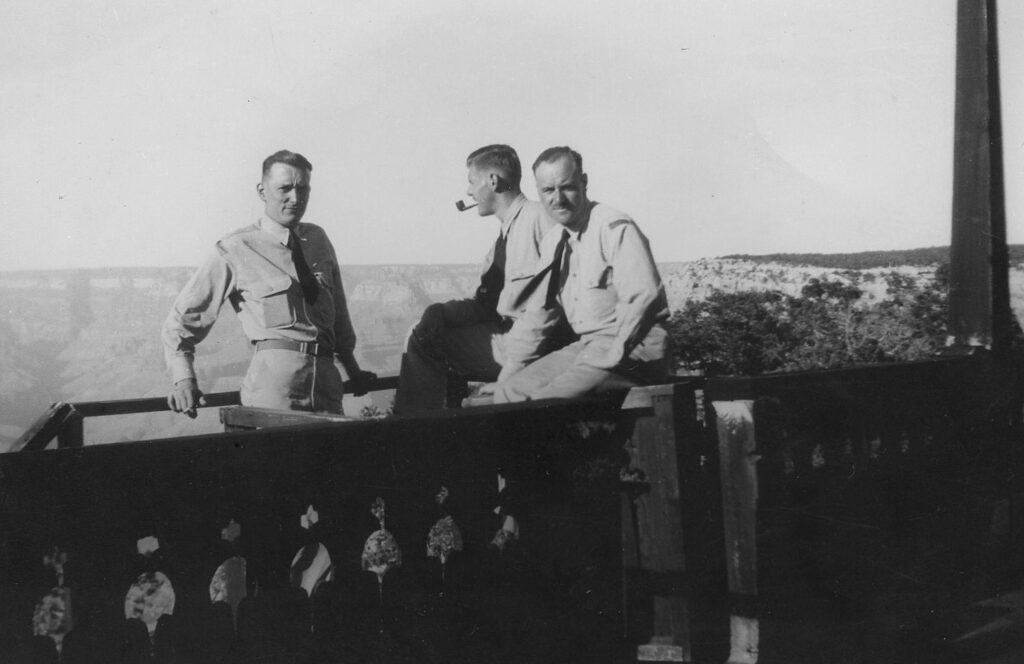
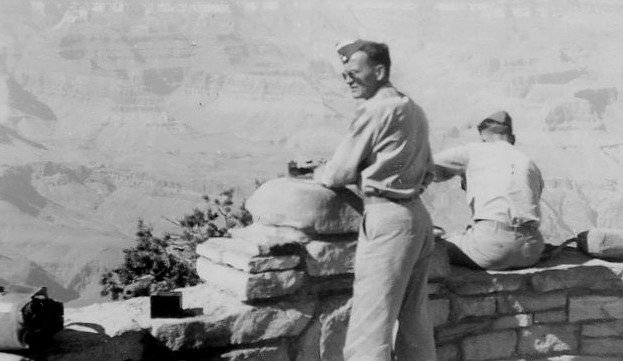
Jack, Mac and I on the south rim of the Grand Canyon, 1944.
We placed ourselves at the exit to the Grand Canyon National Park and two Packard cars stopped for us. They contained a lady and her son in one car and her two daughters in the other. They were en route to San Francisco and said that they would divert via Los Angeles (500 miles) to help us. In a flash my two colleagues were in the daughters’ car and I was left to join mother and son. I was luckier as I could sleep or rest in the rear all the way to LA whereas Mac and Jack took it in turns to drive the rear car.
In Los Angeles we found Duke Ellington and his band were playing in a ballroom. Very few people were dancing but the majority were just standing in front of the stage enjoying the music produced. A couple of days later we went to a concert given by the LAPD (Los Angeles Police Dept.). The stage was very wide and the concert started with the very large curtains opening just enough for a uniformed policeman to walk through. He sang the Lord’s Prayer beautifully, better than I have ever heard it sung. The curtains opened up to reveal 20 police motorcycles with their headlights on and sirens going.
Later that evening we were in a taxi on Sunset Boulevard and when it stopped at traffic lights, another taxi stopped beside us. It contained five young ladies all dressed in pastel blue coloured clothes. My colleagues hopped from our car into the other while the lights were red and I followed. We went to the ‘Brown Derby’ restaurant because we were hungry but when we saw the prices being charged, we decided to have coffee and a biscuit. The waiter brought the bill which landed in front of Mac, who quickly passed it to Jack. He went pale and dropped it in my lap. I knew that between us we had insufficient cash to pay it and I had visions of spending hours washing up in the kitchen. Fortunately one of the young ladies took the bill from me and said, “This is our treat”, and paid it.
We thought that as we were in Hollywood we ought to visit a film studio and consequently made our way to Warner Bros. Studio. We were invited in and spent some time watching Humphrey Bogart and Lauren Bacall acting in ‘To Have or Have Not’. We were amazed at Bogart’s patience as they went through 20 takes of a very short embrace before it satisfied the director. Bogart made no complaint. We had a chat with him and our photograph was taken. There were many other household names of the era about the studio, Henry Greenstreet, Peter Lorre and Ida Lupino, I can recall.

Mac, Jack and I talking to Humphrey Bogart during a break in the filming of ‘To Have or Have Not’ at Warner’s Studios, Hollywood, 1944.
Somewhere or other we met a Mrs Fio Rita, the wife of a bandleader, who invited us to stay at her home in the San Fernando Valley for the night, which we did. We hitch hiked back to Phoenix and Falcon Field, satisfied that we had made the most of our leave.
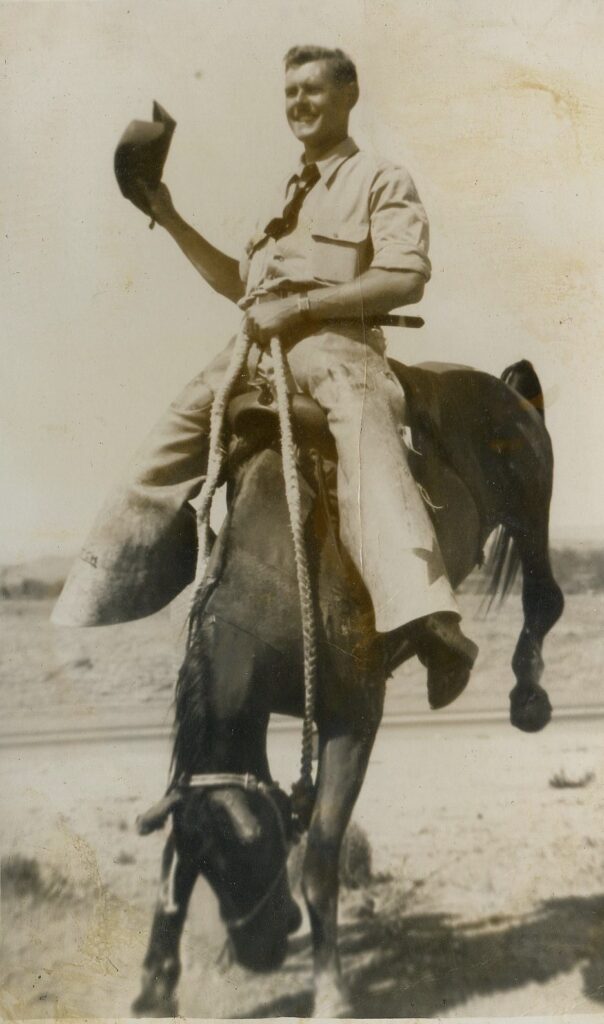
On route for a leave we found this stuffed horse on the roadside as a visitor attraction!
We continued our course and each weekend we three would visit Phoenix to do shopping for stockings and other lingerie to take home for our wives when we returned to the UK. One of our course must have spent the whole of his pay on such things judging by his exhibits in the billets on Sunday evenings. We three continued to stay at weekends with Mr & Mrs Naegli, a couple of German descent, who made us so very welcome throughout our stay in Arizona. Of the 100 who started the course, 83 graduated, ten of which received a commission as Pilot Officer, one of which was me. Now that was a great surprise and the only reason could have been that the adjutant at our final dinner in Phoenix congratulated me on my commission and thanked me for helping my fellow cadet Dainton through his course.
The training became more skilled and more interesting as we progressed into the advance stage with more aerobatics, blind flying, elementary gunnery with cameras fitted, formation flying and practical navigation, as well as all the ground subjects. In no time we found we were having final checks in the air and examinations on the ground. We passed out with a parade of the three courses, basic, intermediate and advanced all present, and our Wings were presented and pinned on our shirts by Air Commodore Willets. We had our final dinner at the Westward Ho Hotel in Phoenix and afterwards I was put to bed in the home of Mr & Mrs Naegli, to whom we paid our grateful thanks and packed our bags for the journey home. The following morning we were on the train again for Moncton, Canada. The ten pilot officers shared two to a cabin which enabled us to sleep comfortably, one on the seats pulled out and the other on what appeared to be a very large luggage rack, which was pulled down from the wall.
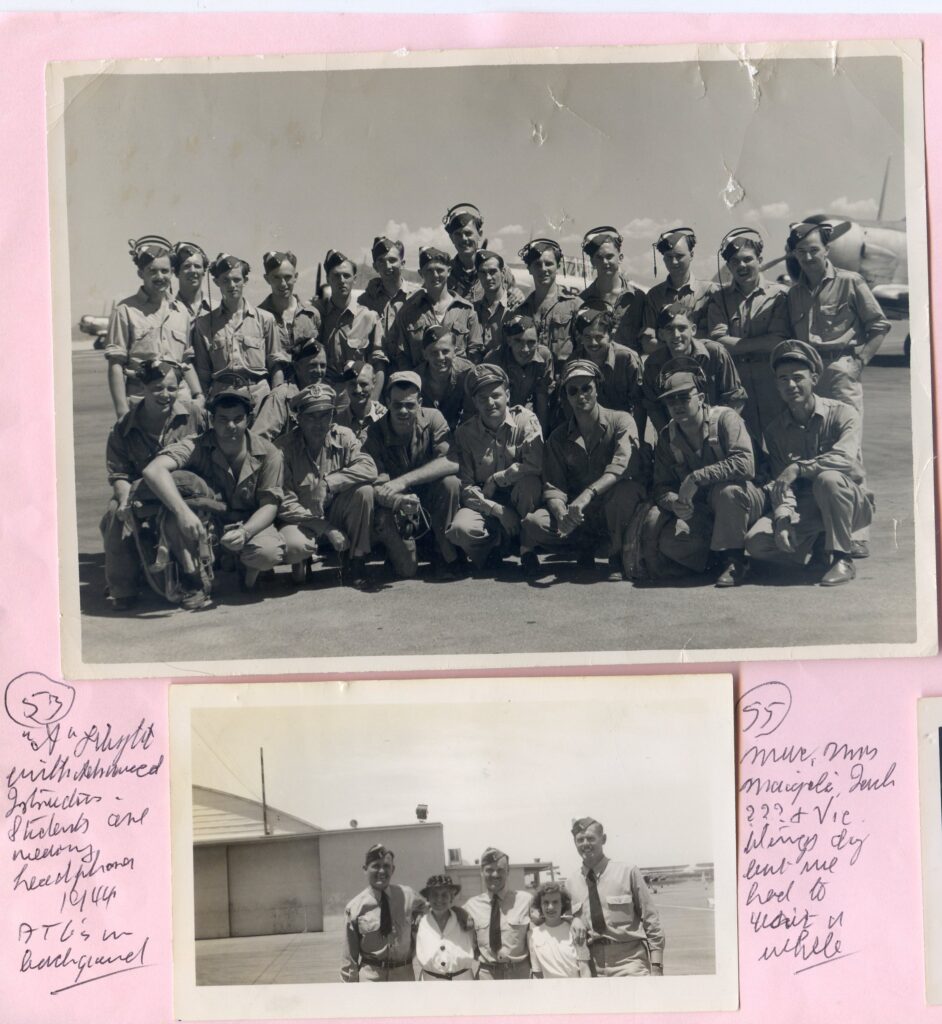
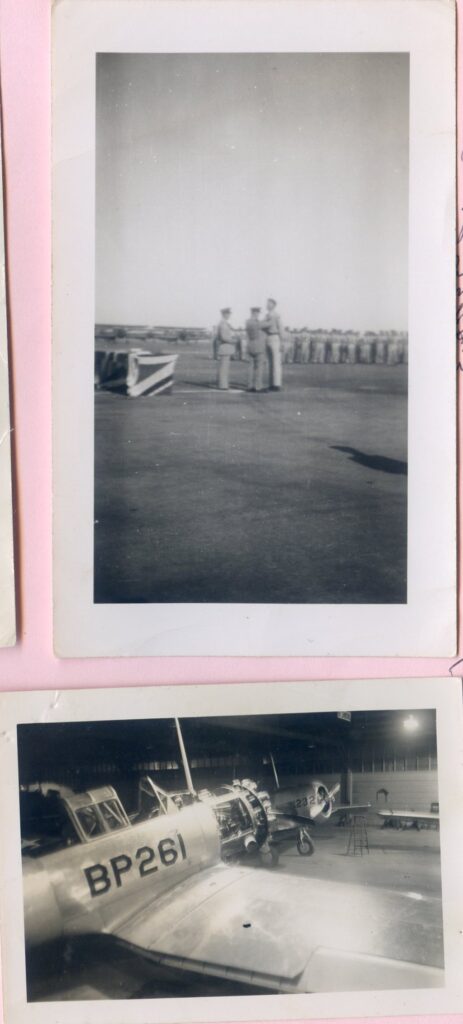
Top left, ‘A’ Flight during advance course, with me in the back row centre, (top right) Receiving my wings, (bottom left), we three with two very hospital ladies from Phoenix, (bottom right) . Harvard being serviced at night. Falcon Field, Arizona.
At Moncton I bought an RAF officer’s cap and a second pair of wings to sew on my battle dress. We were so proud of our wings that some chaps wanted to sew them on their pyjamas. We passed through many forests which in their autumn colours were absolutely glorious.
Return to the UK
The next few weeks at Moncton passed very quickly and we found ourselves in Halifax, Nova Scotia, boarding the Ille de France for our journey back across the Atlantic to the UK. The liner had been adapted as a troop ship with accommodation for 10,000 troops. We slept 10 to 12 per cabin on metal two tier bunks which were not long enough for me and I got what sleep was possible sitting up in my bunk. A meal was supplied every 12 hours, so that if you had breakfast at 6 am your next meal was at 6 pm.
We were fortunate to have two military bands aboard, one from the USA and the other from Canada, that provided some entertainment. We arrived at Glasgow very glad to set foot again in the UK. Our RAF draft was sent by train to Harrogate to be lodged in hotels. As soon as I could I telephoned Peggy as it was her birthday that day, 14th October. I said “Happy Birthday Darling” and she replied “Who is that?” I said “Who else other than your husband calls you darling and knows it’s your birthday?” Her reply did not matter as it was so marvellous to hear her lovely voice again after ten months away.
As soon as leave was granted I made my way to Weymouth to be with Peggy and my parents. I needed uniform as all I had was battle dress and a cap. I tried Moss Bros. as did my colleagues who had been commissioned, and found that their jackets and trousers were quite poor in that both were so tight as to be uncomfortable.
Fortunately I knew a tailor in Weymouth who quickly made me a uniform and a greatcoat, which fitted excellently. I was very lucky in that Peggy had saved all the married allowance she had received whilst I was away and I was able to pay the tailor. I was also notified that my RAF pay would be paid into Cox & King’s Bank in London, which enabled us to live quite well.
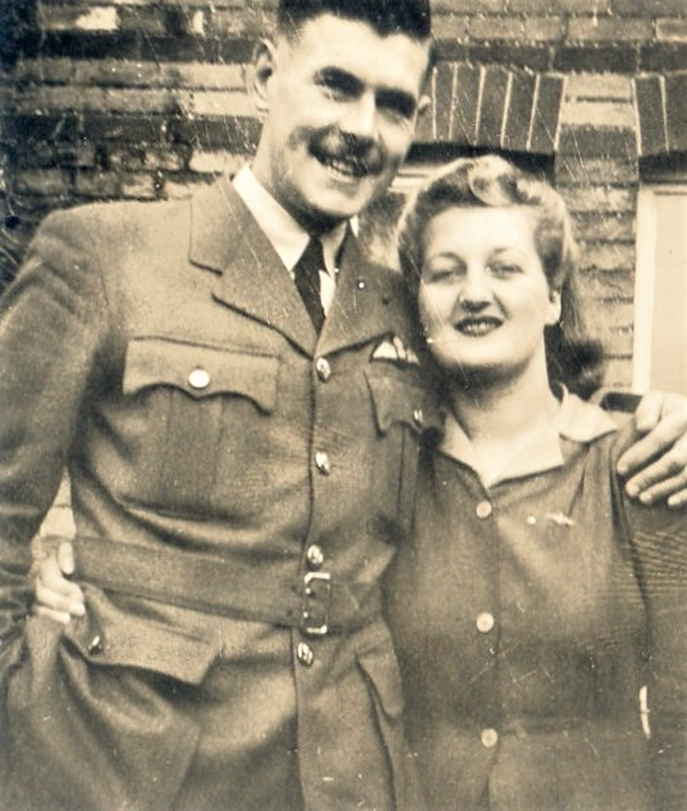
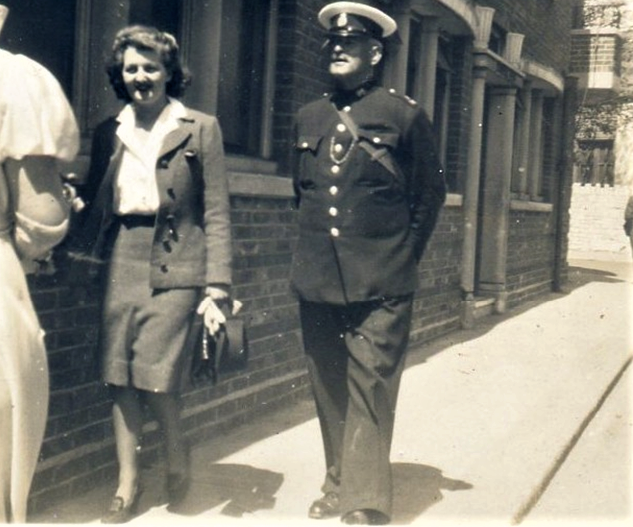
(Left) Peggy & I after my return from the USA & (right) My father escorting his daughter-in-law, Weymouth 1944.
I was so pleased to be in Weymouth, proud to wear my new uniform and see the glint in Peggy and my parents’ eyes when I did so. Whilst at home a lady who was well known to my parents visited our home. Her son, also an RAF officer, had recently passed through Moncton and had spent an evening at the Catholic Club, which Mac, Jack and I had once visited. This lady said that her son, also well over 6 ft in height, had met a tall young lady who wished to be remembered to ‘Vic’. This could have been embarrassing as Peggy and my parents were in the room when she said it. I had to explain that when Mac, Jack and I entered the club there were three tall young ladies just waiting for tall men to arrive. Later of course the same thing occurred when Ray Carter went to the club. What a small place our world is. Peggy made no mention of this conversation afterwards and neither did I. We both had absolute trust in each other when we were apart.
After my leave I returned to Harrogate where the whole draft was told that the RAF were pleased to have us back as pilots but they had not suffered great losses that they had catered for (I could not believe this). So they offered us three alternatives: 1. to join the Royal Navy as pilots, 2. to become aerodrome control pilots sitting in shepherds’ huts at the end of the runways with an Aldis lamp signalling to incoming aircraft that it was safe to land and 3. to be seconded to the Army and be members of the Glider Pilot Regiment, which had suffered heavy losses in Sicily, D Day and Arnhem. I was no sailor so I volunteered for the Glider Pilot Regt. and was quickly passed to it with other volunteers.
On joining the regiment it was necessary to be converted to glider flying and to receive training as soldiers. Our air blue battle dress was no longer used and we were kitted out as soldiers with khaki battle dress, metal framed Norwegian type haversacks but we still wore RAF badges of rank, caps and wings.
Our first station was Shobdon in Herefordshire where we flew small gliders named ‘Hotspurs’ which carried two pilots sat in the nose, one behind the other, with room for eight soldiers. I have no knowledge of this aircraft ever being used on operations. I teamed up with RAF Sgt. Pilot Raymond Hunt, who had been in the Oxford City Police before he entered the RAF and had trained with me in Arizona.
Ray Hunt was an excellent pilot and a very fit man who excelled at cricket and football. We fitted very well together and to this day (December 2012) still communicate from time to time by letter or telephone. After leaving the RAF he transferred from Oxford City Police to the Warwickshire Constabulary, where his brother was serving, and later became Deputy Clerk to the Magistrates at Solihull.
Our course at Shobdon lasted two weeks and we passed out proficient, although for me there was insufficient room for my legs in the nose of this glider. We were given a weekend leave and I went to Weymouth. I enquired at the railway station as to trains back to Shobdon on the Sunday evening and was given the wrong times, which resulted in me arriving at Leominster Station, some miles from Shobdon, on Monday morning to find my draft with all their kit awaiting a train to Brize Norton in Oxfordshire. Luckily knowing that I was on the draft with them, some kind friends had packed my kit, which was there for me on the platform. This railway error resulted in a letter from the Adjutant at RAF Shobdon to the Adjutant at RAF Brize Norton informing him that as I had not returned to base I was to be considered ‘absent without leave’. On arrival at Brize Norton I was called to the Adjutant’s office to explain why I had not returned to Shobdon. After I had done so I was advised to be more careful with my travelling arrangements in future. I learned a lesson there.
Brize Norton was a large airfield and still is. It was built in the 1930’s and had a splendid Officers’ Mess. A few days after my arrival I went down to breakfast and after collecting my eggs, bacon, etc. I saw a f.lt. sat alone at a table. I sat opposite him as I recognised that he had been the manager of the Victoria Hotel in Swanage before the war and I told him that I had worked on occasions at that hotel when I was an apprentice electrician. He was very surprised and we had an interesting chat over the meal about Swanage and Purbeck.
At Brize Norton we did a number of hours flying the American ‘Waco’ glider, which the RAF called the ‘Hadrian’, and many more hours flying the ‘Horsa I & II’. The Hadrian was not fitted with flaps but had spoilers on the upper surface of the wings which, when applied, interrupted the airflow and caused the aircraft to lose height, tending to make it float just above the ground.
Peggy came to the area for a week and stayed in a hotel in Burford. It was a bad hotel in that the heating system was not working and she could only get warm by having a bath. I went to see her every evening when I borrowed a WAAF’s cycle to get there. The weather was extremely cold and all the trees and bushes were covered in hoar frost. The week went by very quickly and Peggy returned to Weymouth. Her reason for being there was that my father had re-joined the police as a first reserve and was working a rotation of duties with night duty every third week. My mother was scared of the air raids during Dad’s absence and Peggy was there to comfort her.
Whilst I was in the USA I received a letter from Peggy telling me that she had obtained a job as a guard on the small railway train that ran from Weymouth to Portland, and also to Yeovil. I was extremely worried at this news I recall as I could picture my blonde wife on the last train from Weymouth to Portland with the train full of happy and drunk sailors. I wrote of my concern but by the time she received my letter she had ceased to be a guard and was employed as a clerk in John Grove Brewery head offices in St. Thomas Street.
After a month at Brize Norton we flew our Horsa gliders to RAF Matching Green in Buckinghamshire where we continued to practice our circuits and bumps with empty and loaded gliders with troops and with jeeps, guns and trailers. To load the glider and ensure it was stable in the air, every item of the load had to be strategically placed and anchored to the body of the aircraft.
From Matching Green we went to the mushroom farm in Braintree to form ’H’ Squadron, 2 Wing, of the Glider Pilot Regt. Our Commander was a RAF Sqn. Ldr., and the Officer i/c the Wing was Colonel ‘Billy’ Griffiths, a cricketer, who became the secretary of the MCC after the war.
H Sqn was moved to Earls Colne Airfield in Essex where we had pilots of the RAF and the glider Pilot Regt. intermixed. I was made a Flight Commander with some 30 pilots in the flight and was later sent to Oxford University on a Flt. Cmders’ course. Whilst there I learned that the Allies had flown over the River Rhine in ‘Operation Varsity’, which was the largest airborne operation of the war. I was disappointed that after all my training in the RAF and the G.P.Regt. It appeared that I was to gain no experience in action. Later I started to think that perhaps I was fortunate in that on Operation Varsity 104 glider pilots were killed that day, 64 of whom were RAF volunteers like me. Had I been involved I may not have returned.
Before the war ended there was still action to be taken. On one occasion ten glider crews were selected from various squadrons and sent to RAF Tarrant Rushton in Dorset to prepare for a special operation behind German lines. With Ray Hunt I was one crew. We were not briefed as to what the operation was but rumour had it that it was to land at Templehoff Airfield in Berlin and take it before the Russians arrived, or to land on the dykes in Holland and prevent them from being breached by the retreating Germans, flooding a great area of the country in the process. We inspected and prepared all our small arms but the cloud base came down to about 500 ft over Dorset that weekend and the operation was cancelled before it could get started. We were all sent back to our squadrons.
During this period of inaction I was ordered to take my flight to Hengitsbury Head in Hampshire for a week’s relaxation. We found some wartime huts there, which we used; we kept fit by day and in the evenings visited Christchurch. Unfortunately Peggy was at Weymouth and I was unable to see her during that week.
For a period of two months whilst I was stationed at Earls Colne, Peggy came to Essex and we obtained accommodation for her at ‘Redwings’ at Coggishall. She found work as a secretary for the MD of the Isinglass Company, which made the product used to preserve eggs for a long period in a bucket full of water and isinglass.
We enjoyed those two months together and occasionally I got permission to sleep out of the airfield.
As the European war ended it was decided to scrap our gliders and a large exercise was arranged to fly 100 of them to Thruxton Airfield. The plan was that the first group of 20 should land well upwind on the left half of the airfield, the second group to land well upwind on the right side, the third group to land behind group one and the fourth to land behind group two, leaving the remainder of the space for the fifth group to land on. We were leading in the fifth group of 20 gliders and when we saw the field it was full of gliders facing in all directions and covering the whole of the landing area. We were committed and with gliders once you have detached from the towing aircraft there is only one way to go and that is down. We must have looked like a gaggle of geese landing on a lake, keeping up as much speed as was reasonable to enable us to jump over gliders in our way. We put them all down without much damage and no injuries. It appears that all the gliders were to be scrapped except that at the Army Air Corp Museum at Middle Wallop between Salisbury and Andover there is the fuselage of a Horsa, which reveals its wooden construction and fragility.
Back to the Dorset Constabulary
After the European war ended the authorities were anxious to get all persons from reserved occupations back into their civilian jobs. Peggy and I discussed the possibility of me applying to remain in the RAF where my pay at that time was £8 per week whereas that of a constable in the police was £3.2.0. We quite properly decided however that to be posted to many different stations in the RAF would mean that we would be apart again for long periods, so I returned to the Dorset Constabulary. Another aspect was that Peggy was pregnant. I was stationed at Weymouth and we both lived with my parents at Weymouth Bay Avenue.
In January 1946 Peggy gave birth to a daughter who was stillborn at my parents’ home. Two Irish doctors attended and were there all night endeavouring to have a successful birth. They came to the conclusion that mother and baby could not both survive due to the baby being very large and I was asked to decide who was to be saved. My decision was that Peggy should be saved if it was possible. I could never thank those two doctors, Devereux and Hanna, enough for their skill that night. Peggy gradually returned to full health and eventually decided that she still wanted to have children. Peter was born in 1949 and Anita in 1952, both at the Portway Hospital in Weymouth.
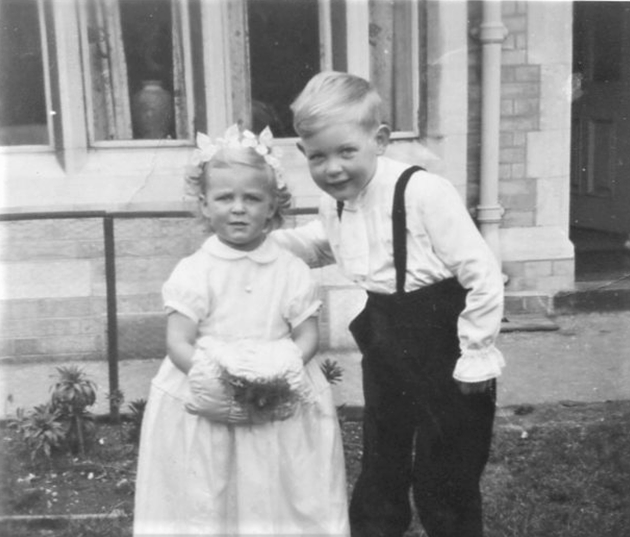
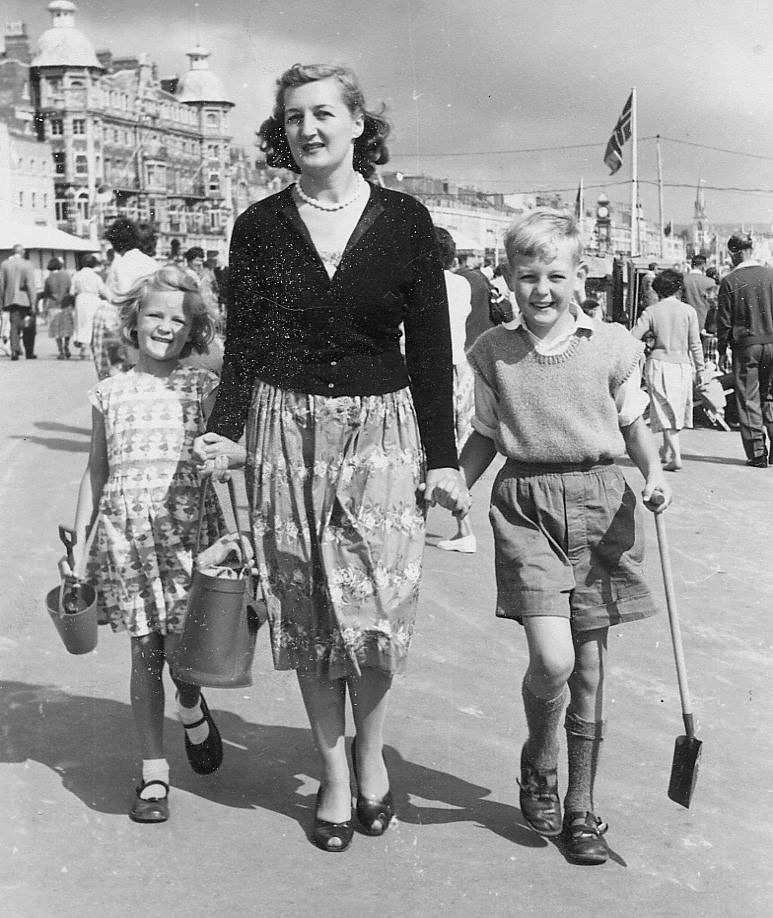
(Left), Anita and Peter dressed for Auntie Dorothy’s Wedding, Poole & (right), Peggy with Anita and Peter going to the beach at Weymouth.
My father was still serving as a member of the First Police Reserve at Weymouth and I was fortunate to be placed in the same squad with him. This made the situation at home much easier as we both cycled to and from duty together. Dad was always the station duty officer and we ‘youngsters’ having returned from HM Forces did the foot patrol. This arrangement resulted in Dad being the ‘cook’ on night duty and in addition to his other duties, used to prepare a meal for all of us between 1 am and 2.30 am.
We were a mixed bunch of ex servicemen. I recall we had notification from HQ that we were to have a new constable stationed with us called Edward Collier-Marsh. We thought that with a name like that he would be from the upper strata of society. In fact he was an ex colour sergeant of the Royal Marines and his last posting was at the detention barracks. He arrived at 6 am one morning and the duty sergeant told him to remain at the station with my father who would introduce him to station duties. There were two prisoners in the cells and Dad suggested that the new man should go and see that they were up and about. Hearing shouts from the cell passage he went up to see what was happening and found that the new PC was enforcing RM detention systems on the two prisoners; blankets were correctly folded into squares on top of the mattress and the prisoners were cleaning their cells and ensuring all dust was obliterated. ‘Ted’ Collier-Marsh became an excellent policeman and a great friend to us all. He was not as originally surmised from his double-barrelled name from the upper crust of society but was a native of Uploders near Bridport and had a delightful Dorset accent. He obtained the rank of superintendant but sadly became ill and died before his retirement.
At Weymouth during the immediate post-war period the Royal Navy was very prominent and especially at weekends would put many thousands of sailors ashore from large ships in Weymouth Bay and Portland Harbour. The numbers of police on duty at any particular time remained the same at between 4 and 6 on patrol. We were fortunate in that the Navy had a squad of 10 to 15 RN police in the area and from them we received considerable assistance and some mobility to keep order and prevent damage. I recall an instance when an older constable and I endeavoured to quieten two sailors who ignored our advice to the extent that they called my colleague a bastard. This at that time was a great insult and my colleague, who was a very mild and patient man, took it as such. He hit the sailor, which propelled him backwards across the road to land in a heap in the gutter. My colleague had been a heavyweight-boxing champion whilst in the army in India. The sailors were arrested for being drunk and disorderly.
If sailors missed the last ‘liberty boat’ back to their ship they would on occasions steal a fisherman’s motorboat to get back on board. One fisherman lived on the quay and if he heard a motorboat going out he would telephone the Police Station and two or three police would go with him in his boat after the stolen boat. I recall one occasion when three of us were after two sailors in a boat and chased them into Portland Harbour where they landed one on the central arm of the harbour wall. We put one of our trio ashore on that wall whilst we chased the other man who had commenced to swim out through the harbour entrance.
A naval ship put one of their motorboats afloat to assist our search and eventually they went to the central harbour wall to collect the PC we had put there. The naval boat was in the charge of an officer who, when the PC stepped on the boat, said, “I am at your command officer”. The PC who had been in the navy replied, “Full astern cox’en, starboard ten”. The officer then appreciated that the PC knew what he was doing and I later asked the PC what his experience was in the navy. He told me that he was in charge of a personnel landing craft in the Adriatic Sea and had done 104 landings on the German held coast, putting agents ashore and collecting them. He held the DSM (Distinguished Service Medal) for his bravery. This medal is a very high bravery award on a par with the DSC awarded to officers at that time.
During these post-war years I played a considerable amount of cricket in the summer and football in the winter for police divisional and force teams. In about 1949 I was asked to play football for the Weymouth Football Club, where I was the captain of the reserves and played some dozen times for the first team when their goalkeeper was absent. On three occasions I was selected to play for Dorset FA. Playing football for the Weymouth club brought me some publicity among the public at a period when watching football was a very common weekend pastime. Even now some 62 years later someone will mention that they can remember me in goal at the Weymouth Recreation Ground.
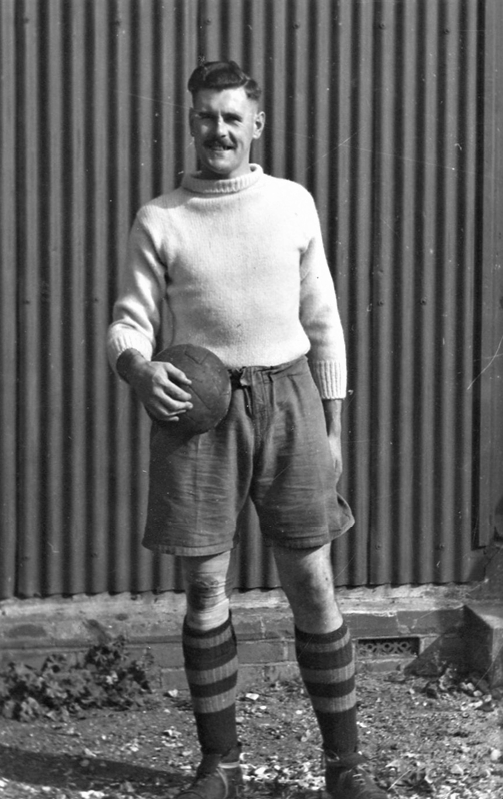
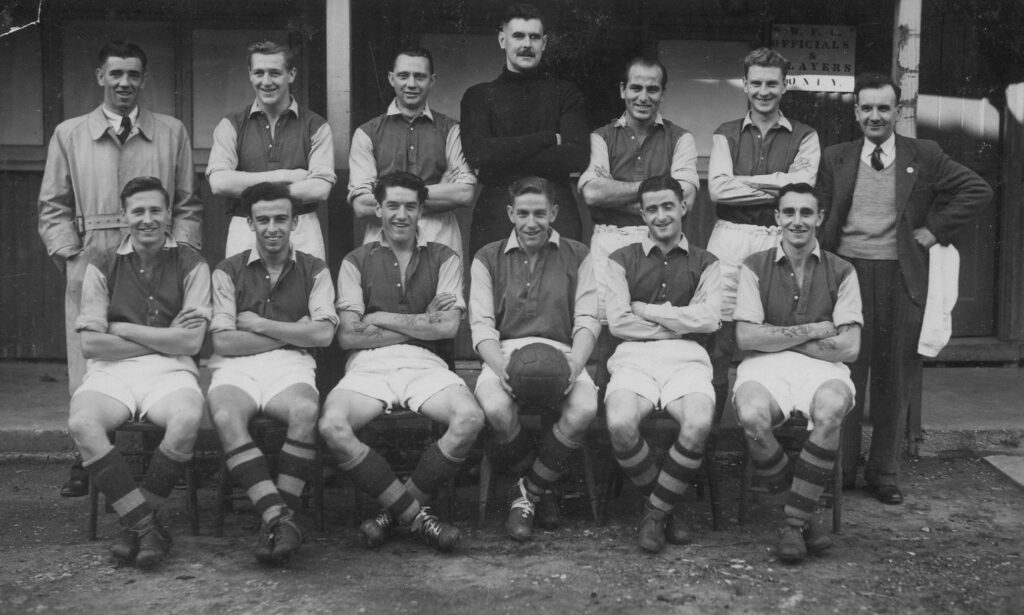
Back row, centre again! As goalkeeper for Weymouth F.C. 1st eleven. Bob Lucas must have been sick.
Even recently about 5 years ago I went with Peggy into a pub for lunch near Weston super Mare. We entered a small private bar and the landlord came around from the public bar and said, “Yes Mr Davis, what can I get you?” I replied ‘How did you know my name, I have never been in this house before?” He explained, “I grew up in Weymouth and I used to stand behind the goal at Weymouth Rec. when you played in goal for Weymouth Football Club”. Then just a couple of years ago I was walking in Dorchester and after a man had passed me I heard his footsteps stop. I stopped and looked around and he said, “Aren’t you Vic Davis?” I replied, “Yes”. He said. “I was with two friends when we jumped over the wall surrounding the Weymouth Football Ground and landed almost at your feet. You were on duty at the time.” I said, “What happened?” He said, “You gave us threepence each, told us to enter the ground by the turnstile and pushed us back over the wall. I asked if they did that. He replied; “No, we waited until you had gone to the other side of the ground, then hopped over the wall again.” I said what about the threepence each. He said, “We bought an ice cream each.” He chuckled and walked away.
I became very well known in the town through playing football and years later I recall that as a Chief Superintendant I was walking in St Mary Street, Weymouth with a young PC when we passed a road sweeper who said, “Hello Vic, everything alright?” I replied, “Yes Jack, how are you?” The young PC was perplexed; he could not understand why anyone had the cheek to call his Ch. Super. by his Christian name. I saw his problem and I explained to him that I had walked the beat he was on many times and I knew the road sweeper well. I also advised him to get to know people like the sweeper and the window cleaners as they were always in the street and saw everything which occurred and were therefore excellent witnesses to any occurrences.
In about 1946 another PC who moved into police accommodation vacated a flat in Monmouth Avenue. Peggy and I were fortunate to obtain the flat and spent three happy years there. Peter was born that year. He was a large baby and spent the first two weeks in an oxygen tent in a side ward. The doctor in charge thought it was proper to have him christened and it was done without his mother or me being present at the hospital. The small ward had a window overlooking a yard at the hospital; I was on night duty at the time and our sergeant was kind enough to allocate me to that beat where I could visit the yard from time to time and listen out for Peter crying there. After a few weeks both Peter and Peggy came home to Monmouth Avenue and we were so delighted.
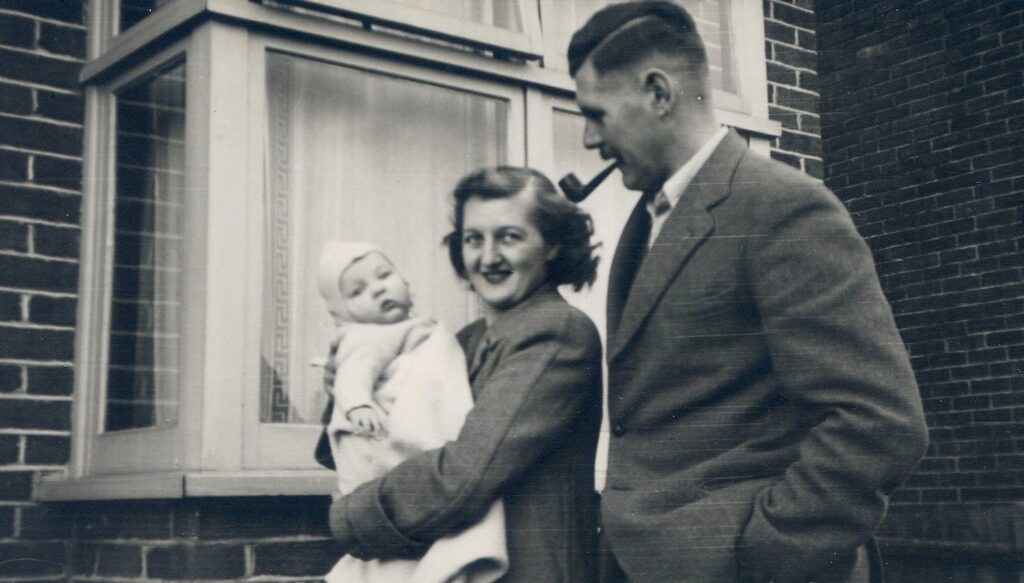
We were so proud of our first born ‘Peter,’ and I still am.
I thought that I would endeavour to get a place in the CID but was told that at my height I was too conspicuous. I then thought of the motor patrol department but found that the cars they were using at the time did not accommodate my long legs. A Det. Sgt. suggested that I should try to get into the training side of policing. I did so and was sent to a District Training School in Staffordshire for a six-week course. Peggy stayed at Weymouth. The Home Office opened a District Police Training Centre for the forces in the southwest at Chantmarle, near Evershot in Dorset. I was appointed as one of the three instructors there with the temporary rank of Sergeant.
Chantmarle
Chantmarle was a delightful old country house. The previous owner was the MD of W.H.Smith and the daily papers were delivered to him by being dropped from the early morning train as it passed by at the bottom of the garden. There was an exceptional tennis lawn there and the woods above were covered in daffodils in the spring. The gardeners would pick up to 50 bunches a day to take to Yeovil for sale. We had two courses of 20 recruits running at once for three months each. We three instructors took a class in turn and the two of us sergeants dealt with the ancillary subjects. Drill, PT and self-defence were mine, and my colleague Fred Gould from Somerset took first aid and swimming. The Chief Instructor, an Inspector from Gloucester, covered for us if absent and the Commandant, a Chief Superintendant from Bristol administered the whole project.

Teaching a class of Police recruits at No.7 District Police Training School, Chantmarle.
We were all accommodated in the old house and the stable yard was used for storage of equipment and to act as locations for practical exercises. We had recruits from the cities of Bath, Bristol, Exeter and Plymouth, and from the counties of Cornwall, Devon, Dorset, Gloucestershire, Wiltshire and Somerset. I found the experience of teaching law and police practice challenging and invigorating, but being absent from Peggy and Peter, except for occasional weekend, a problem. After 15 months I was promoted to full sergeant and moved to Market Street, Poole. Anita was born two weeks before the move, and she and Peggy were taken by ambulance to Poole whilst Peter and I travelled in the rear of our furniture van. Having no car of my own I had requested police transport for my family but was very annoyed when this was denied.
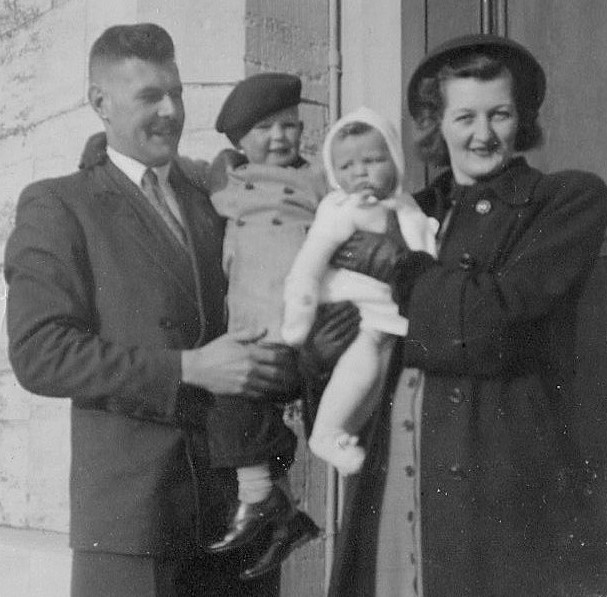
Anita was christened at St. John’s church in Poole the same day this photograph was taken.
Market Street Poole
The Station at Market Street in Poole was the busiest in the then county of Dorset and was quite a challenge for a newly promoted sergeant but I enjoyed it very much. At the rear of the station was a terrace of six three-storey houses, which were quite good and very conveniently placed for us. We stayed there for 3 years and were delighted by our neighbours, all of whom made up a very kind and helpful community. Peggy and Anita, travelling in the ambulance, arrived before our furniture van did. They found that our new neighbours had erected a made up bed in the empty house for Peggy and Anita so that they would be comfortable until we moved our furniture in. The HQ of the RNLI in West Quay Road now occupies the location of the police station.
All kinds of police action was called for in the Market Street Section area covering the old part of Poole, the quayside, Hamworthy, Upton, Oakdale and Broadstone. There were common lodging houses down near the quay where beds were 9 pence or a shilling each and where the smell from the drying wet clothes hung over the large fireplaces gave a penetrating aroma, which lingered in your clothes after you left the place. The quayside was always very active and very boisterous at weekends when the six public houses along there were busy.
The Section was supervised by three Inspectors who had an office at the divisional HQ at Park Gates East, where there was also a Chief Inspector and the Divisional Superintendant. For all practical purposes the section was in the hands of the Duty Sgt. The cells were frequently used to house persons arrested and those awaiting appearance before Magistrates at Park Gates East. On some Saturday mornings it was necessary to call in a JP to the Station in order to deal with drunks, etc. who we did not want to hold over the weekend. One JP was a local baker who would stand inside his shop doorway in the High Street from about 10pm onwards to prevent drunks from using this recessed entrance as a urinal. I recall one Saturday morning when we asked him to come and deal with prisoners; one pleaded not guilty to being drunk and disorderly and the arresting PC gave his evidence, which the drunk denied. The JP said, “What the PC has stated is quite correct, I was stood in my doorway and saw it happen, fined 20 shillings.” What it was to have such a witness.
Whilst on duty with a PC one afternoon we saw a car being driven badly. We stopped it and arrested the driver who we found to be quite inebriated. When he vacated the driving seat, the lady passenger slid across to that seat and turned the ignition on. I took the key out and as she was at that time in a similar state to the man, she was also arrested. At court he was found guilty and fined. She pleaded not guilty to being in charge of the car and her case was dismissed. The prosecution decided to appeal to the Quarter Sessions in her case. She had a Queens Councillor appearing for her, who had the assistance of a barrister beside him. In the final stages of my evidence the QC asked me, “Sergeant, you believe that the Magistrates were wrong to dismiss this case and that you were correct in what you did?” I replied, “Yes Sir, I believe I was correct.” My Superintendant was seated in the court and I wondered what he might say to me. He later said, “Well done Sgt.”
I recall another incident whilst at Market Street. We received a call from the public that there was an unexploded hand grenade in the public area called ‘Baiter’. I was on duty and had just the Station PC. I decided I would cycle to Baiter to see what was there and found it was a rusty Mills hand grenade. At that time we had no personal radios and I could not leave it there without a guard. I put it in my tunic pocket and rode back to the station where I put it in the prisoners’ exercise yard with sand bags around it. The Army Disposal Squad was informed and attended. The officer in charge of it decided that the grenade was so dangerous he would not move it at all and would detonate it where it was. I told him that it would damage the wall but he would not move it and he criticised me for moving it from Baiter. He had the hand grenade exploded and it did some damage to the wall. I reported this occurrence and the wall was repaired.
Promotion to Inspector
After three years I was, to my great surprise, promoted to Inspector and remained in the Poole Division. We moved from our house to another three story one in Longfleet Road. That house has also disappeared now and the site is part of the hospital car park.
As one of three inspectors at Poole I was responsible for the whole division whilst I was on duty. Each of us took our turn in presenting and prosecuting our cases at the Magistrates’ Court twice each week. This was a challenging task but caused me to research much of the law of each case in order to be successful. The most serious cases and those that were committed to Quarter Sessions and Assizes were dealt with by the County Prosecuting Solicitor.
Promotion to Superintendent
In June 1957 I was informed by HQ that I was to be promoted to the rank of Superintendant and moved to take command of the Weymouth Division. At this time there were seven divisions in the force area. The Weymouth Division comprised the area south of the Ridgeway from Osmington to Abbotsbury and of course, having left it just five years previously, was an area I was very familiar with. The first letter of congratulations I received was from the Weymouth Football Club enclosing registration forms for me to sign on again for them. This I declined quite properly believing that to continue to play football would cause me to waste valuable time that I would need to make myself efficient in my new rank. The members of my new division appeared to accept me as their guvn’r and I respected the attitude of the inspectors there who all had more service and experience than I had, but continued to give of their best.
When I was a PC there just 5-6 years previously, I had attended the opening of a new wing of the Hospital, just to keep traffic control and the parking of mayoral and other vehicles. Toward the end of proceedings the Mayor wished to leave but his car was blocked in by a lady Alderman’s vehicle. I tried to move the latter car by releasing the brake but the car was locked. In trying to open the locked car, the handle snapped off in my hand. This accident caused a lot of communication between the Alderman and my Superintendent as to who was to pay for the damage. I am not sure what resulted but in 1957 when I went to my first court in Weymouth I was taken into the JPs’ retiring room to be introduced to them. The lady Alderman was there and she said, “Haven’t we met before?” I replied, “Yes Madam, I am the PC who broke your car handle off.” “Oh” she replied and I let the subject rest there.
My family moved into a very pleasant house in Dorchester Road, Weymouth, just south of the garage at Redlands, and we stayed there for the next two and a half years. In moving the children changed to new schools and this was the greatest drawback of my promotions and our moves around the county, with more to follow. I found the Division to be quite busy and during the first year I was there, some 102 escapes were made from the Verne Prison and the Borstal Establishment at Portland. This caused the road from Portland to be blocked and all vehicles searched, resulting in complaints from residents and with little success. After one such escape, which was unsuccessfully resolved for a few days, I persuaded the Navy and the Army establishments in the area to assist me with searching for personnel in the area above the dockyard where I believed the escapee was hiding. This was unsuccessful also, although later when the escapee was arrested he admitted that he could have touched the trousers of one of the searchers as he passed the bush in which he was hiding.
The Police College at Bramshill
In 1959 I was sent on a Superintendants’ Course at the Police College, located near Coventry. There it was suggested that I should apply for a post on the Directing Staff. This I did and attended a further course for potential directing staff, which was successful. I knew that the college was due to move to Bramshill House in North Hampshire and that married accommodation would be available. I therefore accepted their offer and I commenced my new duties at the college in January 1960. My family moved to Bramshill in June 1960 but here again it meant school changes for Peter and Anita.
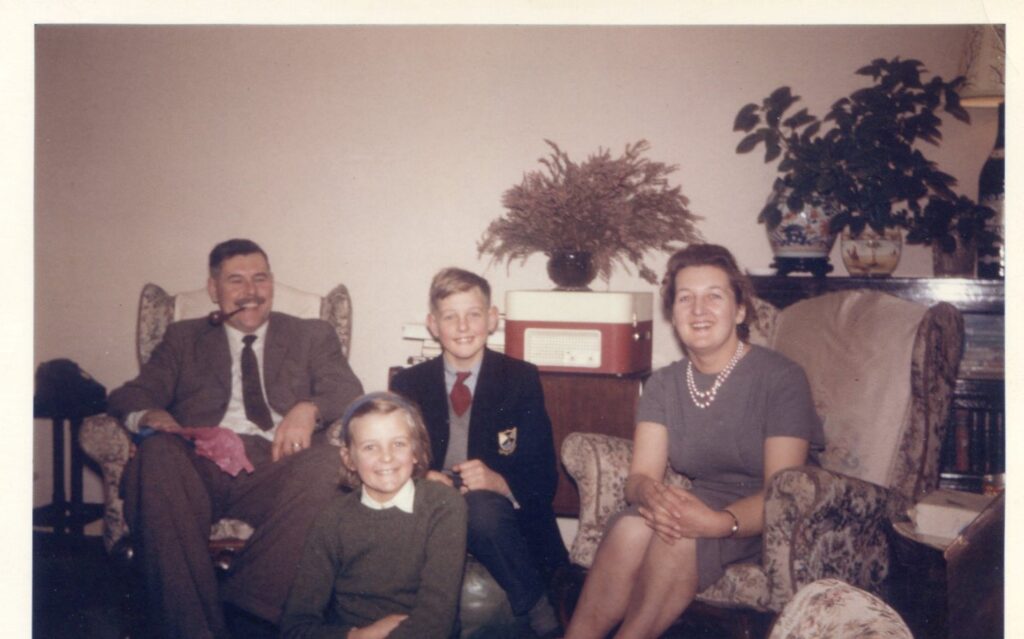
Anita, Peter, Peggy and I in our flat at the Police College, Bramshill, Hampshire.
The college provided courses for sergeants, inspectors and chief inspectors, the latter taking superintendents from colonial forces. I was allocated to the senior course and very much enjoyed the wide variety of subjects covered and the input of the students in my syndicates. Discussions took place on practical police action as well as the law enforcement methods used. Exercises were carried out on major accidents and disasters with visits to possible locations to emphasise the difficulties in using all other services that may be available to assist. We had to report on each student during the courses and we had some difficulty in convincing many of the native colonial officers that we could not accept gifts from anyone, but we appreciated that in many of their own countries that was the manner in which success was obtained.
The Senior course at Bramshill, I’m 8th from left in the front row.
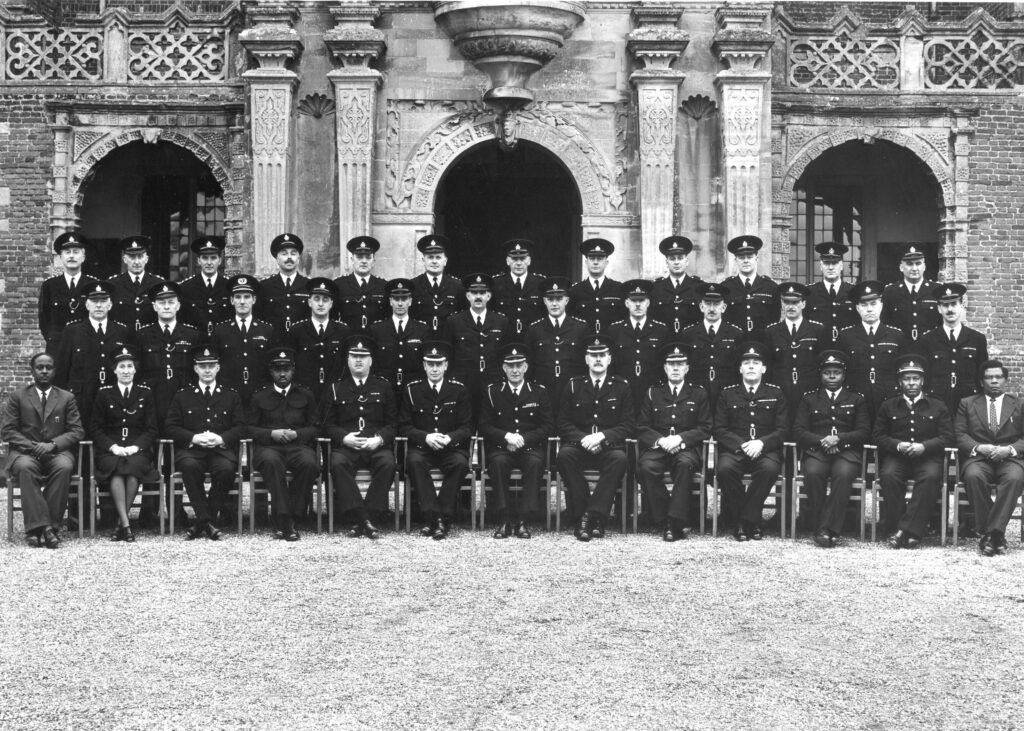
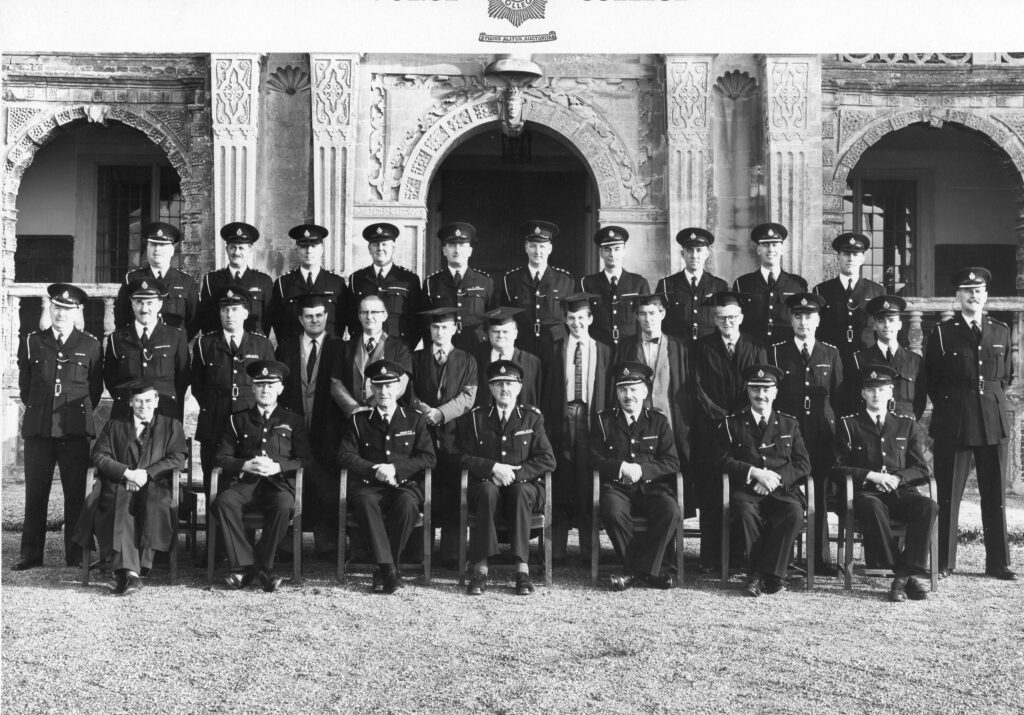
The directing staff at the police college, Bramshill. Cmmdt. Mj. Gen N. Jelfe. Police staff are in uniform. Those wearing mortar boards are all university graduates and formed the Liberal studies department. I had one other duty as I/C drill sergeant and I’m at the far right, after ensuring all others were correctly located for the photo.
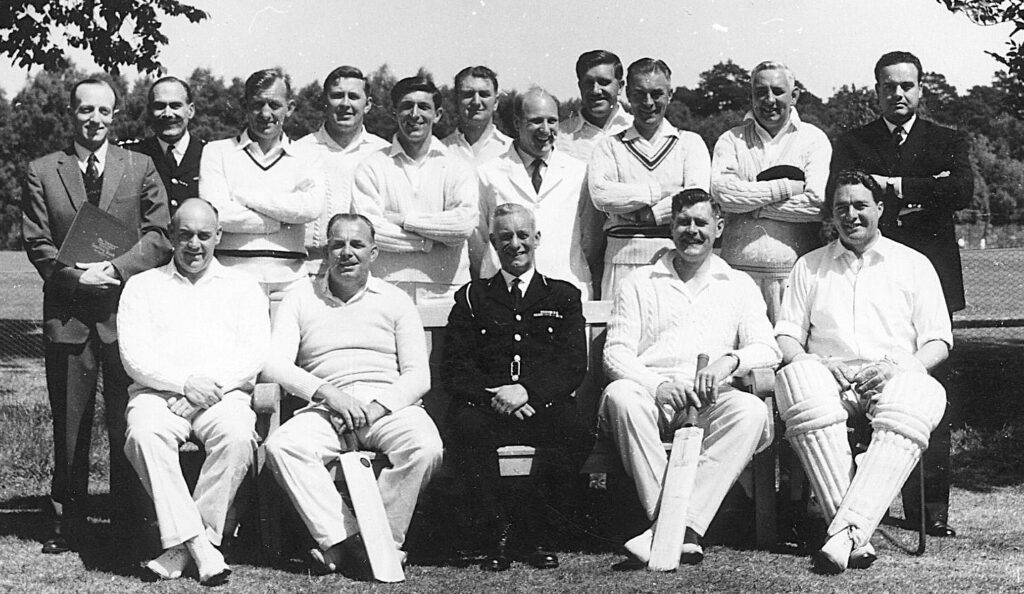
Second from right, front row, as part of the College cricket team at Bramshill.
There was opportunity to take part in some sport and I played cricket during the summer. I played in a match against the Warwickshire Constabulary at their HQ to find that Ray Hunt, who had flown with me during the war, was playing in the opposition and in fact lived at the HQ. We met several times during my time at the College. I was able to get home on many weekends when not on duty and in November 1960 my course was moved to Bramshill House where I was with my family again. Our flat was overlooking a large lake but with just two bedrooms, was not really suitable for all of us. We eventually occupied a three bedroomed house and life became much better. We had a ‘guest night’ each week when two students carried out the president and vice president of the mess duties. These were very formal affairs and we had guests from other service colleges and the Home Office, as well as Chief Constables from our own forces. The ‘Loyal Toast’ after the meal was given by the president calling to his vice president at the far end of the very large dining room, “Mr Vice, the Queen”. On one memorable occasion the president said, “Mr Queen, the Vice”. There were many chuckles around the room but everyone felt sorry for the young sergeant who was president that evening. He was not criticised.
It was the practice for directing staff not in married accommodation to be invited to the married officers’ houses to round the evening off after the dinner and the following entertainment. These were very pleasant occasions. We had one DS in the Liberal Studies Dept. who, being a Scot, celebrated ‘Burns Night’ with a party in his room in the old house. They were memorable nights too. The Liberal Studies Dept. consisted of ten or so graduates who had wide experience of teaching, of armed forces life and ways of widening the knowledge of students in literature. Some of the Police Directing Staff also gained from being with these learned men.
Bramshill House is a magnificent building with parts of it dating between 1351 & 1360, with later additions by successive owners between 1606 & 1625, when the Jacobean house took 20 years to be built. Additions have been made over the intervening centuries.
The main drive to it is from the west, through an arch with a house on either side, down about a quarter of a mile to a small bridge over a river and then climbing again for another quarter mile to the house on a higher level. Another drive heads north and a third leads east to Eversley through a wood of high trees. There was a village school at Eversley which Anita attended and where the headmistress was very keen to give the children a wide knowledge of many subjects but apparently did little to gain them high marks in competitive examinations. Peter attended preparatory school, St Neots, accessed from the north drive. He enjoyed the 2½ years there but this was insufficient for his education to advance.
There was a large lake of about ten acres in the grounds with a small island in the centre and a very pleasant path around it. It contained a variety of fish, which included some large pike. I recall being very worried when our Labrador dog Tess jumped into the lake and we could not get her out until half an hour had passed. There were a number of peacocks in the grounds whose screeches kept some people awake during the night. The Home Office built large accommodation blocks for students and a block of nine flats for married staff. These flats had just two bedrooms each which were insufficient for our family but after a while, when a house became available, we were much better off.
Christmastide 1962 brought heavy snow to the south of England and Bramshill was covered in about 6 inches of it. Just after Christmas, Leonard Clark of the Liberal Studies Dept. was in the college library and hearing knocking at the main door of the house, went to it where he found a student from West Africa who was due to commence a course on 3rd January. He stated that he had arrived at Heathrow and hired a taxi, which dropped him off at the top of the main drive a mile away. When he was asked about his luggage he explained that it was at the bridge halfway down the drive. Leonard went to the bridge with the student where he found a large attaché case with a glove frozen to the handle. The student said that he had never seen snow before.
Back Home to Dorset Again
Because of the snow, many roads in Dorset were not passable and this prevented Superintendent Roy Trickey from moving to Bridport to allow us to occupy the house in Dorchester, which he was vacating. We left Bramshill on 6th January 1963. On reporting back to Dorset Constabulary HQ, I was placed in charge of the traffic Division, with responsibility for Road Traffic Personnel and the state of all vehicles in the force. I was also to oversee all reports of traffic accidents to ensure that correct action as to prosecution, etc. was being taken. I was also to see that our radio communication masts at Bulbarrow and Eggardon Hills were in order. I was unable to visit either of these sites until March, even with a 4-wheel drive vehicle.
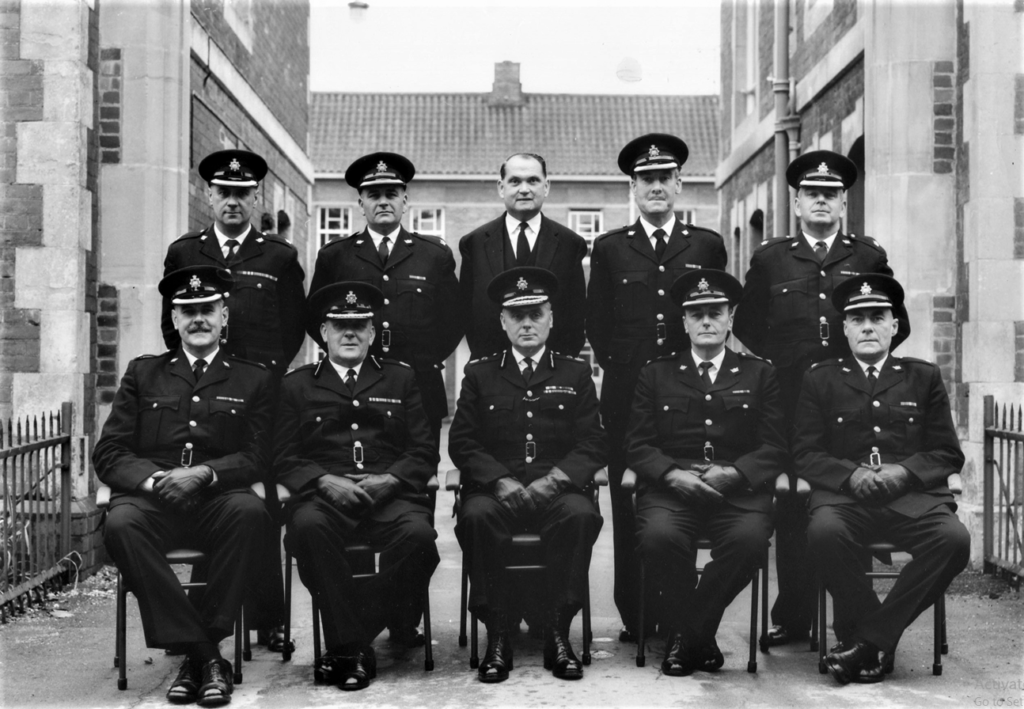
The Chief Constable, Deputy. and Superintendents at gate to HQ. Dorchester. Back row (left to right): Supt. C. Parson, Supt. W. Baigent, Det. Supt. B. Smith, Supt. E.Rushen, Supt. R. Trickey. Front row (left to right): Supt. V.T. Davis, H. Lovell, Ast. C.C., The Chief Constable A Hambleton, C.B.E., M.C., D.L., Chief Supt. J. Grey, Supt. C. Rushen.
I found that I had six officers named SMITH in my division and as I had been absent at the college for three years, many personnel were strangers to me. My secretary produced a pocket book for me in which were the names and all the details of all personnel. This enabled me to consult the book whenever I was to meet any of them and gave me the opportunity to discuss with them their past, present and future situation.
Promotion to Chief Superintendent & Temp A.C.C
At this time there was but one Chief Superintendent in the Dorset Constabulary and he retired in 1963. I was promoted to that rank and given command of the Poole division. We had been at Dorchester for ten months and away we went again to Poole to reside in a two floor flat above the Central Police Station. Here we overlooked Poole Park and a delightful location. Peter attended a grammar school at Bournemouth and Anita went to a school nearby at Lower Parkstone. The division was still the busiest in the Constabulary but having my office in the same building as my home enabled me to clear a heavily laden desk whenever convenient and be in charge of an area which I knew very well.
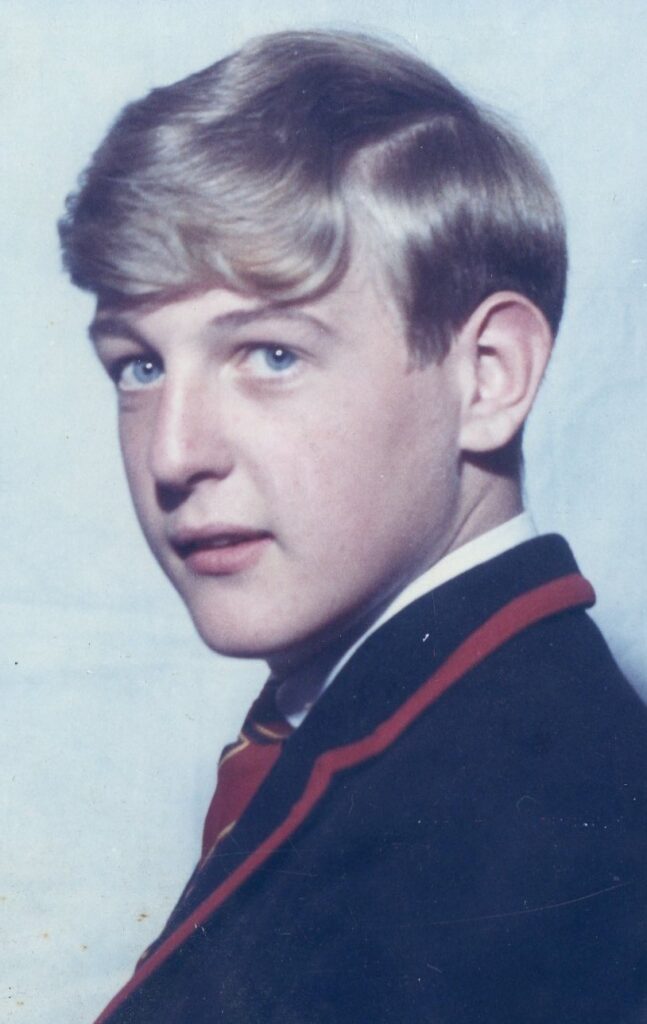
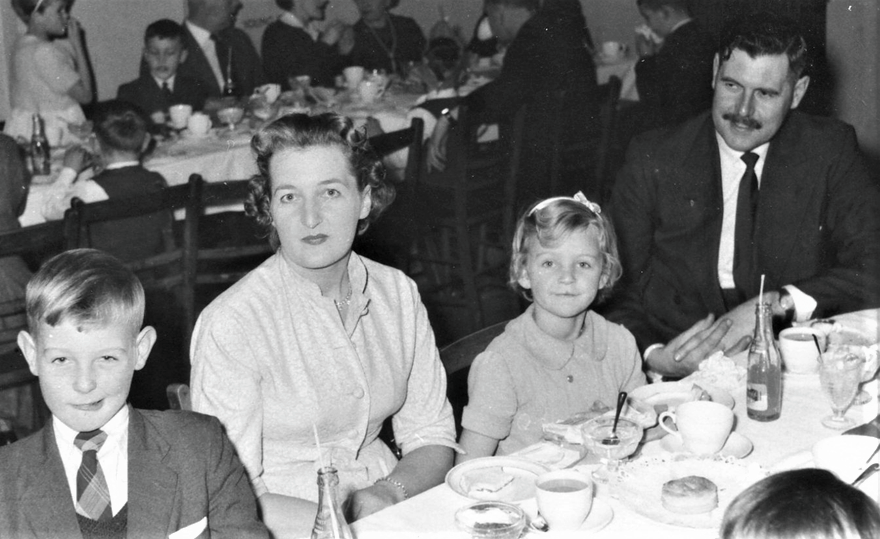
(Left), Peter in uniform of Ringwood Grammar School, Bournemouth & (right), Children’s Christmas Party at Weymouth, Peter, Peggy, Anita and I.
During this posting to Poole from 1963 to 1966, our Chief Constable took up an appointment for ten months at the Police College in charge of a Senior Staff Course for Superintendents and Ch. Supers., preparing them for the rank of Asst. and Deputy Chief Constable. The then Asst. C.C. of Dorset took over the command of the Constabulary and I had a temporary posting as Asst. C.C. while the C.C. was away. This was another challenge for me and another move for Peggy and the children to Dorchester for ten months but we were in familiar surroundings.
When the C.C. returned we commenced the amalgamation of the Constabulary with the Bournemouth Borough Police. I took command of the county division of the Constabulary with my office at Weymouth. The C. Supt. at Poole took charge of the Bournemouth division and a C. Supt. from Bournemouth took command of Poole. My division was the whole of Dorset except Poole and Wimborne, and of course stretched from Portland Bill to Gillingham, and from Swanage to Lyme Regis.
The family moved from Dorchester to Weymouth again and there we stayed until I resigned from the police in 1973. In 1972 I applied to purchase my own home and this was granted. From the local paper I found a bungalow at Bradford Peverell for sale. I happened to be in uniform that day but I immediately drove to Frome View and after looking over the bungalow, agreed with its owner to purchase it at his asking price of £7,000. For three months I spent all my spare time in raising it to our standards. We moved into our own home, our first and last, in late 1972.
The population of Bradford Peverell accepted into their midst a senior police officer and very soon we were joining in the various facets of life operating in the village and of course found that we became appointed to their committees. In fact we thought originally that we had been very lucky to find ourselves in such a happy community and this still applies.
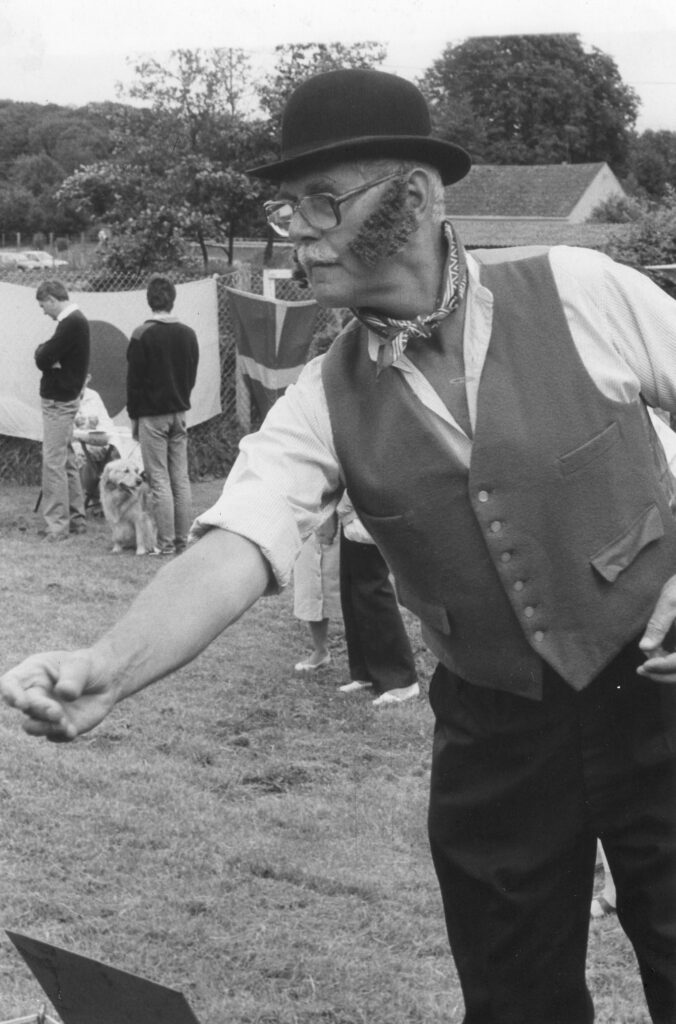
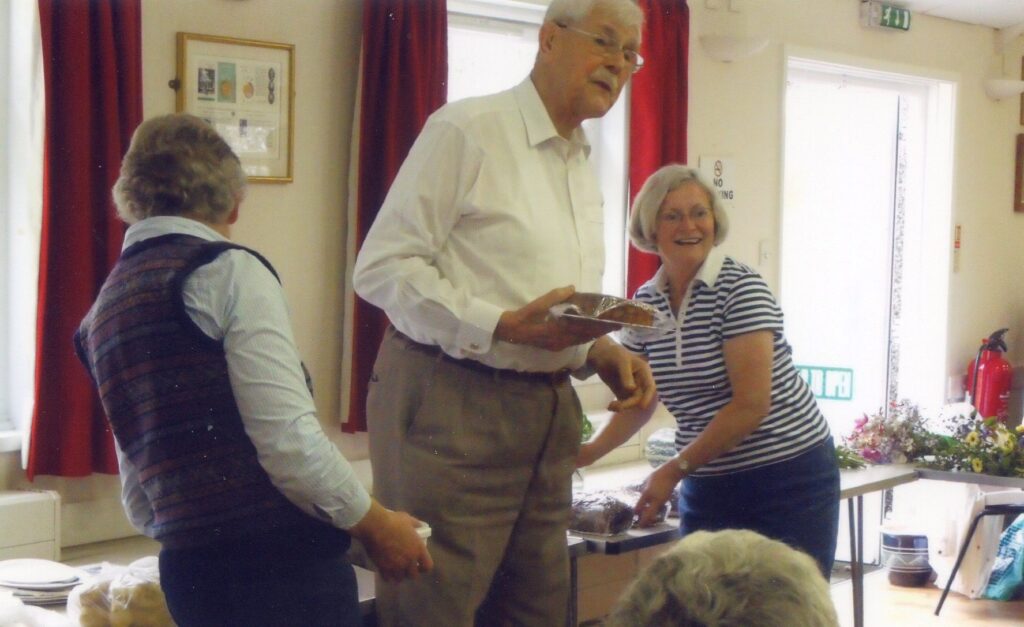
(Left), As ‘yokel’ at summer fete, Bradford Peverell & (right) As auctioneer at produce show at Bradford Peverell. Sue Brown is handing me items for sale.
Resignation and working at Pontin’s
After my resignation from the Constabulary, I needed some employment to satisfy my energy and interest. I applied to Pontins Ltd. for a post in the security side and was appointed by Mr Fred Pontin to oversee two of his 30 sites in the UK. A short while later when a senior security officer retired, he asked me to oversee the whole company from a Security, Health & Safety and Fire Precautions aspect. This I accepted. I needed to visit the Holiday centres to assess the needs in each sphere of my responsibility. One day I was travelling to East Sussex and at Arundel I saw a police constable in the roadway talking to a traffic warden standing on the pavement. I stopped behind the PC and asked him to direct me along the road to Rye. Without turning around he said, “Yes Mr Davis, take the first exit from the roundabout, go up the hill and turn left on the main road.” I said, “How did you know my name?” He said, “I was a constable in your division at Weymouth before I transferred to Sussex.” I then saw he was a PC White who was in fact a native of Portland. I wished him well in his new force and thought, yet another instance of the small world in which we live.
Pontin’s Holiday centres stretched from Devon to the Lake District and from Somerset to East Anglia, plus a laundry at Newton Abbot. I visited them all within a few weeks to introduce myself to the management of each and meet the senior security staff who were designated as Crime Prevention Officers and other locally appointed security personnel. Eventually I found that my coverage of these 30 sites entailed travelling over 20,000 miles per year by car, for which I was paid a mileage allowance. Occasionally I went by air from Bournemouth Airport to the north of England and on one occasion I was returning south to Bournemouth, seated next to an Australian traveller. Over Bournemouth I pointed out the airport to him and he exclaimed, “Just like the Outback”. This amused me no end and I am pleased to say that now it looks a little more civilised.
It will be appreciated that in an industry open for business in the summer months only, the staff who could be obtained was of a variety of standards. The three parts of my responsibility were Security, Health & Safety at Work, and Fire Prevention & Precautions. Security was a problem especially in departments where cash was being handled and there was always a temptation to divert some of it to other personal uses. Checking and emptying of tills and machines needed to be organised and supervised, with the cash being accounted for and placed in secure locations. Systems were needed to limit losses and observe procedures to eliminate the temptations. Cash was, in the main, dealt with by building strong rooms in admin offices with facility to place cash in them after the offices were closed. Preparation and payment of wages were another area where large amounts of cash were being handled and distributed.
Bars, cafes, restaurants and amusement arcades were especially vulnerable and in the three first mentioned, drinks and food could easily be given or taken away if supervision was lax. The storage of cash, drinks and food was also a necessity. The reception of food and drink into storage was also vulnerable. I recall one occasion where a salesman obliged the bars manager with a crate of whiskey with every dozen crates he ordered. When I reported this to F.W.Pontin, he immediately telephoned the MD of the suppliers and cancelled ALL deliveries of their drink to every Pontin’s site. Quite a blow!
Health & Safety at Work was a new subject under a new Act of Parliament and intruded on almost every aspect of work. Much of it was good common sense but I felt that we needed some professional instruction and one of my Crime prevention Officers, an ex Det Insp, and I took a course in London which lasted 6 weeks, two days per week. Having qualified we became members of the International association of Risk Managers although it was not recognised. I recall one evening when we were staying overnight ‘in town’, we decided that we ought to have a look at the Post Office Tower. We dined up there, circling around in the restaurant, and it was a most delightful experience but not one for which we could claim expenses! To pass on our knowledge to other CPO’s and site security personnel, I arranged an annual course at the site in Devon where everyone attending could be brought up to date on this subject and of course others for which we were responsible.
I visited the Laundry in Devon and found a man who had climbed a ladder on to a roof where he was repairing broken tiles. He had nothing to secure him and I said to him, ‘Some months ago a chap was doing just what you are doing and he fell and fractured his leg. He was off sick for 3 months.” He relied, “Yes I know. It was me”!! I was lost for words and thought how do you teach health and safety?
At all holiday centres there was a swimming pool and at larger ones, the pool was bigger and required larger equipment for purity of water as well as frequent checks to maintain high standards. At one centre there was a manhole some 20 feet deep into which a man went every day to check that the drainage system was not clogged up in any way. He did this check alone at 6 am and descended into the manhole. This was a dangerous situation should he be overcome by fumes, etc. It was therefore necessary to ensure he had a personal safety harness, with a tripod, pulleys and ropes to haul him out if required, available and of course a second person at the tripod to summon help and/or to raise the man below. I had to overcome the resistance to the provision of this system because ‘it has always been done without any accident before’.
Hygiene in food handling was, and still is, essential especially when dealing with large quantities and/or catering for large numbers. Supervision by chefs is essential to maintain standards and prevent problems. One instance caused by defrosting chickens on a steel table and then using the table to lay out salads without thoroughly cleaning it caused a centre to close for 6 weeks and the fumigating of all guest accommodation. This resulted in a great loss to the company in guests’ health and opinion of the quality of the centre and of course, finance.
Fire Prevention and Precautions were very important, not only to preserve the facilities of a centre but to ensure escape from a fire situation was possible in very quick time, through well-signed routes and without obstruction. The Fire Brigade’s example family consisted of a man, his wife, two children and two elderly parents of the man, required to get out within 2½ minutes. It was not always easy to ensure that tables and chairs were not moved into exits, especially when popular entertainers were performing before several hundreds of guests. Fire appliances needed to be located in strictly appointed places and not to be moved to become doorstops to improve air circulation. Fire Officers would regularly inspect centres knowing the problems that could be found with guests changing each week and some staff not ensuring fire precautions were practiced.
From time to time odd instances of fire would occur. I recall that one fish and chip shop had a fire after it had been closed for a couple of hours; the cause was the overheating of the bits of hot fish or chips which had been cleared from the boiling fat and were thrown into a small area above the boiling fat. This caused spontaneous combustion but had not been known to the staff operating the shop. Other centres where this facility was established were notified of this danger.
One morning I was driving north to Lancashire at 5.30 am when the car radio informed me that there was a large fire at one of our centres in that area and it was growing in intensity. I changed to the outside lane of the motorway and hurried to the scene. I found that the fire was in a large disused and open building, which was used to store unwanted furniture, which should have been removed off site. Fortunately the fire was confined to that building and no injuries were caused.
Overseas Holiday Centres
The fifteen holiday destinations located oversees, catering for British persons, had similar problems to those present in the UK. Although pretty well all the senior management spoke English well, some of the junior staff did not always understand the advice they were given and others would say that such requirements were not necessary in their country.
At Torremolinos, in southern Spain, there were two eight-storey hotels beside each other and they were managed as one unit. They were popular with guests and the facilities were very good. However there occurred one late evening the most serious crime I experienced in any of our locations, when two young ladies were walking along the esplanade towards their hotel and were accosted by two young men on a motorcycle who grabbed their handbags. The young ladies resisted but lost their handbags and both were injured in the incident, one fatally and the other seriously. They were taken to the hospital in Malaga and I immediately went to Torremolinos to give any assistance to management and police that I could. The relatives were of course notified and flew out to Spain, where I took one lot to identify the body of their daughter and the other to see their daughter in hospital. I found that the standards in both places left a lot to be desired but the hotel management did their very best to reduce the terrible shock they were having. This type of crime was frequent in that period and I was never informed that this serious matter was detected.
To the east of Torremolinos at Estapona we had another holiday centre, right on the edge of the beach. It consisted of terraces of accommodation with central facilities nearby. On one occasion I had my wife Peggy with me and we were invited to this site to assist in entertaining the representatives of a large organisation, which was considering a location for some two hundred holidaymakers. The management put on a lavish spread and the chef even made three ice sculptures to adorn the dining table. We thought we had done well and our visitors invited us to their hotel at Mijas the following day. I hired a car and Peggy and I drove eight miles up into the hills to their hotel. We were well looked after and faced a 4-course meal but unfortunately the first course was a fried egg, which I ate. Later before the meal was over I felt quite ill and sat on the terrace in the cool to let it wear off. It didn’t so I had to drive back to our accommodation at Torremolinos. Mijas is a quaint hill town where many of the taxis are donkeys.
We had three sites on the Balearic Islands to the east of Spain. On Majorca, one was on the northeast and consisted of a series of chalets with the central buildings close by. The manager there was Spanish and very experienced in the business. The central facilities, bars, etc. remained open until the small hours and supervision extended over long hours each day. Beside it and poised on the cliff top was a small hotel of about 20 rooms which provided a better class of accommodation. That is where I slept on my visits. On the east coast, located on a delightful bay, was another site, which was much smaller than the one above, but had a splendid atmosphere, the small bay being almost private for the holidaymakers. On Ibiza there was the third site in this group and it catered mainly for the younger holidaymaker, although on one of my visits I found a sizeable group of the ‘Ladies of Health & Beauty’ from the UK enjoying themselves very much.
On the island of Sardinia we had a hotel close to a lovely beach and surrounded by countryside, which was well looked after, as was the town of Sassari a few miles away. Peggy and I visited this island on one of our trips abroad and enjoyed it. On the Italian mainland, near Naples, there was another hotel site, which attracted customers from many countries. On one of my visits Peggy was with me and from Naples we were to return to the UK via Rome Airport. The manager of the hotel was a Belgian who decided he would take us to the airport over 100 miles away. He was late leaving and drove like h… all the way. We were relieved to arrive safely at Rome Airport.
In Greece we had a hotel on the island of Evvoia, which is 100 miles long and located just north east of the mainland. The water supply was obtained from a well 60 feet down by a main pipe, which was not very deeply buried. A number of houses had been built on the hill and it appeared that many of them tapped into our water main for their supply. I went there with our engineering executive and we were very surprised to find the very poor security around the well and the primitive pump and electric supply to it. We engaged a small firm of local engineers(??) who shocked us by merely putting a plank across the top of the well and sitting on it to effect the repairs they thought necessary. We acquainted the hotel management of the problem and advised them to take steps to alleviate it.
There was a taxi driver who was frequently at the hotel reception touting for custom and he persuaded us that he would take us for a good fish meal one evening. Off we went along the coast to a small cafe where after being introduced to the owner we were invited to visit the kitchen and select the fish we fancied from large drawers filled with ice and fish. None of it tickled our fancy so we were driven a few miles to another cafe. There the same introductions were made and we were able to select a number of small fish between four and six inches long, which appeared to be sardines. When they were cooked the owner demonstrated how they were eaten. He placed the fish across his mouth with its head outside his lips one side and tail the other side. Then putting his tongue out he drew the fish, head and all, into his mouth and ate it. I sliced and boned my fish and shunned his method.
On another occasion I took Peggy on a holiday to Greece and we stayed in the hotel mentioned above. We found the Greek people most hospitable and enjoyed their company many times. We went for a walk up in the hills away above the hotel and there found a little cafe with three shepherds sat outside. We talked to them as best we could and as I was smoking a pipe I offered my tobacco pouch to them. They took it and filled their pipes. The owner came to serve us and we had coffee, and then he opened a new packet of biscuits and insisted that we have as many as we wished. On another day we entered a shop opposite the hotel to buy a few things to take home. We bought a few ceramic coasters (I still have them) and again out came my pipe and pouch. The owner said he didn’t smoke but I persuaded him to try my ‘Gold Block’ tobacco in one of the new pipes he had for sale. He smoked it for a while and appeared to like it. He then disappeared and returned with a tray of glasses of homemade cherry brandy, which he insisted we try. It was very good too.
On that same holiday we learned that some six miles away the public from far and wide would be celebrating Easter in a church on the Sunday evening. This was two weeks before our Easter so we decided to go. The taxi driver took us and we found that about ten thousand others had assembled around the church, which was already full. When the service started no more could enter, but afterwards people swarmed inside, each with a candle, which they placed lighted on an altar near the door. I managed to get inside and it was a very impressive church. On the main road we expected to walk back to the hotel but luckily our taxi came along, already with a man in it, who insisted that we travel with him back to our hotel.
We had one site in Morocco near Tetouan, just across the entrance to the Mediterranean at Gibraltar. The snag from my point of view was that our guests from the UK flew out on a Saturday and returned the next Saturday. As it was my practice to travel on the aircraft that the company had hired for their guests, I had to stay a week in Morocco whenever I went. My strongest memory of the place was when I entered the cold storage room adjacent to the kitchens and was amazed to see a swordfish laying there with its head on the floor and its sword high up the opposite wall almost touching the ceiling. Until then I hadn’t thought that swordfishes could be that size. Because I had to stay a week at the site, I took my swimming trunks with me and the sea was always delightfully warm.
We had facilities to send guests to the Canary Isles, where on Tenerife there was a very nice holiday centre named ‘Ten Bel’, owned by a company from Tenerife and Belgium, hence the name. It was a large centre, quite near the sea and a fishing village, and with the then new Airport on the south of the island just a few miles away. The centre had been built in phases; first with basic amenities of chalets, dining room, dance hall and swimming pool; second with better accommodation and facilities; third even better with silver service in the dining room and fourth, a number of bungalows with two bedrooms and where you had the self-catering facility of kitchens, etc. Pontins did not own any of these units but had the ability to place their guests in the second of them. There, wine was always served in the dining room, and two bottles were placed on each table of 8 persons. Tables were filled as you entered the room so that you always sat with different guests.
On two occasions I took Peggy to Tenerife, once with Anita, and she enjoyed it very much spending a lot of time in the pool and shopping in the small group of shops nearby. One was a cafe/bar where the proprietor had a large organ installed. We were such frequent visitors that whenever he saw us approaching he would loudly play ‘rule Britannia’ to welcome us. In another season Joan and Bert came with Peggy and me, and again we all enjoyed the weather and the facilities available. Peggy and Joan were like a couple of mermaids in the pool and Bert thought the wine placed on the dining tables was ‘paint stripper’ but I preferred it to the water; when you emptied a bottle you just laid it on its side and a waiter would bring a replacement.
In her introduction to this autobiography, Naomi asks that I describe myself under a number of headings. This could be embarrassing OR it could be a glorious opportunity to ‘Shoot a line’, but you may say that is what I have been doing on the previous pages. Nevertheless here goes . . . .
Me
Like my father I am tall, well built and generally in good health. I am soft by nature also and enjoy being generous rather than being stingy. Somewhere it is said that ‘It is better to give than to receive’. I certainly get fun and pleasure from giving although I have never had a bottomless pit of goods, cash or time to do this without some thought. Here again this trend is hereditary as I would always get a half-crown (12 1/2p) from my Dad if I asked him for a shilling (5p).
I have always been interested in people and never thought it a waste of time to sit and watch the world go by and try and guess what those passing were by occupation or interest. This stood me in good stead as a policeman where a quick decision of a person you were about to approach was necessary in order that the initial question was pitched at the right level. I recall one instance when I was way out. I stopped a highly polished Rolls Royce and my first question was set at Rolls Royce owners’ level, only to find that the driver was a scrap dealer who very much called a spade a spade, or a ?????? shovel.
My height was of great assistance as a policeman and I used it to break down the gap between police and public as much as I could. As a constable at Weymouth after the War, there was a duty on a pedestrian crossing where holidaymakers heading to the beach would cross in great numbers. I would stand in the centre of the crossing and pedestrians would pass under my outstretched arms when I stopped the traffic for them. When I saw a ‘Kiss me quick’ hat with elastic under the chin, I would lift it up and let it go again, causing the person wearing it to turn round and blame the person behind them for the intrusion. Those behind often could see what had taken place and would enter into the fun of the situation whilst I kept a very straight face.
There was a song entitled ‘A Policeman’s lot is not a happy one’. This is because police are so often dealing with serious and very distressing matters where being happy is quite out of the question. I mean violent and fatal occurrences where the relatives have to be told and be given every assistance to deal with the circumstances. I found that to offset this aspect of duties it was the habit to promote humour within the force members and all constables were subject to this fun.
When at Weymouth for three years I played football for the reserves of the local town side and it was often necessary for me to change my duty to enable me to do so. The most convenient tours of duty were early turn 0600 to 1400 or night duty 2200 to 0600. We lived at Radipole at this time and two miles from the football ground. I had to leave sharp on 1400 hrs to cycle home, change into civvies, have a quick lunch, pick up my kit and cycle back to the ground for 1500 hrs kick off. On one occasion I wheeled my cycle out of the guildhall, got on it and pedalled forward to be suddenly stopped with a jerk. I found that a line had been attached to the rear carrier of my bike. I untied it and followed it back to the yard behind the Guildhall to find that it was tied to a mooring weight. Back at my bike I looked along the street to see two of my mates sat on their cycles laughing at me. I wasn’t able to catch them but they paid later that following week.
You will appreciate from the previous incident that one had to be able to receive leg-pulls as well as give them and I was able, and still am able, to accept humour about me and what I do.
Fortunately throughout my life I have been lucky, lucky in having wonderful parents, lucky in my early years as a choir boy and boy scout, lucky in joining the Dorset Constabulary, lucky in volunteering for flying duties in the RAF, and extremely lucky in obtaining my pilot’s wings and receiving a commission. The luckiest thing of all though was finding Peggy Read and marrying her on 27th December 1943. My luck continued in that having volunteered to be seconded to the Glider Pilot Regiment, I was on a course for Flight Commanders at Oxford University when the regiment took part in ‘Operation Varsity’ across the River Rhine into Germany. At the time I was annoyed in having trained in so many skills of war that I was denied the opportunity of fighting the enemy. The GP Regt. lost over 100 pilots killed that day; over 60 of them were RAF volunteers like myself, so that again luck was with me.
Earliest Memories
Earliest Memories is the first of Naomi’s list of suggested headings for my life story. I was about 18 months old when Dad was moved from Weymouth to Dorchester so I have very few memories of what occurred there until we went to Swanage when I was 5 years of age. Two things seem to come back to my mind however; one was that I used to be taken to a Catholic Kindergarten in Cornwall Road, Dorchester. Why Catholic I do not know but there I learned the numbers one to five in French and that is all the French I know even today. The other was being in the market when a very large boar escaped from its pen and ran amok around the market area. My mother quickly took me out through the gate to Weymouth Avenue and from that safe point we watched the boar being recovered.
School
At Swanage I started school in earnest at the Infants of the Council School and there I stayed through the senior school until I was 14 years old. It was a good school, with very good teachers at all stages except one but more about him later. I enjoyed learning and always reached the top quarter in the end of term examinations. I did not however excel at the 13 plus exam, I think because I was too interested in sport and when those who were successful and entered the Grammar School, I found that I was near the top of the class every time. I was captain of the school football team until I wanted to change the selected team of the headmaster and he banned me from playing in the team for 3 months. I took his punishment and I learned that one should always engage brain before opening mouth. I was good enough to play in the district representative side and this was an achievement.
Attitude of Parents & Older Persons
I have already written of the wonderful influence my parents had on my life. Other persons also had influence and I took from them what I thought was admirable and ignored that which I found to be useless. A teacher at school used to detain the whole class beyond the playtime with the result that the Horlicks Malted Milk delivered to the class was cold before we were allowed to drink it. This was annoying and I stood up and told him so and that we paid for the milk to be hot. He attempted to place my head under the cold water tap in the cloakroom but I resisted and told my Dad when I got home of the incident. Dad went to the school that afternoon and gave the teacher some advice as to what would happen should he mishandle his son again. It worked.
With a friend, I was playing football in a farmer’s field next to my friend’s house. This was forbidden by the farmer and after some time we saw the helmet of a policeman over the gate. We both jumped over the wall and into my friend’s house. The ball was between the gate and us and we left it there. When I got back I was punished by my father and then given the ball back, which he had bought for me a week before.
Being a Choir Boy & a Boy Scout
I was both when at Swanage and the scout troop was attached to the church and met in the church hall. In 1935 King George VI celebrated his silver Jubilee and throughout the kingdom beacons were lit on all the high points. On Ballard Down a very large beacon was built up and as vandals were lighting some before the date, they had to be guarded. Our scout troop took this job on and with a Rover Scout in charge, we slept beside the beacon every night for about ten days. No vandals appeared!
I was a patrol leader of the ‘raven patrol’, I think mainly because I was taller than the others. I enjoyed being a member of the church choir but our school headmaster sang tenor in that choir which rather restricted our behaviour. One thing we had fun doing was to collect the berries from the bushes in the churchyard and by running your finger nail around them halfway up you could squirt the berry across the aisle at the boys opposite; we had to choose our moment though. Our choirmaster was a very good organist and choirmaster and we enjoyed being part of his choir. One thing, which was so enjoyable, was being paid each quarter for attending, and the choirmaster placed a number of games in our vestry to amuse us when we were waiting. When Dad ended his police career and we moved to Langton Matravers, I ceased to be a choirboy. The Rector at the village never approached my parents or me and I think he was unhappy to have a pub licensee in the church set up.
Being a Teenager
I have already written of my work after leaving school at 14 years of age and I was 12 when Dad took over the ‘Kings Arms’ public house. I spent much of my time as I grew up helping mum and dad in the pub, a lot of it was marking the dartboard scores for the customers playing. This helped my mental arithmetic if nothing else and I find even today that I still reckon numbers from one to twenty and their doubles and trebles in my head, thinking of where they occur on the dartboard.
I had many friends in Swanage and spent some hours there especially during the summer when the weather was suitable. North of Swanage there was and still is a number of wooden bungalows which, having been army quarters during the First World War, had been modernised and improved and their residents were quite wealthy. One was a retired Naval Commander named Withers. His daughter was the film actress Googie Withers and each summer she would spend a few weeks with her parents, bringing a few of her starlit friends with her. They were very attractive young ladies as you can imagine but far and away out of the reach of the local lads, especially when some of us were earning just 7/6 or 10/- a week. My particular friend Harry Solomon was the errand boy at the small grocery in the bungalow estate and his tales of the glamorous visitors amused us all.
In the village I played football for the team, which had friendly matches only. I was then recruited to the Studland Football Club where at 16 years old I was the regular goalkeeper playing in the Dorset Minor League. This consisted of village teams and was a very competitive league; on away matches one had to be careful and quick. At one village I recall youngsters would stand behind my goal and throw clods of turf at me to distract me when their team was approaching. At another you were always relieved if you could get away from the match with no injuries. At Studland we played in a field at the Manor Farm, with no dressing room or any facilities available, and one hoped that there was no rain to dampen our clothes bundled up under the hedge.
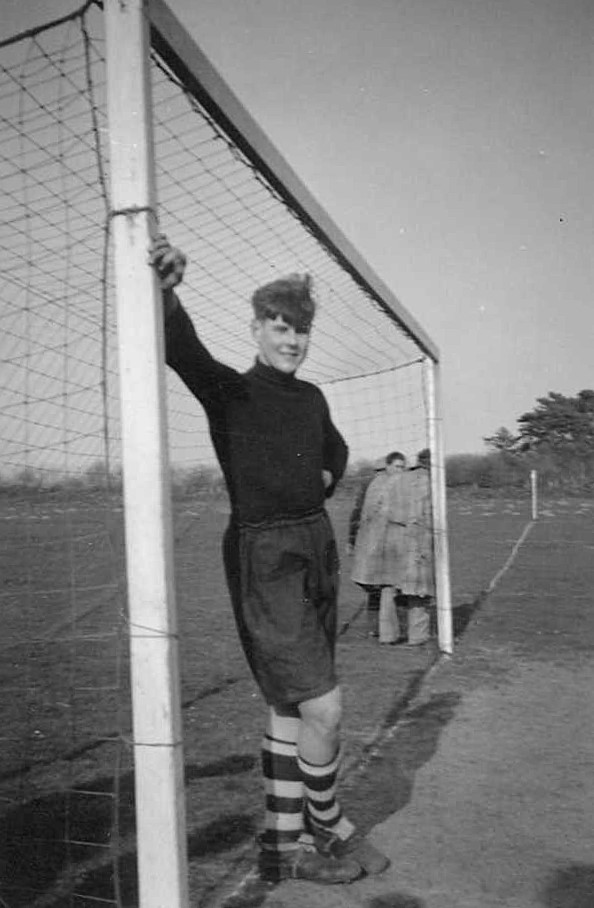
As a 16 year old goalkeeper for Minor League Studland F.C. in Dorset.
Becoming a Father
Continuing the Human Race is why we are all on this earth and when one marries it takes on a special significance so Peggy and I understood what an important period in our life lay before us. I have already written that in spite of having a difficult time early in 1946, Peggy was firm in her wish to have children. In October 1949 Peter was born at the Portwey Hospital in Weymouth. He was again a large baby at 12 1/2 lbs and spent his first ten days in an oxygen tent alone in a small ward. At home we had to get used to being awakened at night when he cried and all the other chores of parenthood came our way. We were so proud of him and the pram we obtained for him was quite special.
After a while when we moved to Perth street, Weymouth, he enjoyed riding on his little bike in the garden and the Christmas parties which we attended.
Anita was also born at Portwey Hospital and almost as soon as she arrived home with Peggy, we were off to Poole. Our children enjoyed their homes and life in Poole, and of course as you will know, we returned there again later. At their schools both Peter and Anita suffered from having attended such a variety where they found they were often being taught lessons which they had already covered elsewhere or were taking subjects which they had no knowledge of.
When we eventually back at Weymouth, Peter was attending a technical college at Poole and Anita commenced work in the town library; she enjoyed this work and took great interest in it, which she has retained even until today. Peter was not happy with his college course and did not find suitable work until he decided he would like to join the police. He was happy to join any force but the one I was serving in and I appreciated his feelings. He was accepted into the Devon Constabulary to be trained at Chantmarle and then to be posted to Barnstaple and later to nearby Bideford. He was an active member of the force life saving team who performed duties on some of the beaches in that part of Devon. Later when he was stationed at Exmouth and on night duty, he swam out to save the life of a lady who was in difficulties at the mouth of the river Exe where tide met the river and sea was not all calm. For this brave action he received a certificate from the Royal National Life Saving Society, which he has now exhibited in the hallway of his home at Wyke Regis.
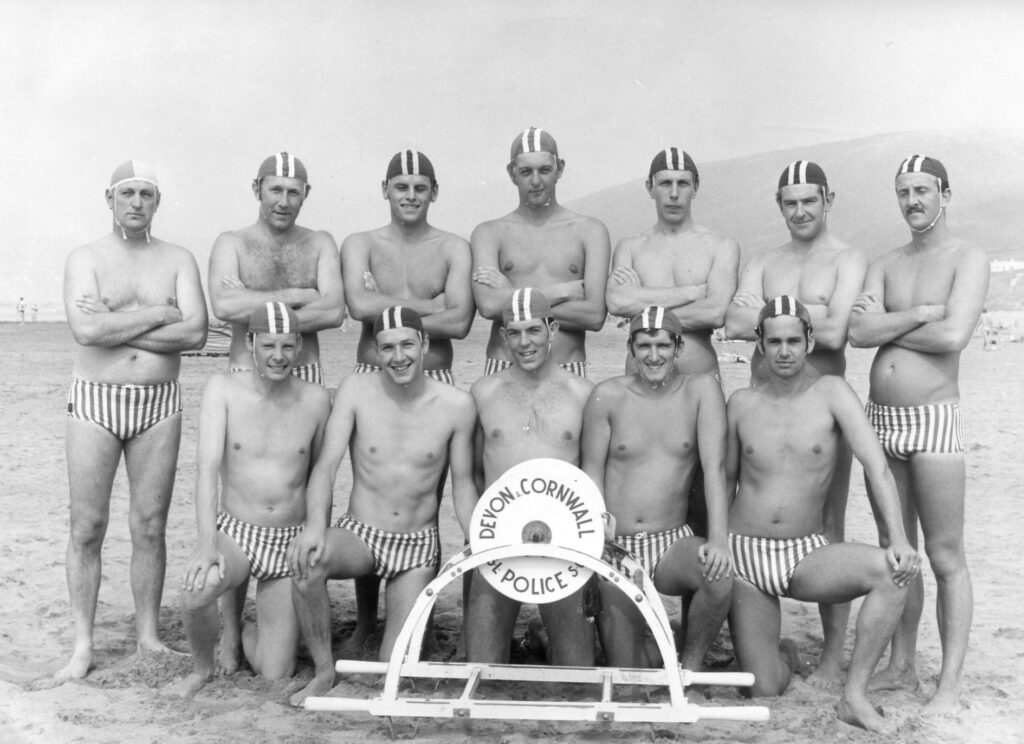
Peter, centre back row, as a member of the Devon Police Surf Life Saving Team.
At this period I changed my car and gave my existing one to Peter. I had used it since it was new and it was in excellent condition. About a year later when visiting him in Devon I found that he had exchanged that car for an older Ford Mexico model, which was in poor condition but of course suited his interest at that time.
Career – did you achieve what you wanted?
I achieved so much more than I ever expected to do and, as I have already written, I was exceedingly lucky to do so. Being in the right place at the right time was important and having made progress on the various courses in the RAF and again in the police, together with being so tall and conspicuous, brought me the success. I also believe that my feelings for my subordinates in both services were correct as I made sure that if ever there was a task to be performed, then I would attend and support those that were doing it, no matter what time of the day or night or the weather.
Homes, Holiday & Cars
Our home at Bradford Peverell was the first and last that we owned and being such a small bungalow, was ideal for us, and now that I am here on my own, is still ideal, except of course that Peggy is no longer here with me.
The Grand Canyon: Our American Holiday in Arizona
Our holidays were few whilst I was a policeman but they were interesting when I took Peggy with me to the overseas sites Pontins had. The most memorable of all was of course our visit to Arizona, USA. We flew from the UK to Chicago and then down to Phoenix to the Camelback Hotel we had booked into at Scottsdale, and where our flying instructors were to hold their re-union halfway through our visit. We hired a car from the airport and the very next day headed off down to the Mexican border at Douglas. We toured the desert museum and many villages in the southern half of the state, staying at motels for a night and then off again. At one motel we did not realise that we were beside a railway line until about 3 am when we were nearly blasted out of our beds by a train that sounded its very noisy hooter right beside us. We were more cautious as to where our subsequent beds were.
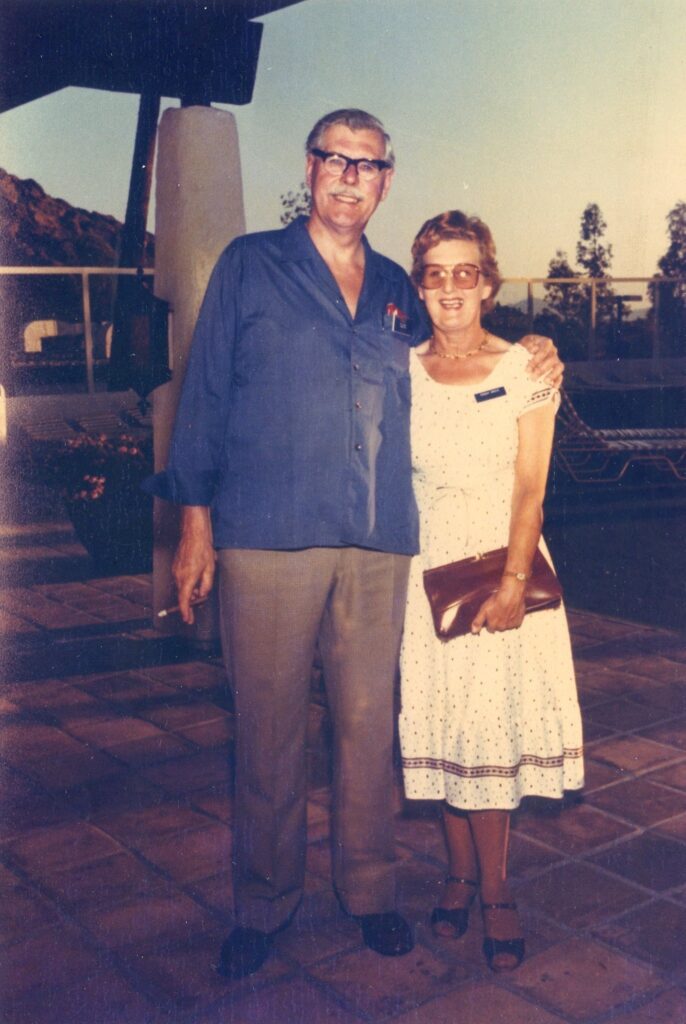
Peggy and I on holiday in Arizona, about to attend a dinner of the Camelback hotel hosted by my ex-instructors under the name of the ‘Helmet and Goggles society’, Phoenix, Arizona.
We continued to tour around southern Arizona and then returned to the Camelback Hotel to enjoy the re-union of the Helmet & Goggles Association, our flying instructors of years ago.
During our stay in Phoenix we attended the Armistice service at Mesa Cemetery where 19 of our cadets had been buried after crashing during their training on the courses that had preceded us. Each grave was decorated with a small Union Jack and beside it the American stars & Stripes. A Scots band of pipers was present and played throughout the service and then overhead flew a Stearman and a Harvard Training aircraft in salute to those who were buried there. This event was most moving to the majority of us and I recall one of our course who came to me and said, “I tried to take photographs but the tears in my eyes would not enable me to see what I was taking”.
Whilst in the area of Mesa we visited Falcon Field, now it had become the mesa aerodrome but still had two of our old hangars filled with old aircraft as well as the fireplace of our old cadets’ lounge and our swimming pool. The pool was being repaired by an electrician who I found was English and told me that his son had gone back to England and was going to play football for the Weymouth FC side. Yet again, what a small world!
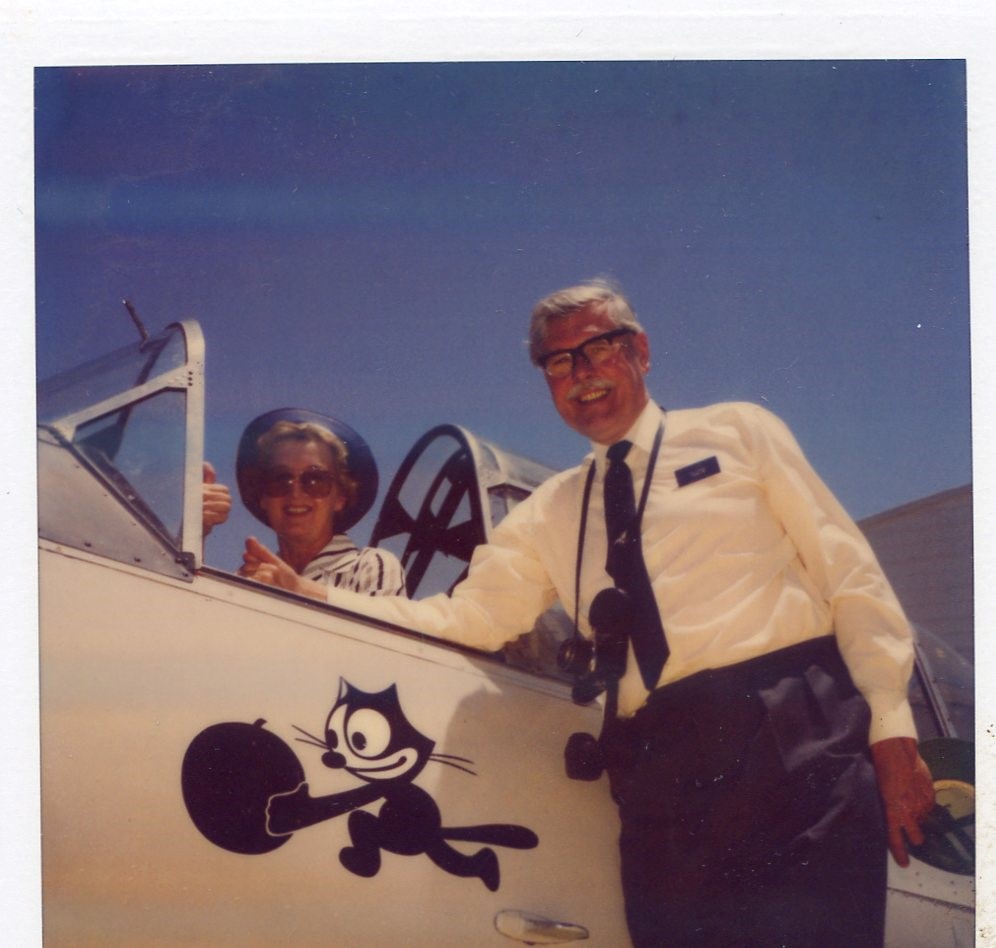
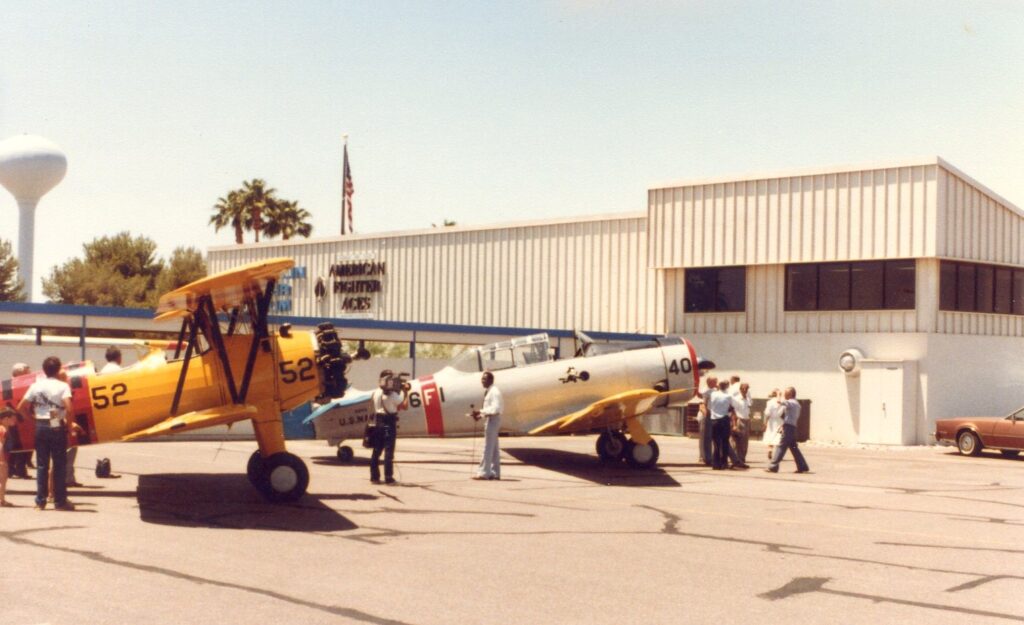
Buckingham Palace Garden Party.
What follows was not a holiday exactly but it was a most memorable occasion that excited and fulfilled us both having received an invitation dated 6th June 2000 asking us to attend a Buckingham Palace Garden Party on 20th July. Fortunately I had a black tailcoat and striped trousers but decide that a top hat would make me too conspicuous, so I did not get one. Peggy of course had to be resplendent for this occasion so off we went to a fine ladies’ shop in Ferndown kept by one of my masonic friends and his wife, and we came away with a fine two piece which fitted Peggy very well and also fitted the occasion. Peter drove us to London where we found a parking space directly outside a delightful restaurant that he knew well and where we lunched well. We then drove along the Mall and parked on the grass verge, directed by the police. Photographs were not permitted during the Garden Party so Peter took several of us outside the gates where we waited in an ever-expanding queue. We knew it would be a lucky day when a pigeon landed on the gate and then took off leaving his ‘card’ all the way down the back of my tail coat.
Eventually the gates opened and we followed those ahead into the area in front of the Palace and past the Guards beside their sentry boxes. We crossed the inner courtyard and entered up the steps into the hallway, then out through the rear entrance on to the beautifully kept lawns of the gardens. We were told by one of the attendants that there would be about 700 visitors that day so we did not believe we should have the honour of speaking to Her Majesty or to others of her family, who assisted in entertaining the guests. The Beefeaters formed into three roads with the guests outside them and when the Queen and her family came from the Palace each took a roadway through the gusts, frequently stopping to talk to the guests on either side. Whilst standing there I looked about me and found that there was another Dorchester resident there with his wife and eventually he saw me. Small world indeed!
After the Queen’s party entered their tent for tea, we were directed to long tents where tables laden with cakes, etc. and staffed by dozens of waitresses, made sure all our needs were supplied. We walked around the gardens admiring the flowers and the layout until it was time for us to depart. We found Peter beside his car and he drove us back home having spent what to we two ‘royalists’ thought was a very special day.
Some few weeks later a Commander of the Royal Navy and his wife visited us at ‘Crantock’ and of course we quietly mentioned that we had been to the Palace Garden Party and showed them our picture taken outside by Peter. He said, “Well done, we have been there twice”. I laughed out loud as this brought us down to earth and later he apologised for saying what he did but I was delighted; he had seen service to the crown and country and well deserved the honours he received.
A Motor Car
We did not have a car until I was promoted to the rank of Superintendent and then I had to have one because at that rank we used our own vehicles and were paid a mileage allowance for its use on police duties. I went to Tilleys Garage in Trinity Street, Dorchester and there saw a second hand Austin ‘Devon’ car which suited my purpose and decided to have it. I paid for it and said to the manager, “What happens if something goes wrong with it in a few months?” He replied, “I will put it right”. I said, “Is there a written guarantee that you will?” He replied, “No but here is my hand and I will do that”. I shook his hand and realised I was dealing with a man who meant what he said and was used to a hand shake as proof of his word. The car went beautifully for the two years I had it and I changed it for a newer model when we were at the Police College at Bramshill. After returning to Dorset I exchanged it for a new Wolseley which some three or four years later I gave to Peter, who was then serving in the Devon Constabulary at Bideford. I obtained a 3 litre Wolseley automatic car which suited my size admirably and being an automatic, I found very relaxing. I have always considered that the motor engineer could change gear far better than a human can and I continued with an automatic from then on.
Becoming a Grandad
Peter’s wife Liz gave birth to a son on 23rd December 1969 and this was our first grandchild. He was an energetic lad from the start and grew up in Devon. Because he was born near Christmas he was named Justin Tom (just in time?)
In 1985 Naomi Clare Trubshawe was born to our daughter Anita and her husband Brian at a Bristol hospital. She became the apple of her grandmother’s eye as shown in the many photographs I have of her. Three years later her twin sisters Holly Kate and Sarah Louise Trubshawe were born on 11th July 1988.
Here are some more photographs of Vic’s family, which were the inspiration for him to write his memoirs.