I want to concentrate on, the almost forgotten men of our current times and hope it does not turn out to be a bit of a rant!
The Community Coppers or ” Village Bobbies”, the men (and of course their wives,) who used to make themselves available 24/7 to their communities, but they are now, pretty much an extinct species, due to progress or rather, cut backs, technology and diary appointments !
If you mention the phrase, “Village Bobby” to the younger generation, no doubt you will get that quizzical look on their face, and the word, “what” coming out of their mouth.
You might be saying that you disagree, as now we have lots of community cops , more recently given the title, “neighbour beat managers “, but they are a group of officers that work shifts in a small team from their “hub”, which is part of a council building , library or fire station that police use for an office.
The days when a police officer lived in a police house, which was also his office, in a village or part of a town are way gone.
The days when locals would knock on the door of a village bobbies anytime of day and night are gone. If he was not there, then his wife would help.
The days when officers were expected to be available 24/7 are gone.
The bedrock of the community was the Village Bobby. They knew everyone, they talked to everyone. they gained information first, they were relied on and respected by their community and the really good ones stayed in “their” village for many years.
Why were they respected so much ? They were respected because they kept everyone safe, most of them had served in the Armed Forces either before , during or in between the World Wars. They has seen almost everything life can throw at you, especially the worst things. They were good listeners and could spot the good and bad in others. On retirement they were lauded and missed, because they were almost impossible to replace !
I am very sure, if like me, you were born in the 1950’s or 60’s , you will all remember those times when we were young and naturally curious of life and up to no good, without our parents knowing. Scrumping or just testing someone’s patience or even worse . We all wondered whether the “Village Bobby” was nearby, and if he was watching, or if by local gossip or “tittle tattle”, he would end up being told about our misdemeanours. You had to be very alert as a young un, otherwise you got a bloody thick ear, or worse that he spoke to your parents, or even worse you got a ride in a police car, booked into the cells and had to face the music. Then even more trouble when your parents arrived to pick you up, even worse if your dad was a policeman !
Perhaps you or your father may well have been a “Village Bobby”.
I do not suppose there were any police women, before 1968 that were “village bobbies” , but if there were, then please correct me and let me know !
As I have said in this blog on my “ABOUT” page, I will be trying to keep my information from the years 1856 to the 1967 before the amalgamation with Bournemouth, but if you have any 70’s memories etc, then I am still interested.
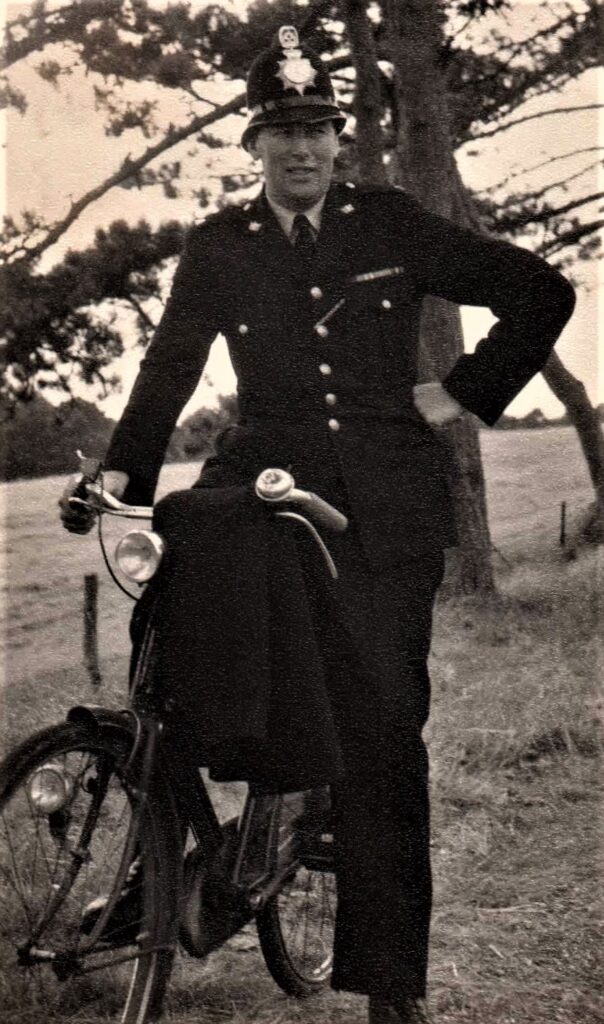
The photograph above is of the great PC 70, Ron BEALE and is used with permission of his family. Ron passed in 2020, but will always be remembered by the Dorset communities he served especially Abbotsbury on the south coast. The photograph has to be pre 1971 as Ron does not have a Sheriffs breast badge, and it is nice to see he is wearing his WW2 ribbons, that is another story. We will talk more about Ron and his brother Tony soon.
When the Dorset County Constabulary was formed in 1856, the majority of the men in the Force would have been, “Village Bobbies”.
With towns other than Dorchester being such small places, the countryside was “flooded” with constables (flooded is probably the wrong word), but if those small villages of Frampton and Toller had village bobbies, then that says a great deal of how many were spread around the County !
Now they have all gone, along with any offices and houses and probably even worse, little police contact at all. We all grew up knowing our local bobby, especially if you were in trouble, but not any more.
It is a shame isn’t it. that he/she is almost extinct, but it is my personal view and I suppose I am showing my age ! Times change and now when doing investigation we get more evidence from, ANPR, digital information, phones and cameras, rather than gossip and by knowing everyone in your village.
I was going to write this post chronologically , but I want to start with the remarkable BEALE brothers !
Ron Harold James BEALE was born in 1921 and Antony Michael BEALE in 1923. Tony joined the Constabulary in 1949 when he was 25 and Ron joined when he was 30 in 1951. They were late starters to the Police, but that was down mostly to WW2, where they saw plenty of action.
Both grew up in the North of the County, natives of Sturminster Newton. Ron had no aspirations of joining the police, he began work as an apprentice ironmonger and Tony, being younger was a Butchers Boy, Tony followed his elder brother and joined the Dorset Regiment Territorial Army in 1939, like many of their friends.
When you read their story, you may realise what our ancestors went through, and how lucky we are !
Before I start I would like to thank their daughters Moira Baldock and Sue Palmer for allowing me to share all their information , photos, letters etc .
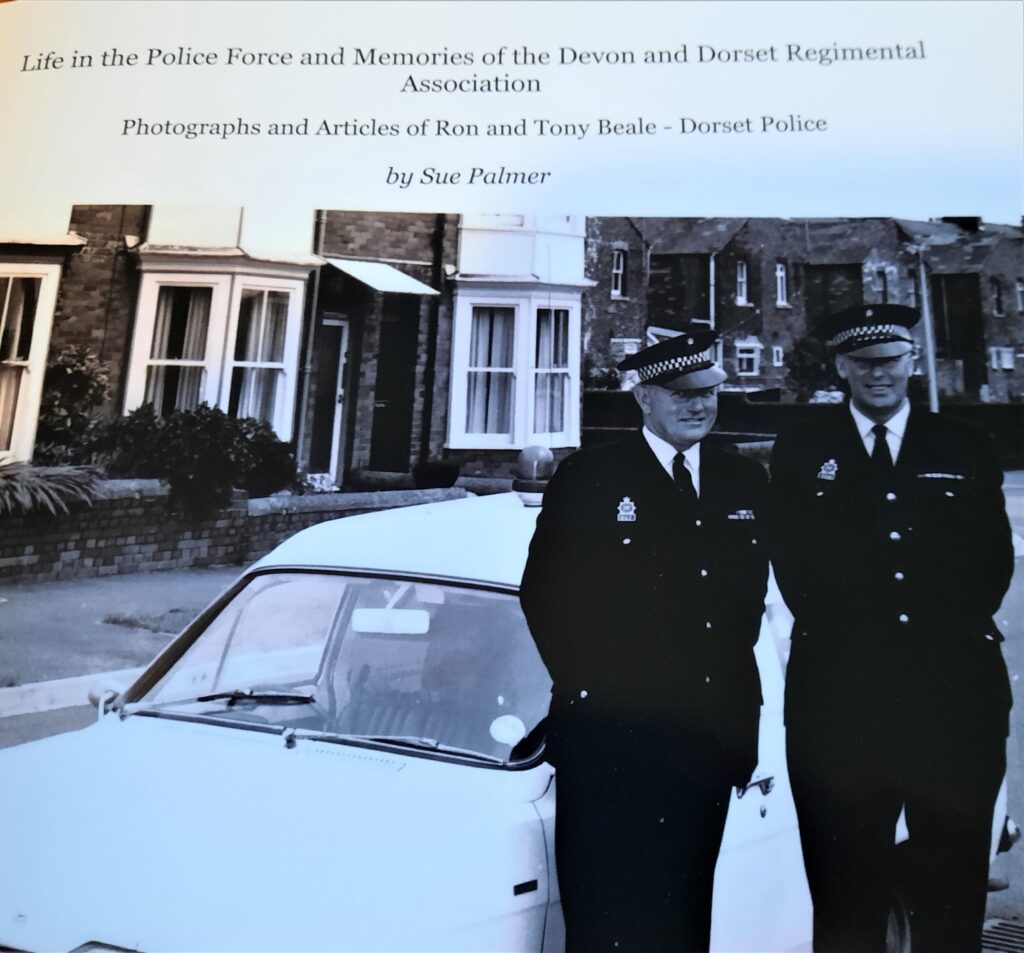
Ron’s daughter Sue Palmer, made a book and published it, here is the front cover with Tony on the left and Ron on the right.
Both Ron and Tony were not the sort of men that bragged , they quietly got on with their work, did what was necessary , but were always ready. Apparently they did not say much about WW2, probably like most heroes, so the facts about them I suspect, they would like to be kept clinical as they did not think they deserved anything special.
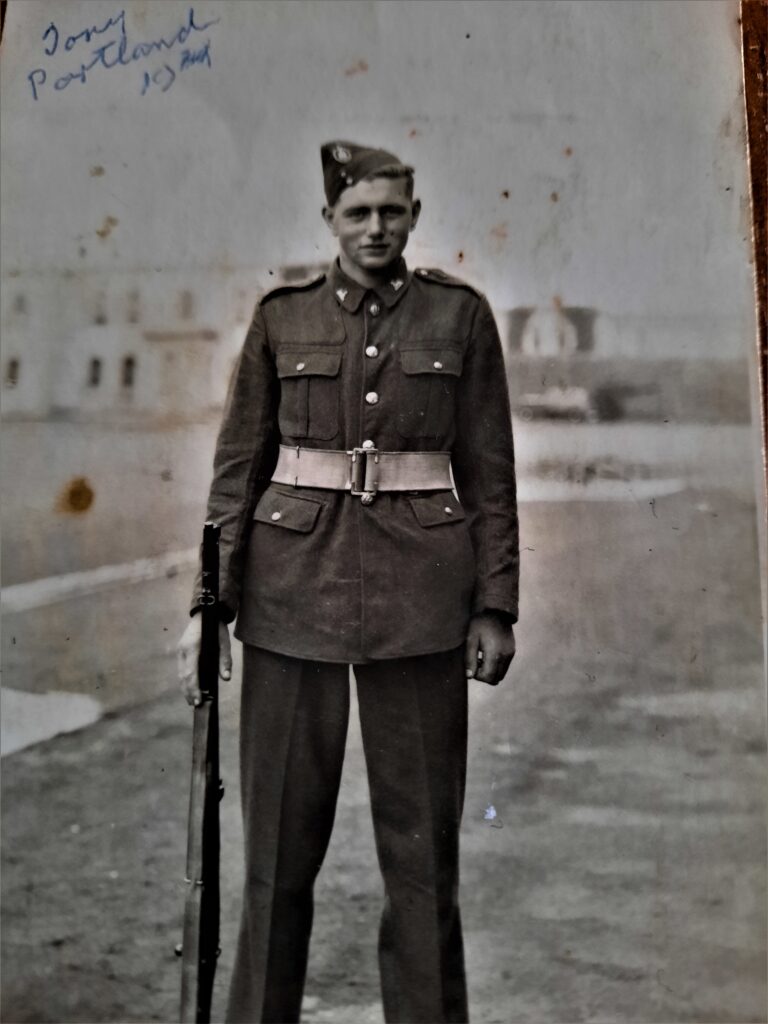
Here is a photo of Tony at Portland just after joining up.
I do not really know much about their service during the early years of WW2, but they must have enlisted together as their numbers were consecutive. Ron said, that were mobilised on the 1st September 1939, they spent their first night on the Drill Hall floor at Gillingham and then the next day moved to Weymouth in billets on the sea front. The next few days were spent in guard duties, P.T. in the early morning on the Esplanade, shooting on the Chickerell range and route marches, all to get us fit. Often those marches took in views from Abbotsbury Hill and Hardy’s Monument.
Tony in 1942 was with the Royal Artillery and his battalion were posted to Singapore. He was in Burma and Malaya before being captured with others on the 14th June 1942. He then became a prisoner of war and was imprisoned in at least 2 POW camps, Changi Camp after Singapore had fallen to Japan and another POW camp in Thailand. This lasted for over 3 years until September 1945 when he was released. Just before he was released an audit of POW’s was completed and he was one of nearly 14,000 UK POW’s.
Ron on the other hand was married also in the summer of 1942 and in 1944 was part of “Operation Overlord” aka , the D day landings. As part of the 4th battalion of the Dorset Regt he landed in France on the 6th June and then moved forward in Normandy and 2 months later he was part of our forces trying to secure hill 112, just south west of Caen. Ron was wounded on the 2nd August 1944 near the village of ONDEFONTAINE, and as a result was invalided out the Forces on the 3rd May 1945. The battle for Hill 112 was one of the biggest battles and if you want to learn more then please google it.
Can you imagine what their parents went through ! Letters to Tony were sent which he never saw till he got home!
Tony’s daughter Moira wrote:
After WW2, Ron returned to their home in Sturminster Newton and took a job as an auctioneers clerk , whilst Tony remained in the Army and was posted to ABERPORTH, near Cardigan in Wales. Those must have been great days to chill a bit after what they had endured, and after meeting his wife, Tony obviously wanted a bit more adventure ! He was not sure where and what to do next, he considered the “Groundnut Scheme” in Tanganyika, now Tanzania in Africa, which was a big failure so luckily, they decided not to go. Then there was the Welsh Constabulary, where his wife “Jane” was from, but he could not speak welsh, which was a requirement, so luckily for Dorset he came back home.
In the summer of 1949 , not long after he was married Tony joined the Dorset Constabulary and was given the number 265. Here is the first photo of him in uniform when he was sent to training school in Gloucestershire, 2 years before Chantmarle was the training centre for the South West.
On a different note, do you recall when someone shouted, ” South West” what your response was ? *
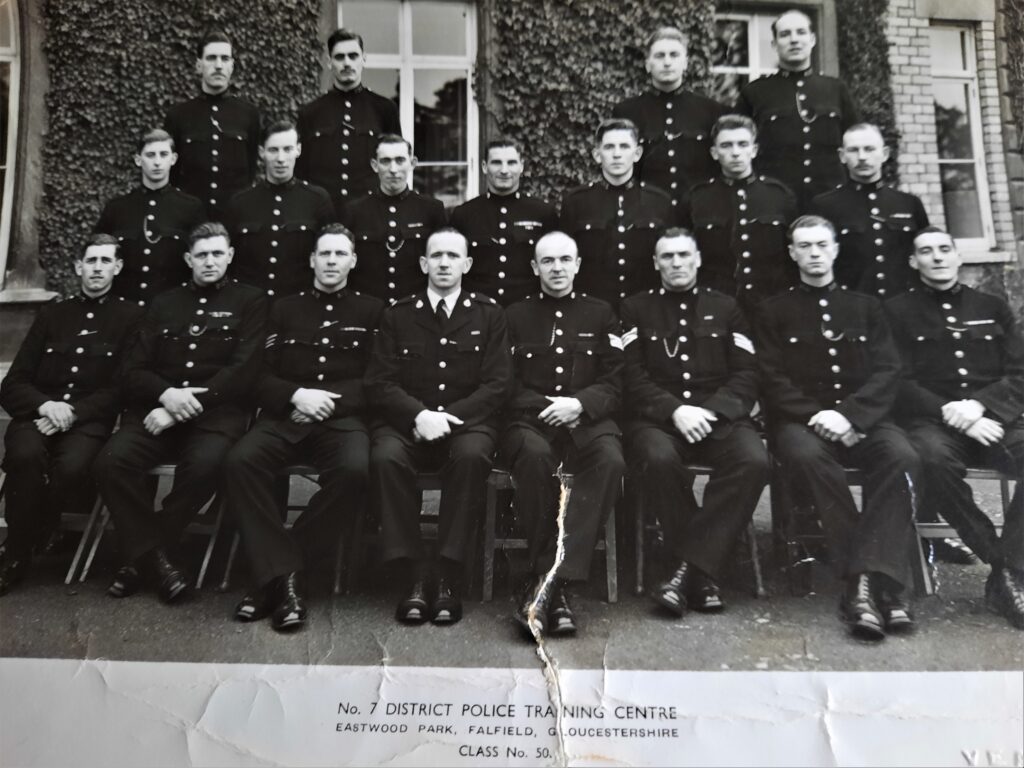
Tony is 2nd left in the front row.
In late 1949 Tony returned to Dorset and was posted to Parkstone , where he was joined by his wife, and whilst there, Ron joined the Constabulary in August 1951.
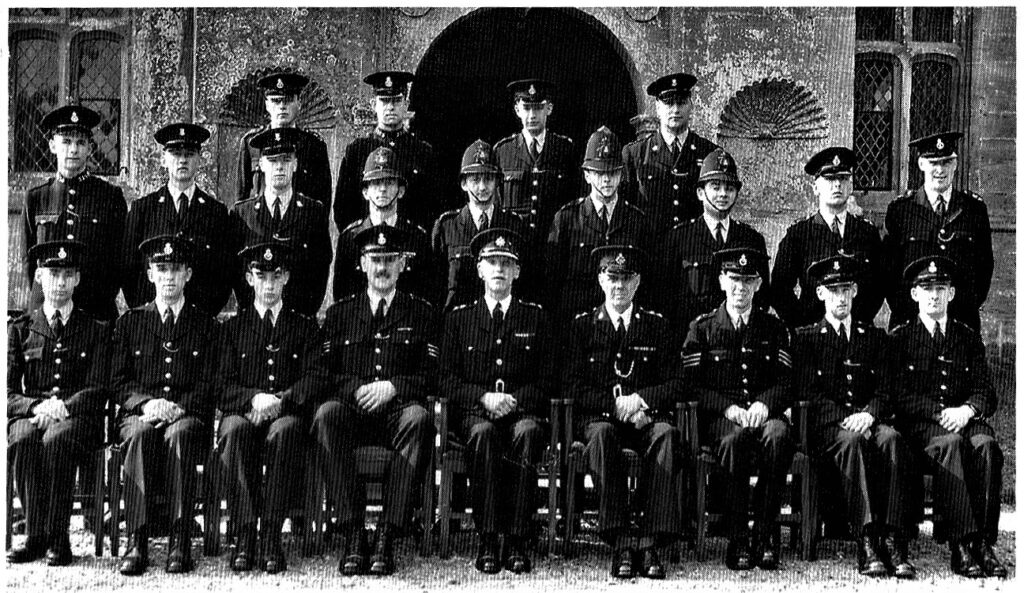
Ron is 2nd row, far right. On the first course at Chantmarle !
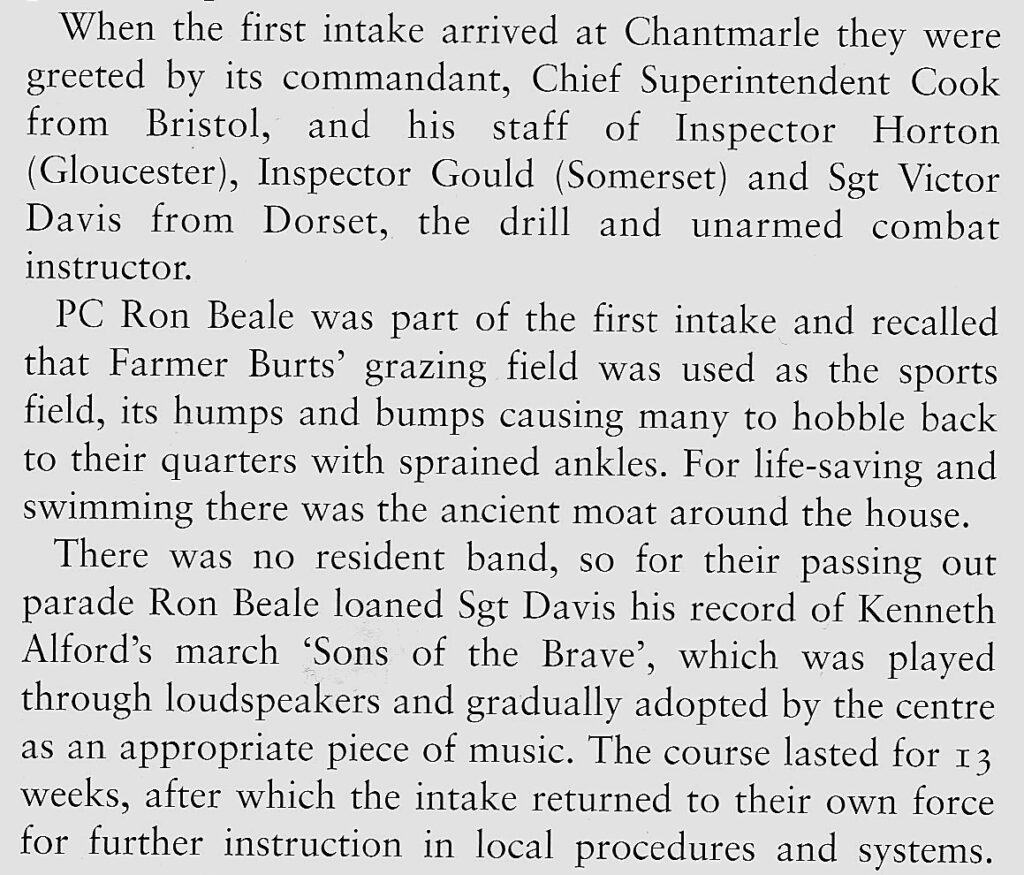
In the Bobbies on the Beat Book this was an extract, with thanks to Melvin HANN.
Another photo , with fellow recruits, I think at the same time !
Ron on the right, if it is not obvious by now !
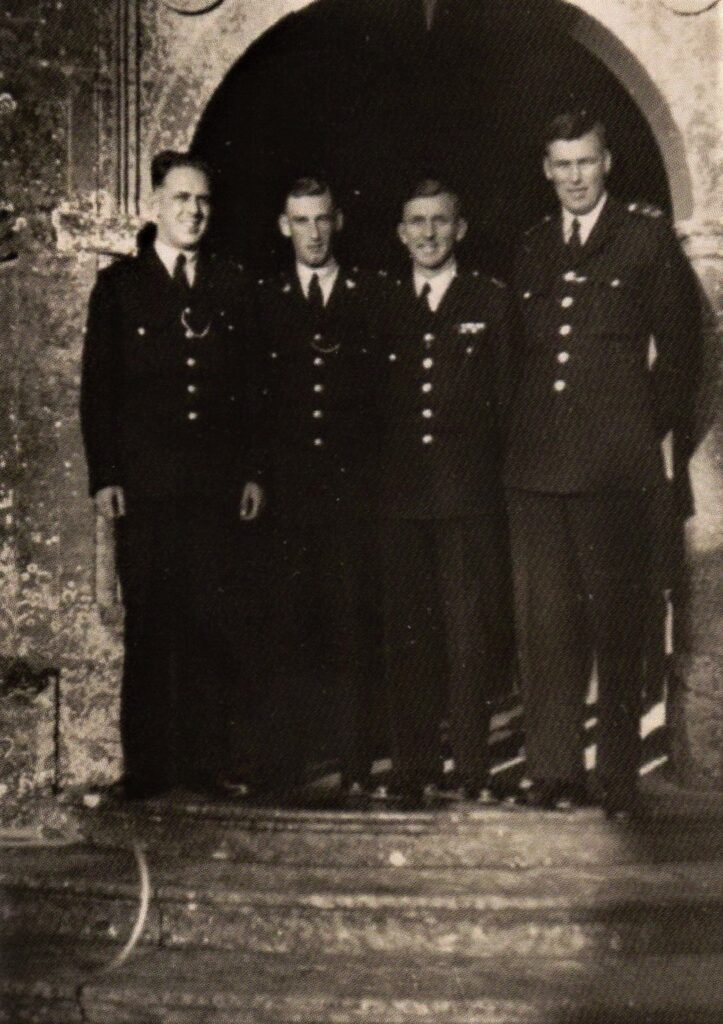
More about Ron later !
These are some more of the memories of Tony’s daughter, Moira, after I told her my great grandfather many years before was also a PC at Parkstone and Chickerell, in his career.
Moira wrote:
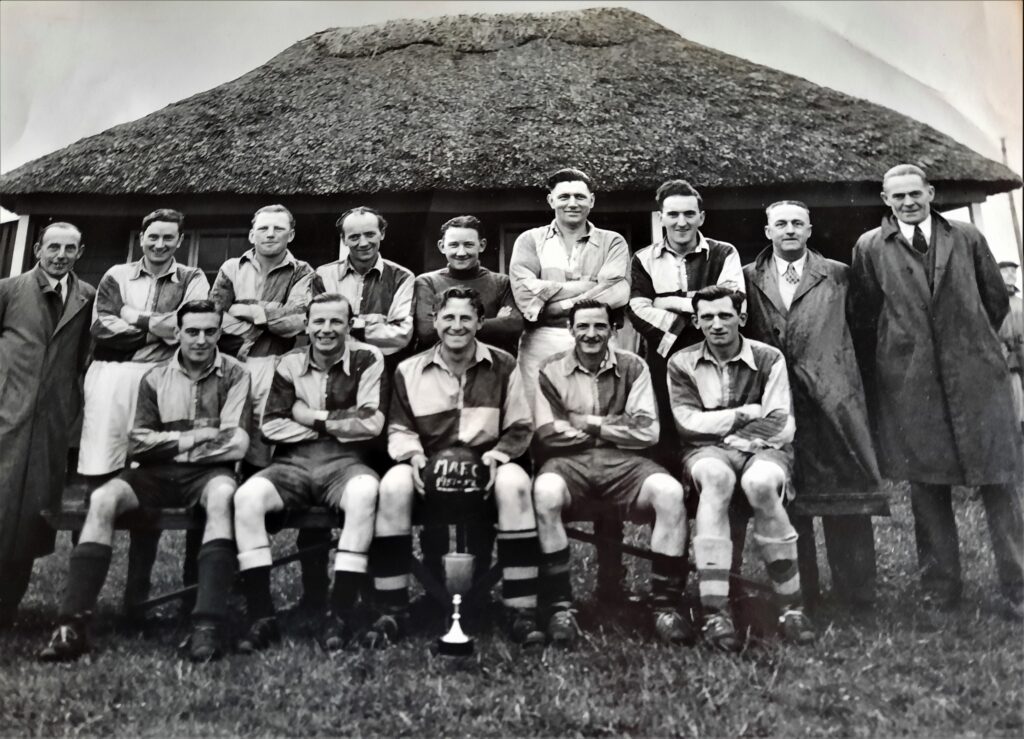
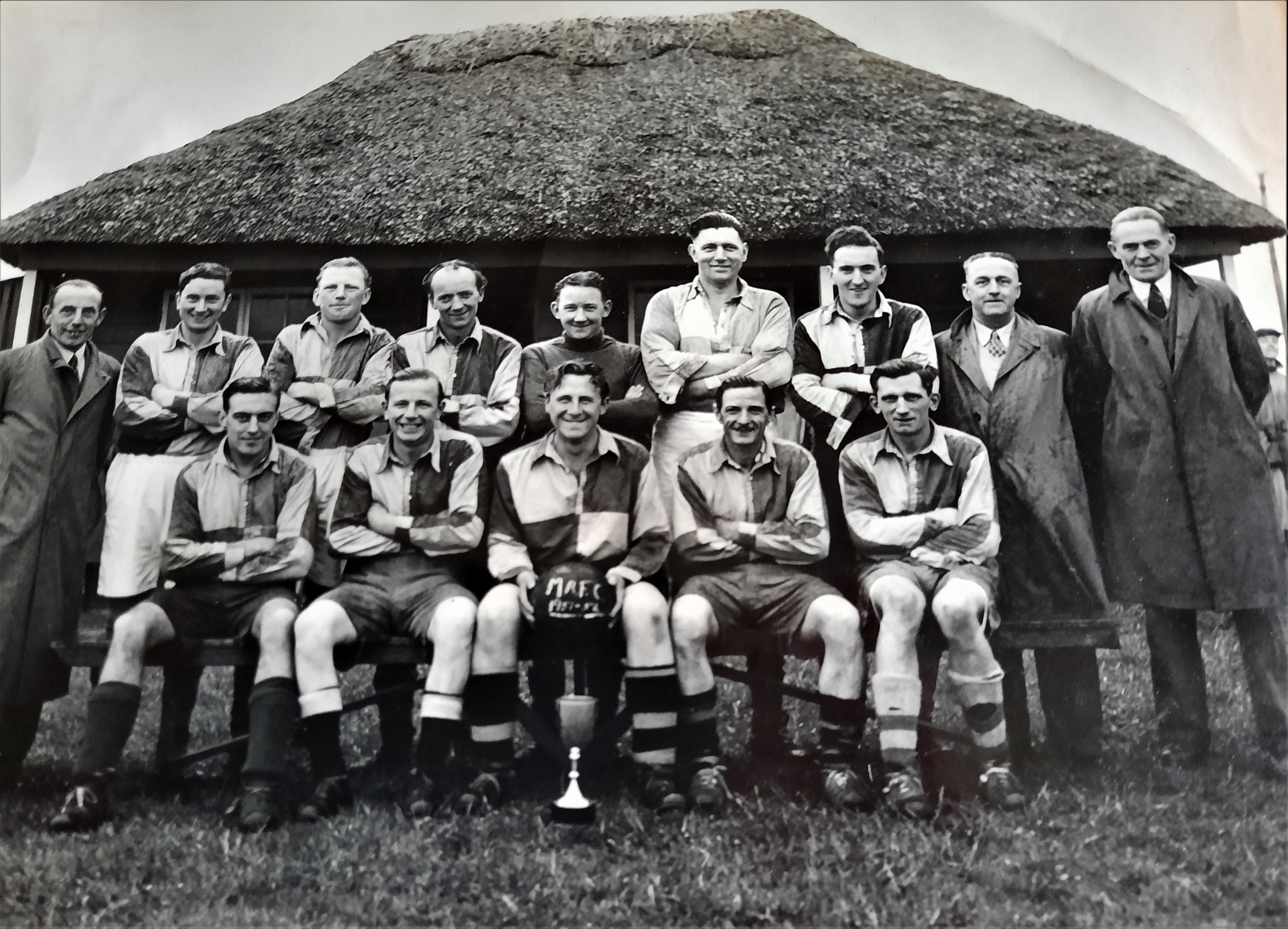
I think you can work out which one is Tony in the Milton Abbas team !
If you are struggling he is 6th in the back row.
As I’ve said, their only mode of transport was push bikes and one of their regular outings took Mum and Dad to nearby Milborne St Andrew, where over a period of time they watched the construction of a brand new police house. And yes….they were the first people to take up residence ! I don’t know the exact year but it must have been some time before 1956 because I was born there. I was 3 when we all moved to Chickerell, so I don’t have any memories of the house in Milborne.
Back to Ron.
Later in life he reminisced that for 2 years at Shaftesbury, while his wife and family were living at Sturminster Newton. Ron said, ” I lived in digs during the week and I would cycle home for my day off. It was all right on the journey home, downhill but getting back uphill to Shaftesbury was hard work”. Bicycle and foot were Ron’s main means of transport, except after being posted to Sherborne in 1954, when he drove a smart Ford Zephyr, complete with alarm bell on the radiator grill. Photo below. Ron , right and we believe Geoff KELLAWAY is left. Ron stayed at Sherborne for about 7 years.
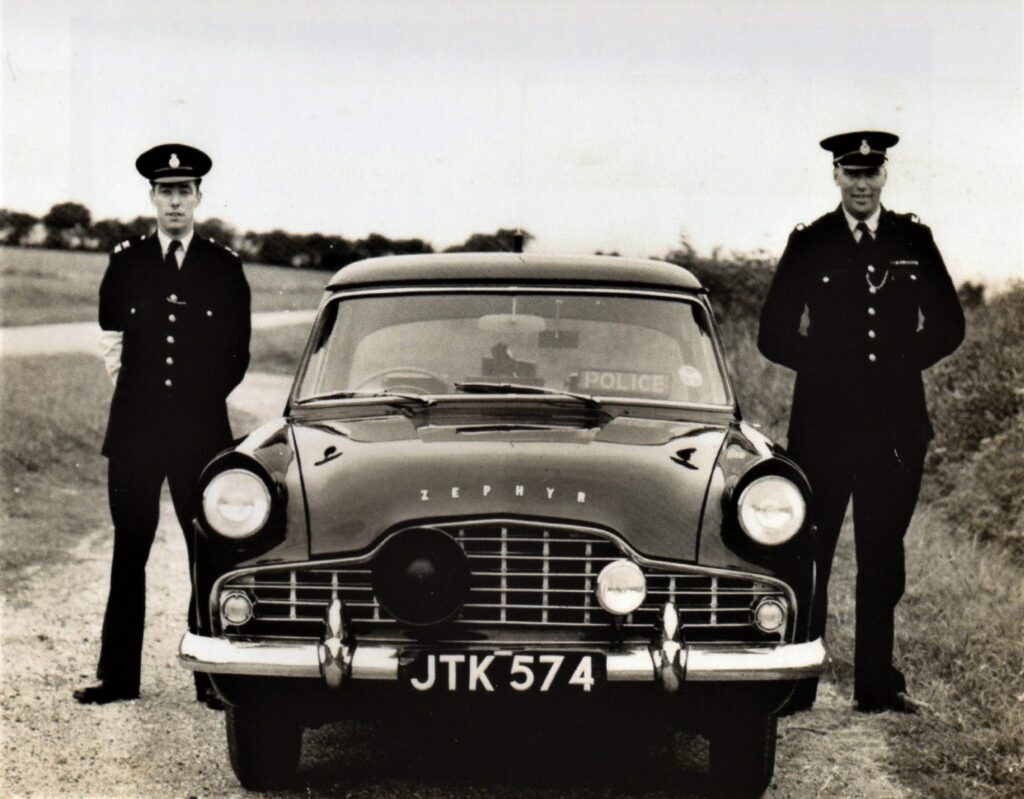
Ron said in later life again:
” I moved with my family into Abbotsbury Police Station (house) in January 1961 in a thunder storm, not a very good start to what was to be the best part of my police service. At the beginning of December 1960 just before Christmas I had returned from an advanced refresher driving course, on reporting back to Sherborne the next working day, I was handed an order to move to Abbotsbury. I knew this was a station with a bit of a reputation with a difficulty with a certain “Lord of the Manor”.
Ron, middle row 2nd left with a big smile after passing the course
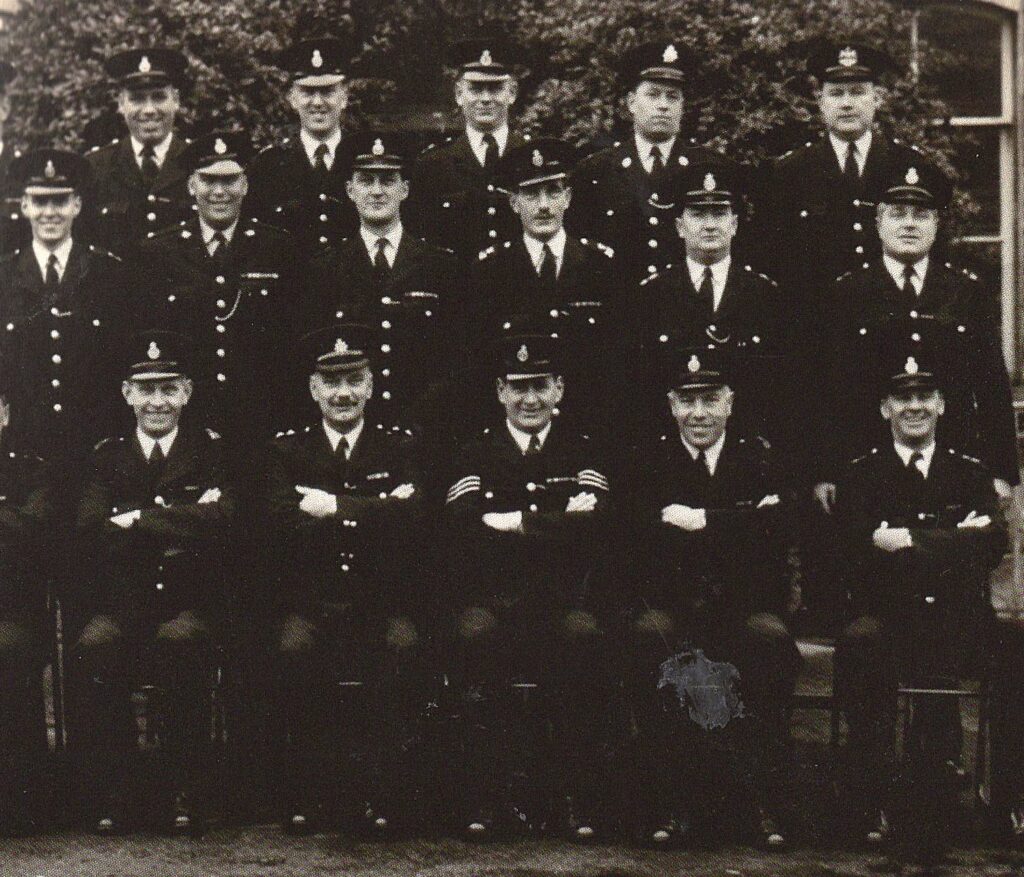
Ron continued:
It wasn’t politic to question the Chief Constable’s orders. I had done alright on the course, I hadn’t pranged or damaged any of the driving school cars, had passed the final drive and exam, however no argument, we had to move. It turned out to be the best 16 years of my service. Once the two boys schooling had been sorted and our daughters work and accommodation had been arranged we soon settled in.
It was a privilege to know the village characters, people like Cyril DAUBENEY, John WOOD, Mrs HUGHES at the White Swan, Fred LEXTER, Charlie PITMAN, The Hon John for a short time, Len MILLS – “D Day Commando, what a story he must have, Miss MIDGELEY and Mrs SIMPSON, school teacher, the Rev BALL and many others.
I started to play cricket for the village, as did my son Michael, side by side with the likes of Joe HAINES, the LEGG brothers, Jack KEECH, Gerald and Farmer DUNFORD and Phil HUTCHINGS who is still involved with the cricket club. Michael went on to play at Lords and keep wicket and captain Dorset. My wife Peg joined the Womens Institute and was lucky enough to go to a Buckingham Palace tea party with Mrs STOCKLEY, Hazel’s mum and wife of the local Butcher.
In the early 1960’s my means of transport was my bicycle and communication was the telephone. My duties were listed on a 16 day rota, a different tour of duty for each day with the location of each telephone kiosk to be visited for that day at set times, also included were places like Abbotsbury Beach, the AA box at the top of Abbotsbury Hill, Hardy’s Monument and the cross roads at the top of Portesham Hill where there were no telephone boxes. There was many a night when it was blowing a gale I visited these points, just in case the SGT or INSP of the day turned up in his warm comfortable Ford Escort wishing to sign my pocket notebook to prove I was there at the appointed time. Very often no one came out ! Today’s modern policeman has draped around his belt many bits of equipment including a multi wave radio and mobile phone, all very different to my day !
I think the most satisfying and rewarding period was working with the Parish Councils at the time of the big freeze and snow fall of 1962. I was the go between the Councils and the Emergency Planning at County Hall, arranging for helicopter food and fuel drops. I also enjoyed the time when Far from the Madding Crowd was filmed in the area, parts of Chitty Chitty Bang Bang and Goodbye Mr Chips were also filmed during my time as a Village Copper.
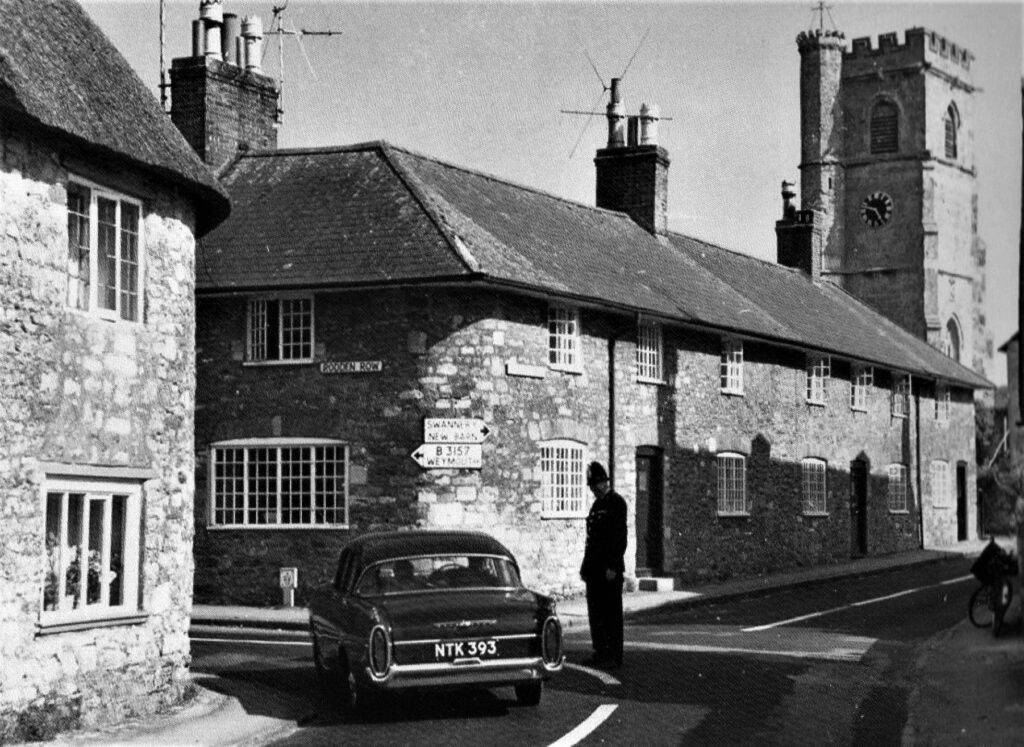
If you know Dorset you will know this corner ! Ron with his trusted steed on the pavement to the right.
Ron continued:
Traffic was as much of a problem then as it is today, a particular difficult period was when the mains sewer was being dug up through the main street. Crime was mailnly of a petty nature, cars broken into at beaty spots, but only one or two more serious crimes. One was a luch time walk in theft at the Post Office , where a large amount of cash was stolen and the theft of a fine collection of antique firearms from the Swannery, and the culprits came back a second time.
In 1970 I was looking to the future and where to live, and his family lived in the police house at Abbotsbury till 1970, then he applied for and was allocated no: 9 Hampton in Portesham.
This meant for their last 7 years Ron and Tony luckily continued to work next to each other on their coastal beats.
Both had passed their normal retirement ages and so they both retired in May 1977 and in June both were awarded the Queens silver jubilee medal.
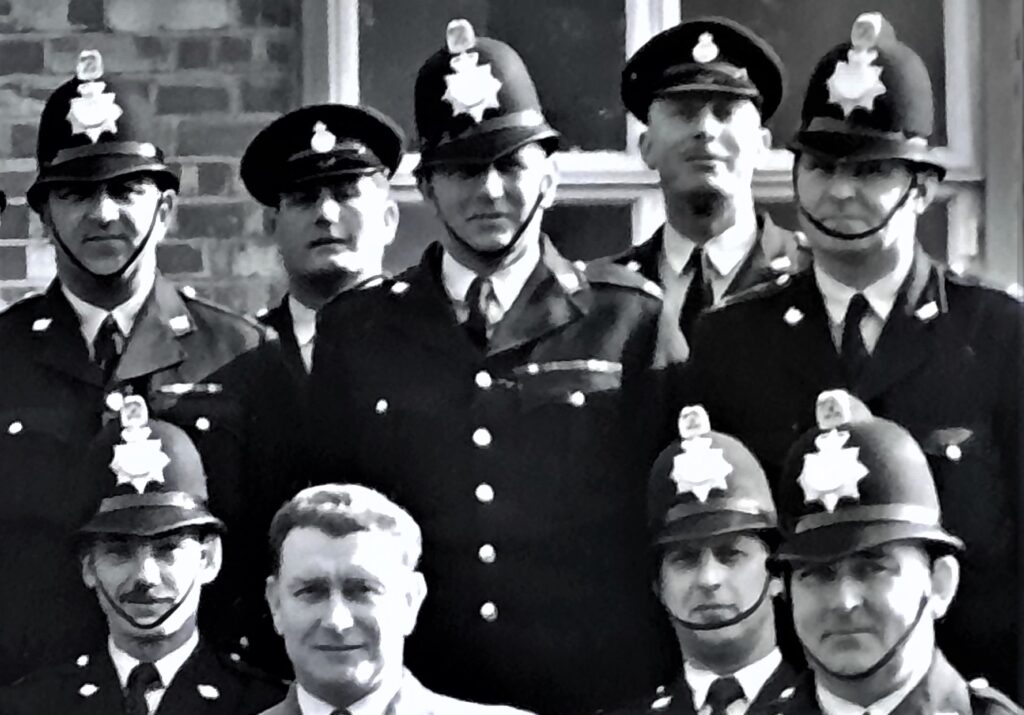
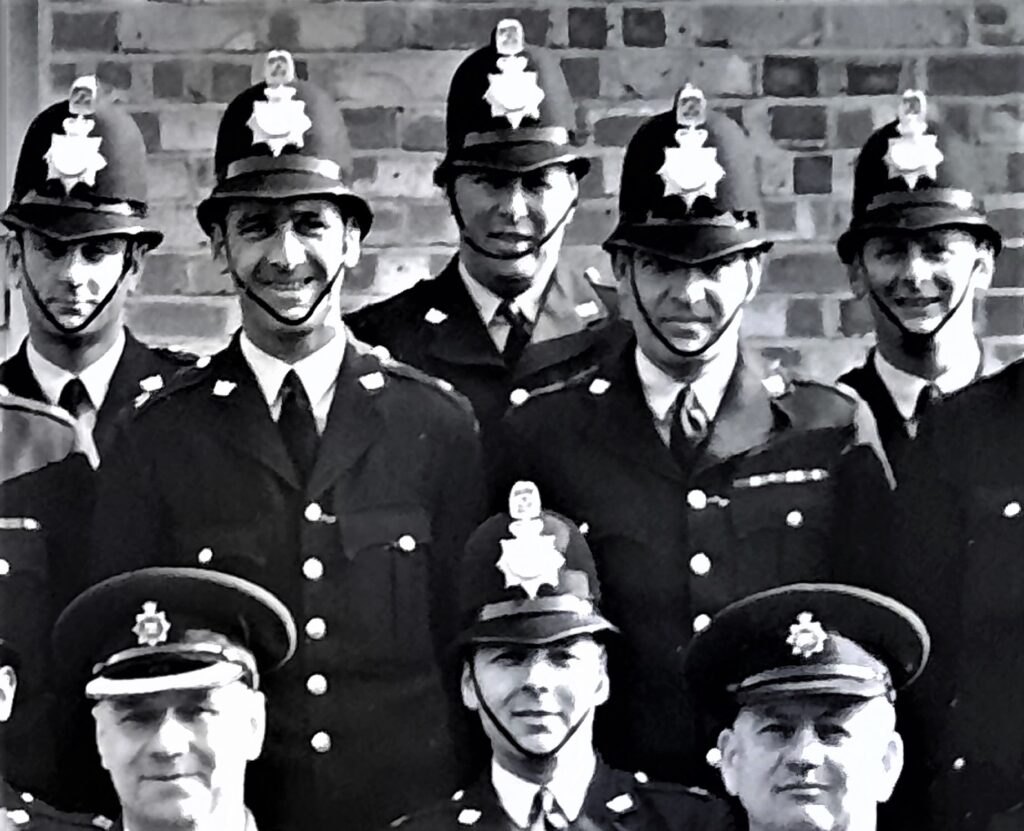
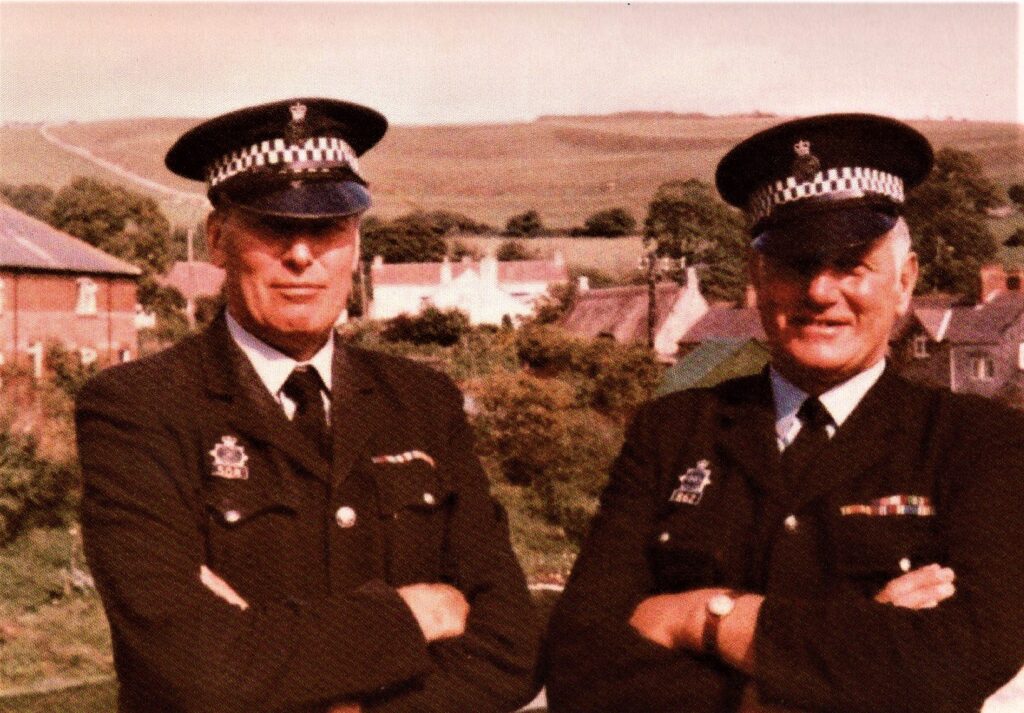
More magic photographs of the brothers, with their Weymouth Division colleagues in the 1960’s , both in the middle . Then a typical cross armed Police pose.
THAT IS NOT THE END !
A year later, after retirement the brothers were both called to court for their Valedictory, although they were not told why !
Judge PENNANT, Mr BURKETT, who represented the Western Circuit Bar Mess, Court Clerk Mr SOAL, Lady WILLIAMS, Chairman of the Magistrates and Supt Dickie DAUBENEY who represented the Chief Constable, all praised the brothers for their service and wished them well. Ron then took up a security job with Pontins and Tony worked as an Usher at Weymouth Court, which was basically security and jack of all trades. Ron was now the main man for the Neighbourhood Watch and continued with his membership of the Dorset Regiment Association for which he was later the Chairman of the Bridport branch. Ron stayed local and Tony retired to Cornwall .
The French Government has been awarding the Legion d’Honneur to D-Day Veterans from many different countries for several years, as a way of honouring and thanking those who fought and risked their lives to secure France’s liberation during the Second World War.
On the 70th Anniversary of D-Day in June 2014, the French President announced that the Distinction would be awarded to all British Veterans who fought for the liberation of France during World War II but must have taken part in Military Operations in France between 1944 and 1945. Naturally Ron was awarded the medal.
A great deal of my information I have been allowed to use because of Ron’s and Tony’s daughters. What sums up what the brothers were like, is when Tony’s daughter , wrote that Tony if he was still alive would be bemused that anyone is writing about him.
———————————————————————————————————
ALBERT FARLEY PC 16
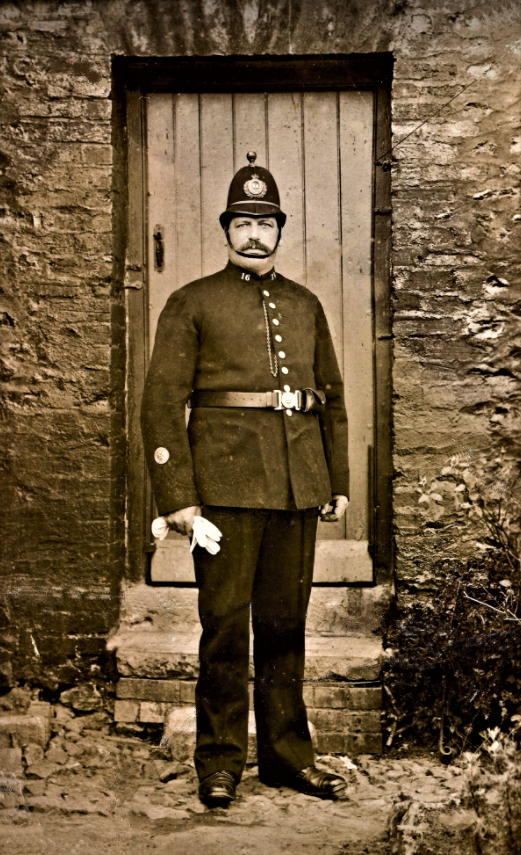
Above is another fantastic photograph of an early ” community copper “.
PC 16 Albert FARLEY, was basically a “village bobby” for most of his career between 1888 and 1913.
Alfred, joined up in May 1888, around the middle of the month, the exact date is not known, but we know his training was about 3 weeks.
On the 9th June 1888, he was posted from HQ to Gillingham and this is all the information from Force Orders about his career till…
12th Oct 1889 Posted from Gillingham to Yetminster, on his own, he was single till married in December. His first village bobby post.
9th Nov 1889 Promoted from 3rd to 2nd class PC
3rd Jan 1890 Posted from Yetminster to Wareham
23rd May 1891 Posted from Wareham to Wool, his next village bobby post.
2nd Jan 1892 Promoted to 1st class PC
3rd Dec 1892 Cautioned for failing to report a robbery of a coat on the 5th Nov, as a result he was punished by being moved to the bottom of the 1st class PC list.
13th Sep 1894 Posted from Wool to Blandford
Whilst at Blandford, he was given information that a local man had stolen a truss of hay. When Albert spotted his wagon, the offender made off at speed, but Alfred overtook it on his bicycle and the offender was found in possession of the truss and was arrested.
17th Apr 1897 He was upgraded to the Merit class for saving the occupants of a burning house.
25th Dec 1897 Posted from Blandford to Broadmayne ( What a christmas present, his wife must have been so chuffed to move her family at that time of year, and it was also their 7th wedding anniversary!!) Their 3rd village bobby posting.
24th Oct 1903 Posted from Broadmayne to Cheddington. Their 4th village bobby post.
19th Oct 1907 Posted from Cheddington to Thorncombe , their 5th village bobby posting.
It is not exactly an exciting career, but most police work is like that, yes it may vary a lot, but being there, all the time for your community was the most important thing. Bear in mind, when he saved the occupants of the burning house, he probably put the fire out himself with the help of the locals, as the Fire Brigade would have taken a while to get there in those days.
If you do a search of the old papers, which I have done with genes reunited, he is recorded as having plenty of arrests and court appearances.
On the 16th January 1913, Albert retired at Thorncombe as I believe his legs were not up to it anymore. I believe the photograph of him is taken at Thornecombe. The community of Thorncombe were obviously very happy with the service he had given them, as these items confirm. Bearing in mind, it was not the done thing to accept gifts from the community and never has been ! The Chief officers frowned upon their officers receiving gifts, but obviously they let it happen on this occasion.
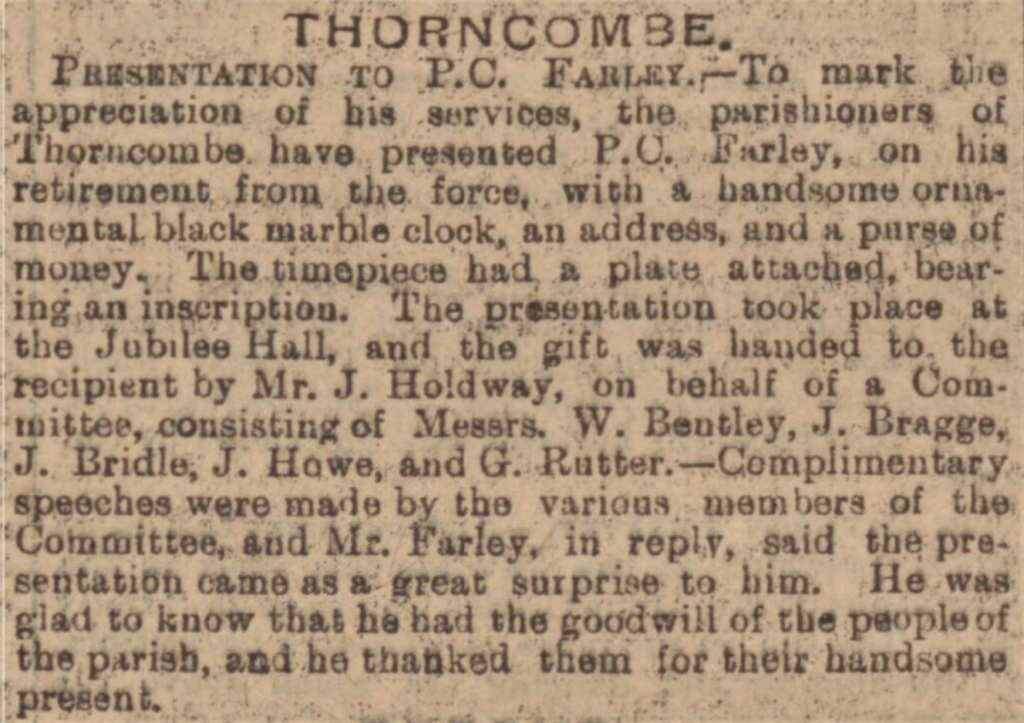
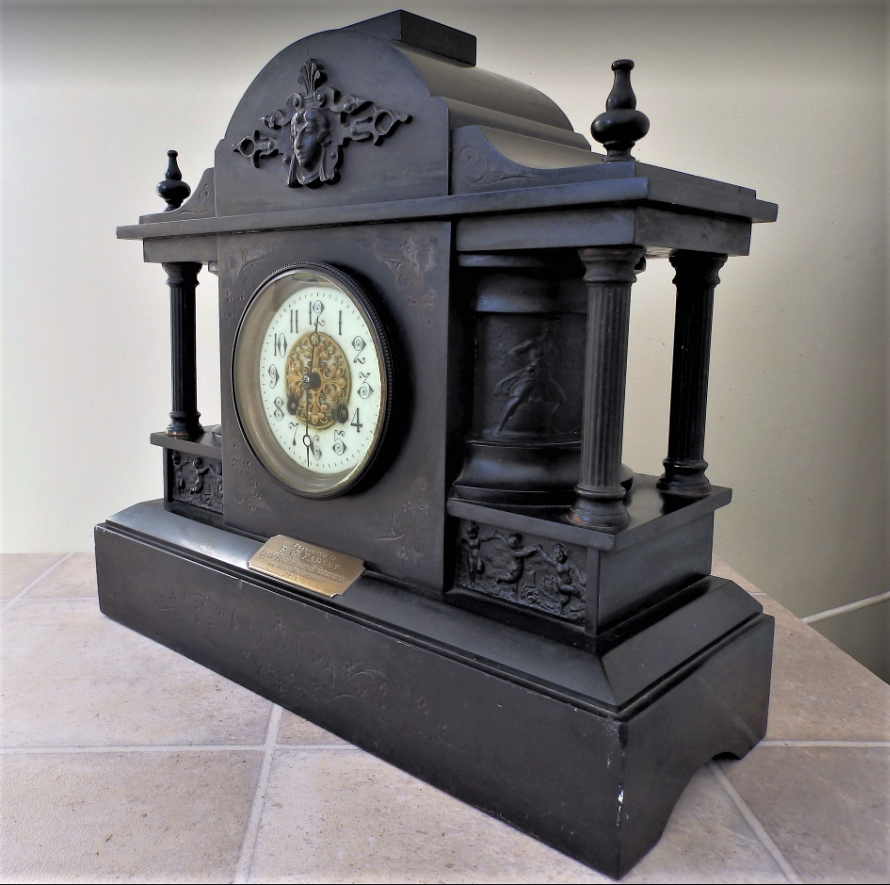
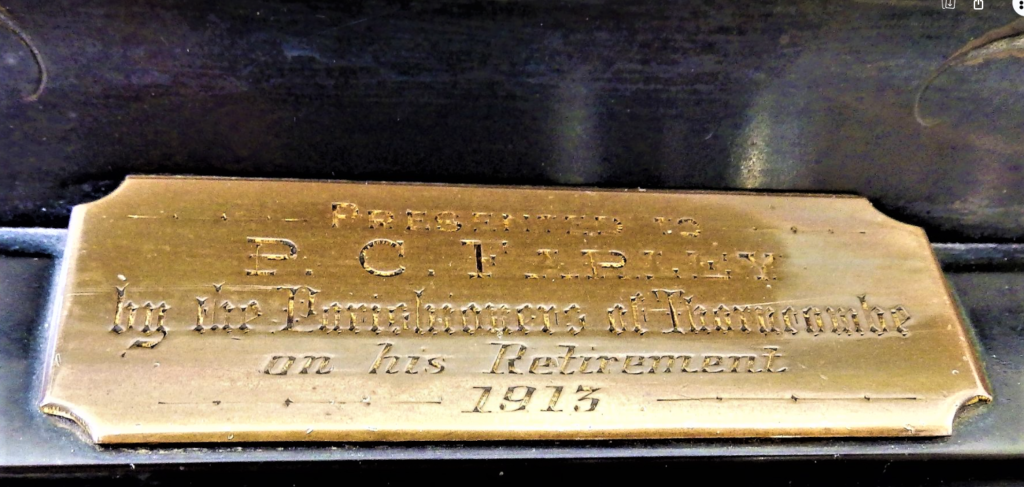
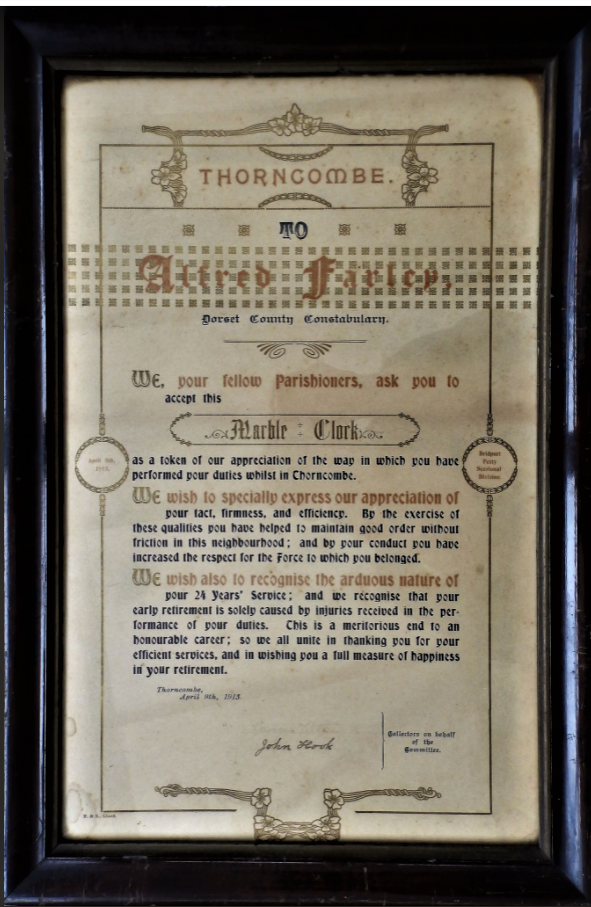
All photographs related to Alfred FARLEY used with the thanks and permission of his grandson Jeff FARLEY.
————————————————————————————————————
PC 4 Fred FALL. Dorset Constabulary 1900 – 1926.
You may be wondering why I am showing a group photograph when talking about one officer, but in it are many village bobbies/community coppers, like Fred in his day.
It shows the men of the Portland Division probably about the summer of 1907. Most of the men were based on the “island”.
This was before the policemen of Weymouth Borough were part of Dorset County Constabulary. Within this photograph are the officers that were based at areas with small populations like, Preston, Wyke, Portland Top Hill, Broadwey, Upwey, Abbotsbury and Chickerell. Fred is stood in the back row, 2nd from the left.
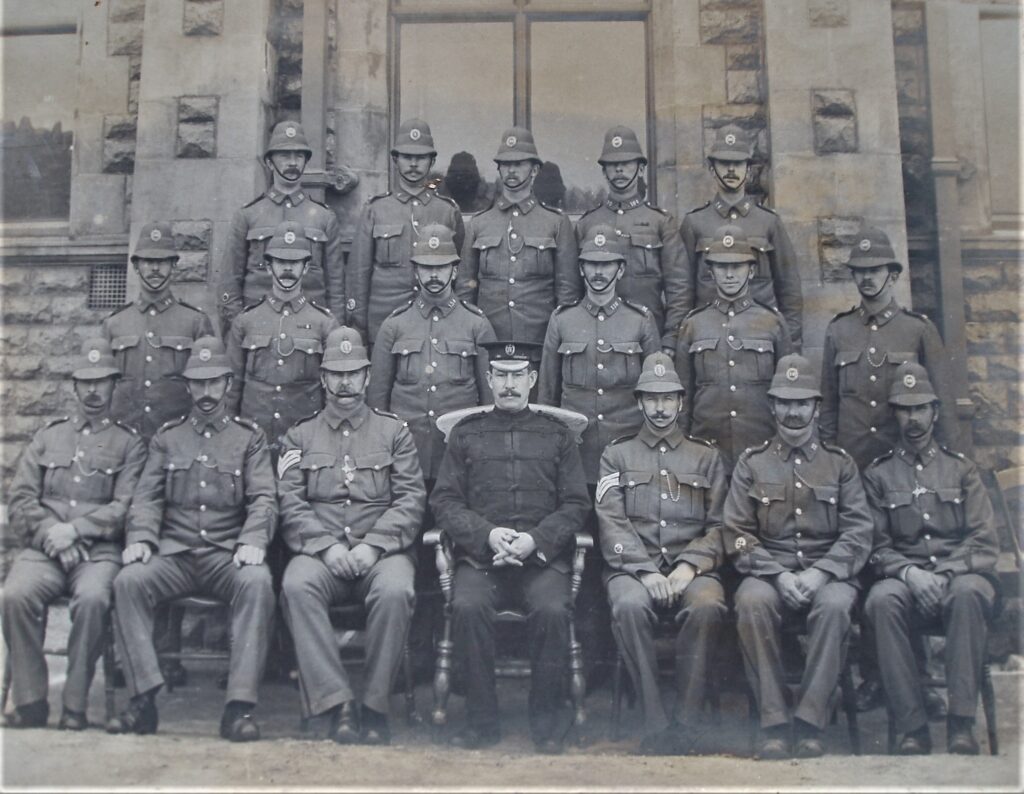
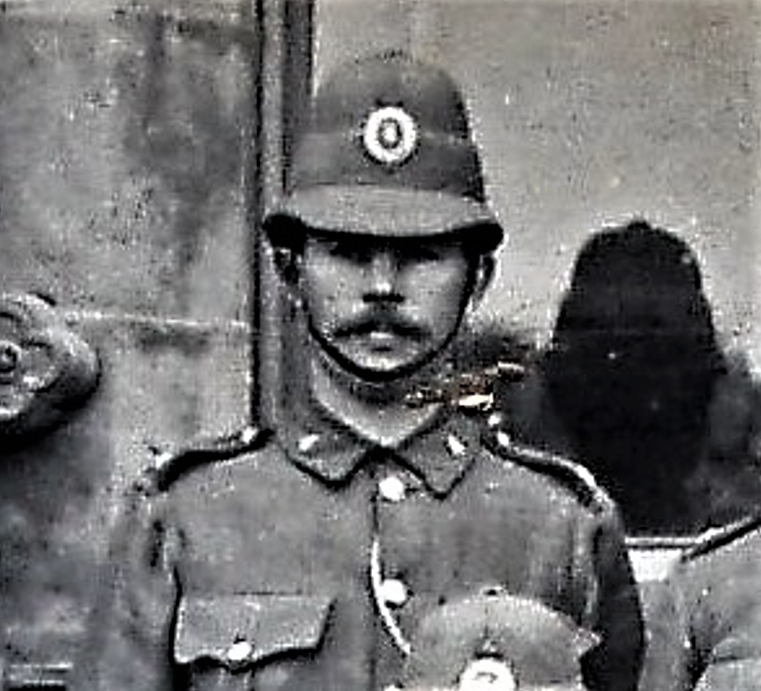
Fred FALL, was different to most village bobbies. Normally you were moved around the county quite a bit, but not Fred , he was the Preston Village bobby for most of his career.
Let’s look ay his career.
Fred joined in October 1899 and was stationed at Dorchester in the single mans accommodation for a very long time for 5 years till he got married. He and his wife then took over the police house at Preston, which is where they stayed till he retired in October 1925. So why did Fred stay in the same place so long ? Well I cannot be 100 per cent but I believe it was because he was a musical man. Fred played the bugle and the trumpet so was always a member of the Assizes squad, where he lead the Assizes parade with another bugler. So because of that, it was convenient to have him close to Dorchester. This photograph shows Fred on the right.
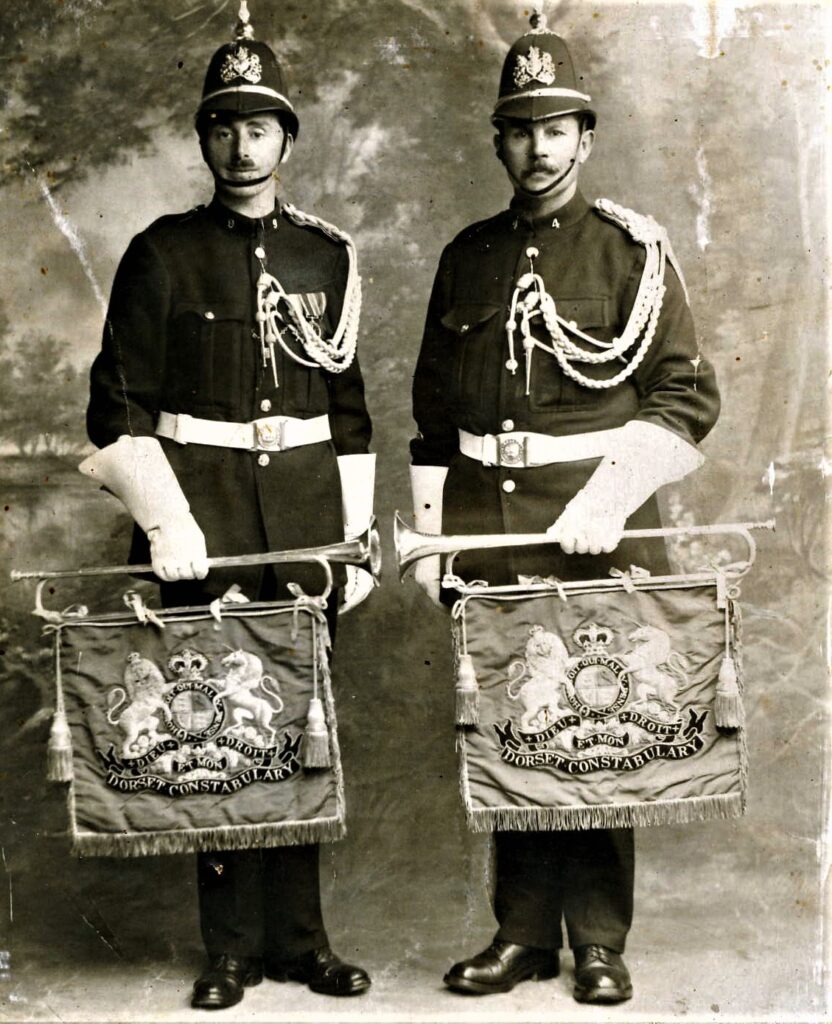
At the Dorset Joint Standing Committee in July 1919

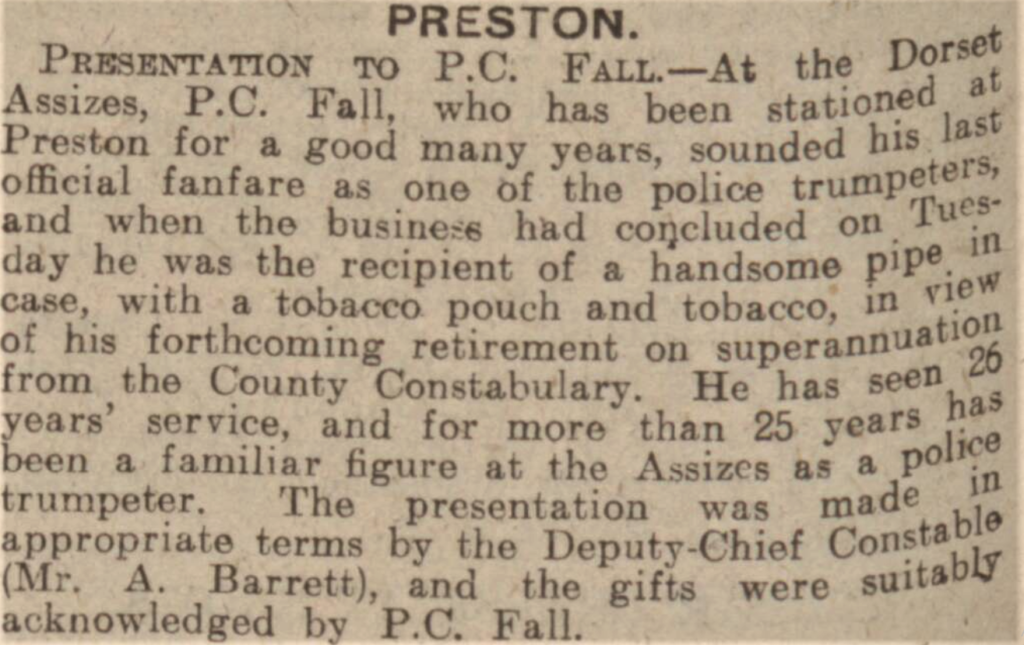
Retirement OCTOBER 1925. In the papers on Oct 23rd.
There are several more village bobbies I need to write about, who inspired so many to join up and tread in their footsteps, hopefully Part 2 will follow soon!
If you know or have any relatives from the Constabulary there were dedicated Community Coppers, then let me know !
* South West , was the code phrase that Dorset police used many years ago to summon assistance over the radio. This was before the days of emergency buttons.